


Fresh paint, rusted engine
View(s):He was not only a friendly bus conductor to the passengers and honest public sector employee to the government, but also a knowledgeable and intelligent person. Those days, I found lots of insights and in-depths in his conversations.
One day I met him at the Bus Stand, issuing tickets and getting passengers to his bus – it looked like a new bus. New buses often arrive with a fresh paint smell and unfaded, bright colours that make them look modern and appealing. The Sri Lankan government must acquire new buses – mostly from India using Indian credit lines.
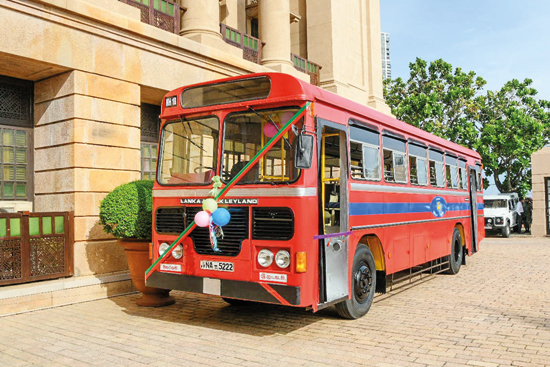
File picture of a newly-restored SLTB bus
I said, “Uncle, it’s beautiful. You have got a new bus – right?”
He smiled and said: “That’s right, son. But the problem is, it’s the same old engine! How could it be any better, if it is running on the same engine?”
Private transport system
Sri Lanka’s historical records on its public transport system reveal that the very first motor bus was introduced in 1907. It has expanded as a private business with individual owners and smaller bus companies. Even though the British government attempted introducing “limited liability bus companies” like in Britain, it was just a few years before they left handing over the country at Independence.
The buses became a popular mode of transportation because they were cheaper and more flexible than trains, reaching areas that the railway network did not cover. For ordinary people, buses opened new opportunities for travel and connectivity.
However, it was said to be a chaotic transport system with serious problems. Interestingly, some of these issues have been carried forward for about 100 years so that they continue to exist to-date.
There was no central authority to regulate routes, safety, or time schedules. As a result, bus operators competed fiercely to collect passengers, often racing each other on the roads. This aggressive competition led to reckless driving, accidents, and even violent clashes between rival operators. Timetables were unreliable, and the quality of service varied widely depending on the owner.
Transport nationalisation
 A new chapter in Sri Lanka’s bus transport system began in 1958 with nationalisation and centralisation under the newly created Ceylon Transport Board (CTB, later SLTB). The government’s aim was to bring order and safety to a sector that had long been chaotic under private ownership.
For a time, this worked: the CTB introduced standardised routes, timetables, and fares, making public transport more organised, predictable, and accessible to ordinary people. Yet, while some of the earlier problems were addressed, the new system soon showed signs of being unsustainable.
As a state-run monopoly, the CTB became vulnerable to political interference, weak financial management, and overstaffing. In fact, successive governments used the CTB as a “job agency” in the absence of wider employment creation, swelling its workforce far beyond operational needs. Even election victories were symbolically reflected in changing the CTB logo colour between blue and green, underscoring how politicised the institution had become.
Fares were often kept artificially low for political and social reasons, but operating costs continued to rise, leading to mounting losses that had to be covered by increasing budgetary transfers. The bus fleet itself did not expand adequately to meet the demands of a growing population and expanding transport needs.
Without incentives for efficiency or innovation, the CTB gradually turned into a burden, weighed down by inefficiency and financial losses. What began as a solution to the disorder of private transport evolved into a long-term problem for Sri Lanka’s transport sector. Although a few distinguished personalities were occasionally praised for their leadership, the deeper issues lay in the system itself, not just in individuals.
Liberalisation
As the Sri Lankan economy was opened in 1977, the public transport system was also liberalised, allowing private individuals—not necessarily organised bus companies—to return and operate buses alongside the government-owned SLTB fleet. On the surface, this appeared to solve the shortage of buses and gave commuters more options, as the number of vehicles on the roads increased rapidly.
However, this expansion came at the cost of quality and standards. Many small private operators competed aggressively to collect passengers, often squeezing them into overcrowded buses with little regard for comfort or safety.
Problems such as reckless driving, poor vehicle maintenance, and weak regulation became widespread. The system grew fragmented and chaotic, with efficiency sacrificed for sheer quantity, leaving passengers with more buses but a less reliable and less safe service overall.
In effect, the transport system expanded again into a chaotic state, resembling the disorder of the pre-nationalisation period. Yet this time, it was more complex and politicised, shaped by a different socio-economic environment. Although regulatory bodies and law enforcement authorities existed, the liberalised public transport system continued to operate in a lawless and undisciplined manner, reinforcing the long-standing challenges of Sri Lanka’s bus transport sector.
Development indicator
A developed public transport system is often seen as a visible sign of a country’s progress. It serves both the rich and the poor, offering safe, convenient, and reliable travel for the general public. At its best, it even encourages midle-income classes to give up their private vehicles, reducing congestion and environmental strain.
In Sri Lanka, however, the story has been different. Over nearly half a century of liberalised public transport, the system has hardly evolved. The SLTB and privately-owned buses have continued to coexist, but public transport has remained largely the mode of the poor.
As incomes rose and social mobility improved, even poorer households aspired to own private vehicles, gradually abandoning buses. This shift added new socioeconomic challenges—fuel demand increased, traffic congestion worsened, and road safety declined.
It created a paradox: while the rich were never expected to rely on buses, the poor too began moving toward private transport as they improved their upward mobility, leaving public transport underfunded and neglected.
In contrast, when transport systems are reliable, safe, and efficient, they directly support economic growth. Workers can reach jobs on time, businesses benefit from steady flows of goods and customers, and cities expand without being strangled by traffic.
Strong public transport reduces costs, saves time, and makes urban life more productive. In this way, a modern transport system is not only a reflection of development but also a driver of further growth.
Social development
A modern transport system is not only an economic asset but also a reflection of social development, because it shows that society has invested in infrastructure that benefits everyone, not just the wealthy. In this sense, a well-managed public transport system becomes both a sign of development and a driver of further growth, creating a cycle where better mobility leads to stronger economic and social outcomes.
Economists and planners often emphasise that public transport must be efficient and convenient, but also affordable. When transport costs are high, the overall cost of production rises—workers spend more to commute, businesses pay more to move goods, and industries lose competitiveness. Household budgets also come under pressure.
By contrast, a cheaper and well-managed system helps keep wages and production costs under control, while still allowing people to travel reliably. In this way, affordable public transport is not just a social service—it is an economic strategy that supports growth, competitiveness, and wider access to opportunities.
The challenge, however, lies in striking the right balance. Public transport must be affordable enough to support economic progress, but not so cheap that it becomes financially unsustainable and dependent on continuous losses.
At the same time, it must be efficient and convenient so that not only the low-income class but also the middle class will choose it as their preferred mode of travel. Only then can public transport truly serve as both a social equaliser and an engine of development.
Innovative solutions
Improving public transport in Sri Lanka has historically been seen mainly as a matter of adding new buses to the fleet. In the 1950s and 1960s, the country imported Mercedes Benz buses from Germany and Leyland and AEC double-deckers from England. Later, Japanese brands such as Isuzu were introduced, followed by Indian varieties for a longer period of time. Over the past 75 years, the bus fleet has indeed been renewed and expanded at different times, but the question remains: has this alone truly improved the public transport system?
The answer is that simply adding new buses does not automatically upgrade the system. A modern transport network requires innovative management models and technology-driven solutions that make travel more efficient and user-friendly.
By learning from global best practices, Sri Lanka could build a transport system that is not only larger in size but also smarter, safer, and more sustainable. In this way, innovation ensures that public transport evolves beyond simply moving people; it becomes a driver of economic growth, social development, and environmental sustainability.
(The writer is Emeritus Professor at the University of Colombo and Executive Director of the Centre for Poverty Analysis (CEPA) and can be reached at sirimal@econ.cmb.ac.lk and follow on Twitter @SirimalAshoka).
Hitad.lk has you covered with quality used or brand new cars for sale that are budget friendly yet reliable! Now is the time to sell your old ride for something more attractive to today's modern automotive market demands. Browse through our selection of affordable options now on Hitad.lk before deciding on what will work best for you!