


Poems of curse and blessing
View(s):Early in the morning, some motorists on bikes, tuk‑tuks, cars, and vans would bring their household trash in polythene bags and toss them over the fence into the estate. Though no one lived there, the garbage became a nuisance for the villagers opposite: heaps of waste, foul smells, and stray dogs, cats, crows, and lizards rummaging through the mess.
Clean-up campaign
Occasionally, the villagers organised clean‑up campaigns, offering voluntary labour to clear the heap. Ironically, this seemed to encourage the motorists, who kept dumping, confident that someone else would tidy up.
Then, one morning after the previous day’s cleanup campaign, a banner appeared on the estate fence. It carried a Vas‑kavi – literally means a curse poem, invoking misfortune and disaster upon those who threw trash, extending its wrath to their families and generations.
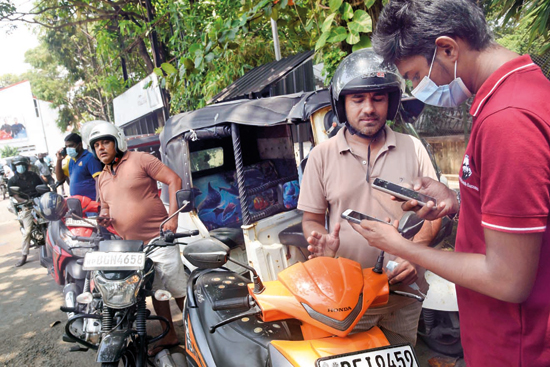
File picture of a fuel queue in 2022. After the latest West Asian crisis, motorists panicked forming queues outside fuel stations.
A respected village leader declared: “Let all the people travelling on the road read this poem morning and evening.”
Listening to their conversations, I grasped the spiritual meaning of his words. The more the curse poem was read or sung, the stronger its effect would be. Naturally, everyone passing by read it. Strangely enough, from that day onward, the dumping stopped.
Invoking blessings
It is a common belief that poems or chants intended to curse, harm, or bring misfortune upon others can indeed have an impact. This is why many people visit shrines of various spiritual beings or follow occult practices, repeatedly chanting verses of curse to invoke their power.
Politically motivated groups, too, have long gathered at protests carrying placards inscribed with verses, shouting them aloud. Many believe that collective chanting is effective not only in the spiritual realm but also in the real world.
The opposite is equally true. There are verses of blessing—Seth‑kavi—which people recite with the conviction that blessings can be invoked through repetition. These verses, rooted in religious tradition, are believed to channel goodwill and divine favour upon others.
Speculation
About the future: To begin, I pose a question that often confuses the audience: “How many of you believe that Vas‑kavi and Seth‑kavi—poems of curses and poems of blessings—can have real effects?”
Some students remain silent, trying to figure out where I am heading. Others, taking the question literally, raise their hands to show they believe.
The underlying belief is simple: if people read such verses repeatedly, they will have an impact—whether intended as a blessing or a curse. And if more people gather to do so, the effect multiplies and intensifies.
Public speculation in economics works in exactly the same way. When the public believes something about the future, that belief itself shapes reality. The irony is that it does not matter whether the speculation is right or wrong—eventually, it becomes true.
Fuel shortage
 Given the Gulf War and its economic repercussions, as we discussed last week in this column, we witnessed panic buying and stockpiling. In Sri Lanka, motorists lined up at fuel stations to fill their tanks and even additional containers.
The effects on the domestic fuel market were striking. Within just one week, consumers purchased 59,200 metric tonnes of diesel and 47,500 metric tonnes of Octane 92 petrol—equivalent to 1.5–2 full tanker shipments. Under normal sales, these stocks would have lasted much longer.
Had panic buying continued on a wide scale, a shortage of supply would have been inevitable. There was an increase in domestic fuel prices too. Authorities also tried to convince the citizens that it was the consumer panic that accelerated the upward revision of domestic fuel prices.
Didn’t we say?
It is not difficult to understand from the “fuel panic” described above how the concept of public speculation works. It operates like a chain reaction: once an expectation takes hold, it quickly reshapes consumer behaviour and market outcomes.
As news spreads—whether through media or even rumours—about a potential global fuel shortage, more people begin to believe it. Fuel lines at stations grow longer, and others, seeing the crowd, rush to join it.
The larger the gathering, the greater the panic buying. In the domestic fuel market, the sudden surge in purchases was not driven by any actual shortages but by fear of future scarcity.
This illustrates how speculation, even without concrete evidence, can create self‑fulfilling disruptions. Under normal circumstances, these stocks would have lasted longer. But speculation compressed consumption into a short window, distorting the supply‑demand balance. In the end, panic buying itself produced the very shortage people feared.
And the public speculation comes true! Someone can boast – “didn’t we say this?” But actually, it was because “some people did say that” guided by what they believed; fuel lines were multiplied and extended until the fuel stocks got exhausted. It was not due to the reverse causation – something that was going to happen predicted.
Herd mentality
Ironically, government plans become lies, policymaking becomes baseless, and economic forecasts become absurd. In fact, the politicians and policymakers should keep their word, because otherwise they may also contribute to speculation, multiplying the problem.
This reveals the political reality of speculation. If people lose faith in their leaders, speculation worsens, as individuals rely more on their own perceptions than on official assurances.
The mechanics of speculation rest on perception rather than reality. When consumers anticipate higher prices or shortages, they act defensively by stockpiling. This behaviour magnifies demand artificially, forcing suppliers and authorities to respond as though a genuine shortage exists.
Speculation also carries a psychological multiplier effect. Once some consumers begin stockpiling, others feel compelled to follow, fearing they will be left behind. This herd behaviour amplifies the initial shock, creating volatility in markets that might otherwise remain stable.
Had panic buying continued, Sri Lanka would have faced a real shortage—ironically caused by the very actions, meant to guard against scarcity. Speculation thus demonstrates how collective expectations can override actual supply conditions, turning imagined risks into tangible economic consequences.
Inflationary expectation
Public speculation plays a major role in macroeconomics, serving as a powerful determinant of many global challenges: rising inflation, depreciating exchange rates, stock market volatility, commodity market instability, debt sustainability, and more.
Take inflation as an example. Public speculation about rising prices often results in inflation itself. Why? Because once individuals, households, businesses, banks and other entities begin to expect higher inflation in the coming months, they all adjust their spending decisions.
Consumers rush to buy goods before prices rise. Some invest in durable items to lock in current costs. Businesses build inventories in anticipation of higher replacement costs. Production firms stockpile raw materials, parts, components and machinery.
Banks, too, adopt defensive strategies—raising interest rates and tightening lending—because money lent today may be worth less when repaid in an inflationary environment.
This expectation‑driven change in behaviour fuels inflation, even when underlying supply conditions remain stable. In many countries, inflationary spirals have been triggered not only by monetary expansion but also by speculation about future price levels.
Maintaining stability
In conclusion, public speculation is one of the most powerful forces in macroeconomics because it shapes expectations—and expectations often drive real outcomes. It becomes especially potent in economies already facing instability, where speculation can magnify and worsen the very problems it anticipates.
To minimise these disruptive effects, it is essential to foster a stable macroeconomic environment anchored in public trust. Trust is the cornerstone of stability. When people believe that authorities are transparent, credible, and capable of managing the economy and economic crises, they are less likely to engage in destabilising behaviours. In this way, confidence itself becomes a stabilising force, transforming speculation from a threat into a manageable element of economic life.
(The writer is Emeritus Professor at the University of Colombo and Executive Director of the Centre for Poverty Analysis (CEPA) and can be reached at sirimal@econ.cmb.ac.lk and follow on Twitter @SirimalAshoka).
Hitad.lk has you covered with quality used or brand new cars for sale that are budget friendly yet reliable! Now is the time to sell your old ride for something more attractive to today's modern automotive market demands. Browse through our selection of affordable options now on Hitad.lk before deciding on what will work best for you!