

Sunday Times 2
Martyrdom and the Iranian State
View(s):By Dr Ruben Thurairajah
Iran is a country where the dead have a career longer than the living. Their work does not end with burial. On the contrary, it begins there. Photographs, slogans, anniversaries, murals, and speeches take over, smoothing complexity, eliminating doubt, and restoring purpose to what might otherwise have been an interruption. Death, in the Iranian political imagination, is not a failure of policy. It is a form of clarification.
To understand this, one must begin not with modern Iran, nor even with Islam as a whole, but with a particular memory within it: one that has endured not because it is comforting, but because it is useful.
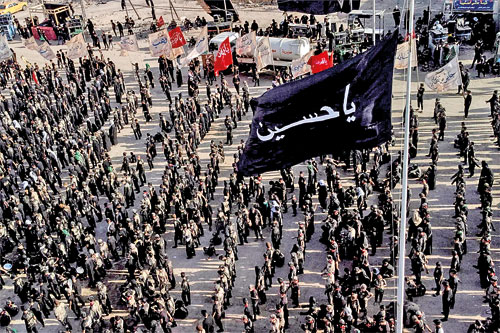
Shiite Muslims commemorating the martyrdom of Imam Husayn
A history that refuses to end
Shiite Islam emerged from a dispute that followed the death of the Prophet Muhammad in the seventh century: who had the right to lead the Muslim community, and on what basis. For Shiite Muslims, authority belonged to the Prophet’s family, and legitimacy was inseparable from moral conduct. Power that abandoned justice forfeited its claim to obedience.
This conviction found its defining expression in 680 CE, at the Battle of Karbala, where Imam Husayn, the Prophet’s grandson, was killed after refusing to submit to the Umayyad caliph Yazid. Imam Husayn was outnumbered, isolated, and aware of his fate. His death, remembered in extraordinary detail, became the central moral act of Shiite Islam.
What mattered was not the battlefield outcome but the posture taken towards power. Imam Husayn’s refusal established a template: to live under injustice was worse than to die resisting it. From this came the idea of martyrdom (shahadat)—not suicide, not recklessness, but the bearing of witness through suffering when truth and survival diverge.
This memory is ritually renewed every year during Ashura, when sermons and lamentations retell the story with an insistence that collapses time. Karbala is not past. It is recurring. It waits for new actors.
From mourning to mobilisation
For centuries, this ethic shaped Shiite piety more than Shiite power. Martyrdom was commemorated, mourned, internalised. It offered consolation to the powerless and dignity to defeat. It did not, by itself, create a state.
That changed in Iran in 1979.
The Islamic Revolution succeeded not only because it overthrew a monarchy, but because it supplied an explanation for suffering that had accumulated without meaning. Economic inequality, political repression, and cultural dislocation were gathered into a single moral narrative. The Shah was recast as a latter-day Yazid. Protestors were elevated as heirs to Husayn’s companions. The killings by the Shah’s forces in the streets were not unfortunate excesses; they were confirmations.
Revolution, once achieved, did not discard this language. It preserved it, refined it, and administered it.
The bureaucracy of sacrifice
The new Islamic Republic set about institutionalising martyrdom with remarkable efficiency. Foundations were established to register martyrs, support their families, and curate their memory. Cemeteries became ideological landscapes. School textbooks taught children not only history, but how to interpret loss.
This was not merely commemoration. It was governance.
The Iran–Iraq War (1980–1988) accelerated the process. The conflict produced casualties on a scale that could not be managed emotionally without structure. The state responded by sanctifying loss. The war was named “Holy Defence,” a phrase that foreclosed doubt. To question the war was to question sacrifice; to question sacrifice was to question faith.
Iranian youngsters died in great numbers. Their deaths were explained before they occurred. The language of martyrdom absorbed tactical failure and strategic miscalculation alike. Losses did not require apology. They required reverence.
The soldier as witness
Within the armed forces—most notably the Islamic Revolutionary Guard Corps—martyrdom became an organising principle rather than a contingency. Soldiers were trained not only in combat, but in interpretation. Death, if it came, was not to be regarded as a negation of purpose, but its fulfilment.
This had practical effects. A military culture that treats death as meaningful is less constrained by conventional deterrence. Fear operates differently. The loss of commanders does not produce panic but ceremony. Succession is prepared for; mourning is routinised; continuity is emphasised.
The fallen Iranian military officer becomes an asset in a different register. His photograph replaces his decisions. His errors disappear.
Foreign policy as moral theatre
Iran’s regional engagements reflect this moral architecture. Its alliances across Lebanon, Iraq, Syria, and Yemen are framed not primarily as strategic calculations, but as participation in an extended struggle against injustice. Geography becomes secondary to symbolism. A death in Damascus or southern Lebanon is folded seamlessly into the same narrative as a death near Tehran.
This has allowed Iran to sustain influence disproportionate to its economic capacity. Martyrdom functions as soft power. It supplies a language that allied movements recognise and share. Resistance becomes a vocation rather than a tactic.
For adversaries accustomed to cost-benefit reasoning, this poses a problem. Pressure intended to coerce often serves instead to validate. Assassinations confirm belief. Sanctions reinforce narratives of persecution. Martyrdom absorbs punishment and converts it into meaning.
The death of leaders
When senior Iranian political or military figures are killed, external observers often predict chaos. This expectation reveals more about Western assumptions than about Iranian reality.
In Iran, elite death is not anomalous. It is anticipated, rehearsed, and ideologically prepared for. Institutions do not unravel. Replacements are appointed. The system proceeds. The narrative tightens.
The deceased undergoes rapid transformation. Whatever disputes surrounded him in life dissolve in death. He is promoted into moral clarity. The state acquires a new symbol. Criticism becomes awkward, then impolite, then irrelevant. In this way, martyrdom serves as a stabilising mechanism. It removes individuals while strengthening institutions. It discourages internal reckoning while reinforcing external defiance.
The quiet resistance of the living
Yet the system is not without friction. Beneath the official choreography, Iranian society has changed. Large segments of the population—particularly the young—experience martyrdom rhetoric as distant from their own concerns. Inflation, unemployment, and social restriction do not readily translate into transcendence.
In recent years, some families have resisted state attempts to claim their dead. Funerals have become contested spaces. Grief has been asserted as private rather than national. In these moments, martyrdom fails to function as intended. Death does not unify. It divides.
This is not rebellion in the classical sense. It is something more subtle: a refusal of interpretation.
Inflationary pressure on meaning
Martyrdom is a powerful currency, but it is not immune to inflation. When death becomes ubiquitous, its capacity to confer distinction diminishes. When sacrifice is endlessly invoked, belief risks fatigue.
The Iranian state has so far managed this tension by narrowing its audience. The language of martyrdom resonates most strongly with those already invested in it. For others, it increasingly resembles an explanation offered in place of improvement.
A politics that relies on sanctified suffering can endure crisis, but it struggles with normality. It excels at resistance and falters at reform. Compromise appears as moral erosion. Success threatens to deprive the narrative of its central antagonist.
Karbala and the future
Karbala endures because it answers a question that power alone cannot: how to behave when justice and survival diverge. For centuries, it provided dignity to defeat. In modern Iran, it has been repurposed to manage victory, loss, and continuity alike.
The current cycle of conflict and elite martyrdom will likely reinforce this system in the short term. Each death will be absorbed, interpreted, and deployed. Expectations of collapse will once again be disappointed.
The longer question is whether a society can indefinitely live inside a story that privileges heroic death over ordinary life. States require productivity, aspiration, and consent, not only heroic endurance. A culture trained to revere sacrifice may find it difficult to celebrate success.
For the wider Middle East, Iran’s example remains influential. It demonstrates how belief can be converted into durability, how theology can be operationalised, and how death can be made to work.
But it also illustrates the cost: a politics that struggles to imagine an end to struggle.
In the end, the most unsettling possibility for a system built on martyrdom is not defeat, nor even dissent, but the gradual emergence of citizens who prefer to live without meaning rather than die with it.