


Gulf storm and the Sri Lankan economy
View(s):The war has broken the sense of safety. Trade routes are disrupted, energy markets shaken, and millions of lives unsettled. A region that thrived for decades is now marked by instability.
The world’s response is mixed. Some countries expected to take sides have stayed out, avoiding a bigger global conflict. Others quickly condemn one side, hoping to gain political points at home or abroad. Meanwhile, some governments stay silent, calculating the economic fallout.
Others seem frozen—unsure what to do as risks grow. They act like business as usual, doing nothing and not knowing to do anything.
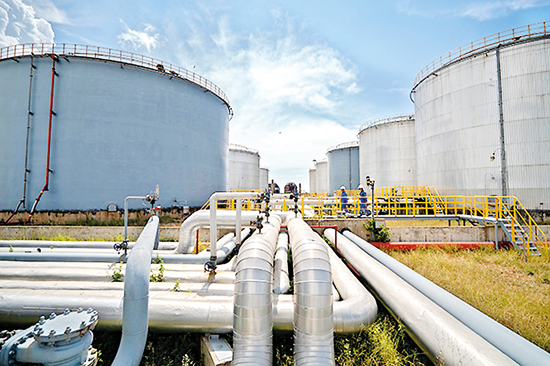
Oil tanks in Hambantota
Public speculation
For those who are interested in current economic affairs, the big question is what would be the economic impact of the Gulf war in a country like Sri Lanka. While nobody has a perfect answer to the question, the depth and width of the war impact on the economy depends on a number of factors – time duration of the conflict, integration and dependence on the Gulf, and the degree of vulnerability of the country to external shocks.
While in situations like this panic buying and hoarding supplies are a common issue pushed by public speculation. We have already seen extended fuel lines with tuk-tuks, motorbikes and other motor vehicles at the fuel stations to fill up the tanks as well as additional containers.
The same issue has been reported in Israel as well as many cities in the Gulf region. In Dubai and Abu Dhabi too, people rushed to supermarkets to stockpile essentials like bottled water, canned food, and batteries, though UAE authorities have assured that national supplies remain sufficient.
Panic buying and hoarding is related to the issue of how much the citizens trust their governments. If the governments – particularly the leaders who run the governments – are untrustworthy to the citizens, then their panic buying and stockpiling can get worse.
Public speculation in economics works in a strange way. Even when the fear is wrong, it can end up becoming true. Why? Because speculation changes behaviour. People start panic buying and stockpiling. Supplies get drained faster than usual. And eventually, the shortage everyone feared actually happens.
Integration and dependence
 Sri Lanka is deeply tied to Iran and the wider Gulf region through oil imports, worker remittances, tea exports, air travel, tourism, trade and shipping. The Gulf is both a lifeline for foreign exchange and a source of vulnerability, so any disruption there directly impacts Sri Lanka’s economy.
The most critical link is energy.
Sri Lanka’s crude oil and refined petroleum supplies come largely from the Gulf, directly or indirectly. With nearly one-fifth of global oil passing through the Strait of Hormuz, even a small disruption pushes global prices up and inflates Sri Lanka’s import bill.
Forecasts already suggest crude prices could rise from US$ 80 to $ 100 due to the conflict. For Sri Lanka, that means higher local fuel prices, which feed into inflation and raise transport costs.
The ripple effect doesn’t stop there. Historically, global food prices move closely with oil prices. When oil rises, food costs tend to rise too — adding further pressure on households and businesses.
Tea, tourism and remittances
The Gulf region is vital for Sri Lanka as a major source of foreign exchange earnings through tourism, worker remittances, and tea exports. Together, these three sectors account for more than half of Sri Lanka’s total foreign exchange from goods and services.
Tourism dependence is twofold. First, West Asian tourists themselves—especially from the UAE, Saudi Arabia, and Qatar—form a growing share of arrivals, often seeking leisure and medical tourism opportunities. Second, the Gulf’s role as a global aviation hub means disruptions that can weaken Sri Lanka’s connectivity. Long-haul travellers from Europe and North America rely heavily on Gulf stopovers, so instability in the region can discourage them from visiting Sri Lanka.
Worker remittances are the single largest source of foreign currency, exceeding $ 8 billion in 2025. Most of these flows come from Saudi Arabia, UAE, Qatar, and Kuwait. Any instability in the Gulf could reduce remittances—either because migrant workers face job insecurity or because they hold back funds as precautionary savings. A slowdown in remittances would directly weaken Sri Lanka’s external reserves and worsen its current account balance.
Tea exports and shipping are equally tied to the Gulf. West Asia is a major market for Ceylon Tea, with Iran and Gulf states among the top buyers. Conflict-driven inflation or reduced consumer demand could cut into this revenue stream. Shipping disruptions in Gulf maritime corridors add another layer of risk, raising freight costs and insurance premiums. These higher costs increase the landed price of imports and erode the competitiveness of Sri Lankan exports.
Depth and width
The severity of the Gulf war’s economic impact on Sri Lanka will hinge on a few key factors. The most important determinants are the length of the conflict, the level of economic integration and dependence, and the degree of vulnerability to external shocks.
Length of the conflict is decisive. If the war is short-lived, disruptions in oil prices, shipping routes, supply chains, and investor confidence may be temporary. These shocks, though painful, could be absorbed relatively quickly, allowing the economy to stabilize once conditions improve.
A prolonged war, however, would magnify uncertainty. Sustained high energy costs, disrupted trade flows, and weakened investor sentiment would expose Sri Lanka to persistent inflationary pressures, fiscal strain, and slower growth.
Economic integration and dependence add another layer of risk. Sri Lanka’s reliance on imported fuel, its dependence on Gulf remittances, and its trade connections with Gulf economies mean that any disruption in these channels translates directly into domestic consequences.
Rising fuel costs feed into inflation and transport expenses; reduced remittances weaken external reserves; and trade disruptions cut into export earnings and raise import costs.
Series of shocks
The degree of economic vulnerability to external shocks will ultimately shape the depth of the Gulf war’s impact on Sri Lanka. The country’s economy is already fragile, constrained by limited fiscal space and high debt exposure. This leaves it less resilient to sudden spikes in global energy prices or disruptions in trade.
Countries with stronger buffers—such as diversified export bases or robust foreign reserves—can absorb external shocks more effectively. Sri Lanka, however, faces cascading risks: higher fuel costs feeding into transport and food inflation, reduced remittances straining household incomes, and mounting pressure on government finances.
In short, the war’s economic toll will be determined not only by the conflict itself but also by Sri Lanka’s structural weaknesses and its limited capacity to absorb shocks.
Sri Lanka’s vulnerability is particularly large. Since 2018, the economy has been hit by a series of internal and external shocks—from political instability and debt crises to the pandemic and global commodity price surges.
Each shock has weakened the country’s economic “immunity.” Although gradual improvements have been made during 2023–2025, resilience remains thin. For an economy still in recovery, facing another external shock of this magnitude is extremely critical and potentially destabilizing.
Macroeconomic cost
Rising import costs—particularly for oil and essential goods—combined with falling foreign exchange earnings capacity, place mounting pressure on Sri Lanka’s balance of payments and foreign reserve position. This makes it harder to meet debt sustainability targets under the IMF programme.
At the same time, higher global shipping costs and supply chain disruptions risk driving up food import prices. This directly erodes household welfare by increasing the cost of living and worsening food insecurity.
Together, these dynamics create a dual challenge: external financing strains that complicate macroeconomic stabilisation, and domestic welfare pressures that heighten social vulnerability.
Silver linings
Yet, even in stormy weather, there are silver linings. Sri Lanka has a history of benefiting intermittently from shifts in global market dynamics, often not through deliberate policy but through external circumstances.
Political instability and uncertainty in the Gulf could divert businesses toward Sri Lanka, positioning it as an emerging regional hub and investment destination. Colombo Port, in particular, stands to gain if shipping lines avoid Gulf routes, strengthening its role as a transshipment hub and enhancing its strategic importance in South Asia.
(The writer is Emeritus Professor at the University of Colombo and Executive Director of the Centre for Poverty Analysis (CEPA) and can be reached at sirimal@econ.cmb.ac.lk and follow on Twitter @SirimalAshoka).
Hitad.lk has you covered with quality used or brand new cars for sale that are budget friendly yet reliable! Now is the time to sell your old ride for something more attractive to today's modern automotive market demands. Browse through our selection of affordable options now on Hitad.lk before deciding on what will work best for you!