


Lifting the veil on a hidden world
When I meet Ira Mukhoty at the Ceylon Literary Festival last week, it feels like an appointment with someone who has taken brief leave from the fantastic Mughal court – the harems and zenanas – the glittering world of India’s ranis from the days of legendary Draupadi to Mumtaz Mahal.
For Ira in her books reconstructs those Indian ‘boudoirs’, and has written narrative histories of the ladies of Hindustan, those of legend and lore, the goddesses incarnate of the epic ages, as well as the devious, scheming, very canny and real begums of Delhi who from their intricate havelis with marble and pearls and rubies fiddled with the fortunes of whole empires and races.
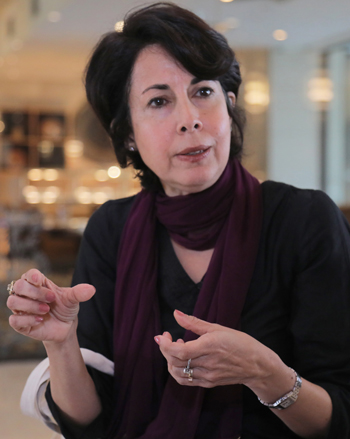
Bringing out life in the zenana: Ira Mukhoty: Pic by M.A. Pushpa Kumara
Ira, born to a French mother and a Bengali father, with a degree in the natural sciences, began to be curious about those historical women when she was searching for stories to tell her then young daughters. In traditional accounts, “all the women were depicted in a heroic, ideal way”- which jarred in the 21st Century. “I wanted to have another way of talking about great Indian women.”
She was, moreover, a Delhi-wallah, living in one of the oldest cities of the world, where the imperial Mughal presence is still ‘inevitable’. This is not just in the architecture but “in the language we speak- Urdu- the clothes we wear and the food”. Yet “we knew so little of the Mughal women,” their contributions to history, their legacies- “did they write anything? Did they patronize the arts?”
Ira was sparked by the travel books of William Dalrymple, who explores especially the Mughals in prose that reads like adventure fiction.
Ira’s own oeuvre ranges from her books Heroines: Powerful Indian Women of Myth and History; Daughters of the Sun: Empresses, Queens and Begums of the Mughal Empire; Akbar: the Great Mughal; The Lion and The Lily: The Rise and Fall of Awadh and Song of Draupadi which is a novel.
Conjuring the worlds of these women requires laborious research and each book takes years. While primary sources from the contemporary days of your subjects are crucial, the most curious of sources especially for Mughal women would be miniature paintings- a “whole other subtext”.
Ira explains that while the Mughals favoured the written word to transfer their glory to posterity, the miniature paintings while revealing everyday life, included details that the writers have been ‘told not to include’.
She also looks at architecture, for there are instances where the women have left writing on walls. “And of course writings of dissidents- those who are critical.” For Akbar, there is the official biography called Akbarnama by Abu’l-Fazl, but also Abdul Qadir Badayuni’s “very critical” unofficial biography which reveals a whole aspect kept away from the court chronicle.
It is akin to the effort of putting together a jigsaw puzzle- where each piece itself doesn’t give the whole picture, she says.
One of the most fascinating books she wrote, for Ira is The Lion and the Lily which looks at the French influence in North India because “we have forgotten that till the mid-18th century the French were as equally powerful in India as the British”.
With her maternal side being French she was able to access the French East India archives which have not been much explored before. It gave her a ‘fresh perspective’ she smiles.
Asked who is the most interesting woman she has written about, Ira says this would be Khanzada Begum, a sister of Babur who founded the Mughal Empire in India. According to history, Babur when ruling from Samarkand was besieged by Uzbeks for six months and the Uzbek leader sent Babur a missive telling him that they could all go free if they cede over Khanzada.
Babur did so and Khanzada was forcibly married to the Uzbek leader Shaybani Khan and lived with him for ten years. Once Shaybani was defeated Khanzada was sent back to the Mughal court where she was received with great honour and became the Padshah Begum- the most respected woman in the harem. This, Ira says, is so different from the Rajput tradition where it’s better for a woman to kill herself than be sullied by an enemy. To Ira this Mughal attitude was “refreshing”.
The book that required the “most imagination” on her part was Daughters of the Sun, which deals with women of the Mughal Empire “because so little is known”. There are some twelve women treated in it and Ira sometimes could only pick a single sparse sentence from one source- and ended up with some “very disjointed information”.
For example there was Gulbadan Begum, a daughter of Babur and aunt of Akbar. As a dowager she went on the “biggest all-female pilgrimage ever” – on Haj- a seven-year adventure involving shipwreck and accidents. There are no contemporary records of this odyssey and Ira had to refer to other 16th Century accounts of the Haj to put together the tale.
When confronted with a void such as this Ira “extrapolates” from other contemporary sources. One question Ira very often gets asked is if Jahanara Begum, the eldest child of Shah Jahan, who was forbidden to marry as then her husband’s family would grow powerful, had any lovers. “And I’m like- if there are no written records, how can I postulate what her private life was like? I know there must have been something- she was a human being after all, but I have not explored that side at all, because there is absolutely no information.”
Away from the zenanas, Ira, exceptionally, wrote a book on Emperor Akbar, a very influential monarch. “It was an attempt to explain the forces at play at the time- how he dealt with a multicultural India as a Muslim king, the institutions he created to incorporate a multi-cultural, multi-ethnic, multi-religious country and govern it as one monarch.
“The sort of institution he left with us was referred to even at the time of Independence. It was a very precious thing he created… and … still in today’s world which is so fractured, so interesting to look at.”
Searching for an ideal partner? Find your soul mate on Hitad.lk, Sri Lanka's favourite marriage proposals page. With Hitad.lk matrimonial advertisements you have access to thousands of ads from potential suitors who are looking for someone just like you.