


Behind Bridgerton
Dearest gentle reader,
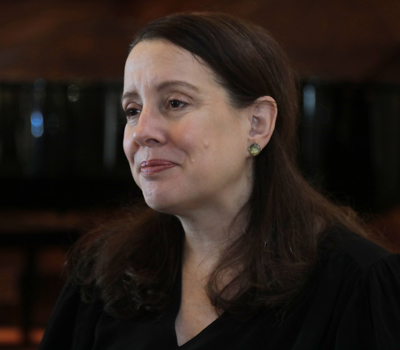
A certain voice: Julia Quinn. Pic by M.A. Pushpa Kumara
One does not simply meet the talk of the Ton – one is granted an audience. And so it was that, amid the literary buzz of the Ceylon Literary and Arts Festival, which took place from February 13 to 15, The Sunday Times was granted just such an opportunity with none other than Julia Quinn, architect of dukes, dowagers, and deliciously improper glances across ballroom floors.
Best known as the author of the wildly beloved Bridgerton series – and, more recently, as the literary force behind Netflix’s Bridgerton adaptation – Julia’s journey into historical romance was less a calculated career move and more a natural extension of what she loved as a reader.
Her origin story has already passed into publishing lore. Born in 1970, Julia studied art history at Harvard before being accepted to Yale School of Medicine, a path that seemed to promise stethoscopes rather than story arcs. But the impulse to write came much earlier. At 13, challenged by her father to justify her steady diet of romance novels, she declared she was “doing research” to write one herself. He promptly sat her down in front of a rudimentary 1983 computer – “a little screen, black with a blinking green cursor” – and she wrote two chapters that very night.
“I think I caught the bug then,” she says. Years later, after publishing around ten novels, she revisited that teenage manuscript. It was rough, she admits, but recognisably hers. “You can tell it’s me.” Voice, it seems, is not manufactured; it reveals itself early. Her debut novel, Splendid, was published in 1995. Since then, she has written more than 40 books, which have been translated into dozens of languages, and has become one of the most recognisable names in historical romance.
Historical romance, Julia explains, is not nearly as restrictive as critics imagine. She prefers the term “parameters” to “conventions”. “You have to have your main two characters either meet or meet again at the beginning. There has to be a happy ending, and the canvas between them is wide open.” She likens it to mystery novels: a body at the start, a solution at the end, and boundless possibility in between.

Fan-time: Signing books after her session.
As a young reader, she gravitated toward the genre’s evolution from sweeping, purple prose to sharper, faster, funnier storytelling. Authors like Judith McNaught, Julie Garwood, Lisa Kleypas and Amanda Quick shaped her sensibilities. “I wasn’t reading and thinking, ‘I can do this better,’” she laughs. “I was reading and thinking, ‘I want more of this.’”
Julia describes herself as a character-driven writer. While she outlines emotional arcs to some degree, she allows space for discovery. “A lot of it comes about as you’re moving along,” she says. “Sometimes it takes you in places that you didn’t fully expect.”
When writing outside the Bridgertons, whether in the Bevelstoke or Smythe-Smith series, she does consciously enter each character’s mindset. One heroine who stands out is Honoria Smythe-Smith from Just Like Heaven, the first Smythe-Smith novel. “She felt very distinct to me,” Julia says. Honoria understands perfectly well how dreadful her family’s annual musicales are, and yet she loves them fiercely and wants them to remain a cherished tradition.
“My characters are not wildly different,” explains Julia, “but I try to give them all little things.” Readers may spend a few hours or days with a novel, but Julia lives with her characters for months. “I’ve lived with them for six months at least,” she says. “You just sort of get in there without even thinking about it.”
Stylistically, however, she doesn’t dramatically shift gears between projects. Genre fiction, she notes, is defined by reader expectation. Romance readers expect certain emotional beats, and she intends to deliver them. “The stories can change, the plots can change, the characters can change,” she says. “But I think they expect a certain voice – and that’s something I feel strongly I want to give them.”
Her books are known for sparkling dialogue and light-heartedness, but they are not without weight. Francesca Bridgerton’s story, for instance, grapples with grief and pregnancy loss – themes Julia was navigating personally while writing. “You had to dig a little bit deeper into the emotions,” she reflects. Humour, she insists, is simply part of her narrative DNA. Handling serious themes, however, requires deliberate care – particularly when writing about issues such as depression in a Regency context, where characters lack the vocabulary of modern psychology. Sensitivity and historical accuracy must coexist.
Reader expectations, admits Julia, do influence her, though they do not dictate her storytelling. “I don’t think it’s giving in,” she says. But she does pay attention. If readers respond enthusiastically to a particularly witty novel or an “enemies to lovers” dynamic, she may find herself thinking, ‘Perhaps I should do that again.’ The distinction is subtle but important, much like the balance she strikes between creative instinct and audience engagement.
When asked which characters readers most identify with, Julia answers without hesitation: Penelope and Eloise. “Penelope is that feeling we’ve all had – I know who I am on the inside, but I can’t figure out how to be that person on the outside.” Eloise, meanwhile, appeals to those who speak before they think. “I’m both of those people,” admits Julia, though with a smile she adds that she may now be more Violet Bridgerton than either of her younger heroines.
The leap from page to screen was transformative. When Shondaland, led by Shonda Rhimes, approached her about adapting the series, Julia was asked the crucial question: would she give up creative control? “I immediately said yes,” she says. It was, in her words, a once-in-a-lifetime opportunity, and she trusted the team implicitly.

At CLAF: Julia in conversation with Ashok Ferrey. Pix courtesy CLAF
One change genuinely surprised her: the addition of Queen Charlotte, a character absent from the books. But surprise quickly turned to admiration. She calls it “absolutely brilliant”, praising how the character ties the seasons together. Seeing her characters embodied onscreen has altered her imagination. “I’m not a very visual writer,” she admits. Now, when she thinks of Simon Basset, she sees actor Regé-Jean Page, and she’s perfectly happy with that.
When asked why she believes Regency romance endures, Julia says it is possibly because it occupies a narrative sweet spot. “It’s far enough in the past that we can romanticise it, but it’s modern enough that we can give our characters hopes and dreams and traumas that resonate,” she explains.
Her appearance at the Ceylon Literary and Arts Festival was more than a professional engagement. Julia reveals that she has wanted to visit Sri Lanka since she was three years old. Her preschool teacher, Miss Silva, was Sri Lankan and wore a saree every day. “I thought she was the most beautiful woman I’d ever seen,” laughs Julia. “She called it Ceylon then.”
For a writer whose career began with wanting “more of this”, there’s a certain symmetry in that. Julia Quinn has spent decades creating expansive, emotionally generous worlds for her readers. Yet at heart, she remains what she always was: a reader first – chasing delight, chasing connection, and occasionally, catching lightning in a blinking green cursor.
Searching for an ideal partner? Find your soul mate on Hitad.lk, Sri Lanka's favourite marriage proposals page. With Hitad.lk matrimonial advertisements you have access to thousands of ads from potential suitors who are looking for someone just like you.