


England exploit on Sri Lanka’s batting woes ahead of T20 World Cup
When England arrived in Sri Lanka for the white-ball tour, expectations were of two closely-contested series. With both teams struggling for consistency, Sri Lanka being whitewashed by Pakistan in an away ODI series, struggling in the subsequent T20 matches, and England also suffering a whitewash against New Zealand in ODIs and 4-1 Ashes thrashing in Australia, it was expected to be a battle between two evenly-poised teams.
With three each of ODIs and T20Is, the tour was important for both teams no only as an opportunity to test their strengths for the ICC Men’s T20 World Cup 2026, but also a testing ground for the 50-over World Cup to be held in 2027 in the Africas.
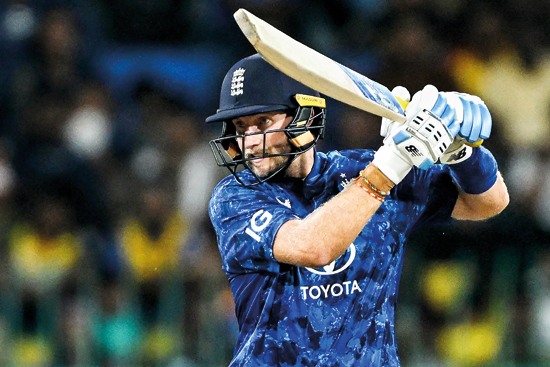
Despite Joe Root's impressive form in the ODIs against Sri Lanka, he still failed to make it to the England T20 World Cup squad - AFP
Leading up to the ODI series, Sri Lanka had enjoyed an impressive record during the recent five years, notably with 11 consecutive series wins at home. The hosts came out with unchanged squad led by Charith Asalanka, while under Harry Brook, the Englishmen were determined to regain their lost pride following a dismal New Zealand tour. Eventually, the series progressed with the first two games dominated by bowlers, notably spinners.
Known for their dominance in spinning, even Sri Lanka had to taste their own medicine, with England spinners, namely, Adil Rashid, Liam Dawson, Will Jacks and Joe Root, sharing 18 out of the 26 wickets claimed. Lack of footwork against spin, frequent dot balls, poor strike rotation, and risky shot selection were major facts that put Sri Lanka on the backfoot. Though skipper Asalanka cited of abrasive pitches during the first two ODIs, that fact was far from what reality offered.
Senior batsmen, namely Asalanka, Pathum Nissanka, Kusal Mendis, and Dhananjaya de Silva collectively produced only two top-order half-centuries, with skipper Asalanka, who encountered challenges in limited-overs formats, even affecting his leadership, totalling 75 runs with a batting average of 25. Dunith Wellalage showed promise with a quick 25 runs, two wickets, and three catches, yet struggled with his consistency afterwards after the English batsmen countered him efficiently for the rest of the series.
The young Pavan Rathnayake was the standout performer with 162 runs, at an average of 54. Initially batting at No.7—an unfamiliar territory compared to his usual No.4 at domestic level with an average of 45.06—he seized his opportunity at No.4 in the third ODI with an impressive 121 that propelled the total to 304 in a losing game. Rathnayake’s maiden ODI century was highlighted by former cricketer turned commentator Russel Arnold as a knock that resulted in using his feet well, reading the bowlers early, timely step-outs, and taking quick runs.
Following their early loss, England rectified their mistakes, with Joe Root’s reliable form that made him the leading run-scorer with 760 at an average of 76 in Sri Lanka in 15 ODIs. Others played supporting roles as Root raked in 247 runs at 123.50 with a century and two half tons from the series, while England adapted well to the conditions.
Skipper Brook scored 136 off 66 in the third ODI, where Root recorded his 20th ODI century, as England posted 357 runs and won the game to record a 2-1 series win to hand Sri Lanka’s first home series loss in five years.
Heading for the T20I series as preparation for the ongoing World Cup, the team suffered a 3-0 whitewash with more questions needed to be answered than rectified. Since the last T20 World Cup in 2024, Sri Lanka has heavily relied on its top order, which has scored 2,617 runs at 31.53 with a 134.75 strike-rate, including 19 fifty-plus scores. The middle and lower order has struggled, managing just 1,239 runs at 18.49, making it clear to opponents that breaking through the top order exposes a vulnerable lineup.
Despite strong starts in all three games, Sri Lanka lost nine wickets for 78 runs in the first T20 and eight wickets for 70 runs in the third — worrying signs ahead of a World Cup. Just days before the big event, Sri Lanka replaced an underwhelming Dhananjaya de Silva with Kamindu Mendis, while T20 skipper Dasun Shanaka still continues with his poor form. Shanaka scored just 20 runs at 8.33 and his reluctance to bowl further questions his role as an all-rounder as well as captain. Wanindu Hasaranga’s recent struggles with bowling is another alarming factor, while Dushmantha Chameera’s comeback to record his career best figures of 5-24, and Matheesha Pathirana’s return to form are silver linings to Sri Lanka’s dark clouds.
Yet again, Sri Lanka faltered against spin in the T20 series, to suffer their 11th consecutive defeat against England, enduring a disappointing series, as England celebrating a convincing away win. Now, England heads confidently to the T20 World Cup, while Sri Lanka still face unresolved issues.