


Can Sri Lanka shift gears as a buoyant skipper claims?
View(s):But redemption does not come from hopes alone. It requires character, clarity and more importantly consistency–three elements that Sri Lanka have rarely shown since lifted the title in 2014 in Dhaka. As they now prepare to take on Ireland–not a top-notch team–in their Group B opening clash today, Sri Lanka will be more cautious in their approach as they know the margin for error is very thin in this hugely popular format.
Personally, I prefer playing on good batting tracks where I can express my ability, something that becomes difficult on excessively turning pitches
For many years, Sri Lanka’s campaigns have ended before the start of the business end of the tournament. In 2016, the year they went in as defending champions, Sri Lanka bowed out with just a solitary win against Afghanistan. Five years later, when the tournament was held in Dubai, Sri Lanka managed to beat Bangladesh and West Indies, but losses to England, South Africa and Australia cut their journey short.
They exited in the Super 12 stage in the 2022 tournament after managing two wins and three defeats. Sri Lanka also had a disappointing 2024 T20 World Cup, failing to advance past the group stage, with only one win in four matches. This is Sri Lanka’s scorecard since 2014 and a home tournament has given them an opportunity to rewrite the tale better.
However, even this time, despite playing in familiar home conditions (as one of the two host nations), there is some genuine belief that they will break that cycle. The recent past, however, isn’t in their favour. They lost to Zimbabwe and Pakistan and were comprehensively outplayed by England at home, in their most recent series. None of these defeats were inexplicable occurrences but a result of years of mismanagement across all levels which has prevented players moving with the world.
Having won just three matches out of the 11 competed in the lead up to the tournament, Sri Lanka arrive without momentum, on the prayer that the opening fixture will give them the confidence required to go the distance. The uncomfortable question, however is, are we ready for the intensity of a World Cup?
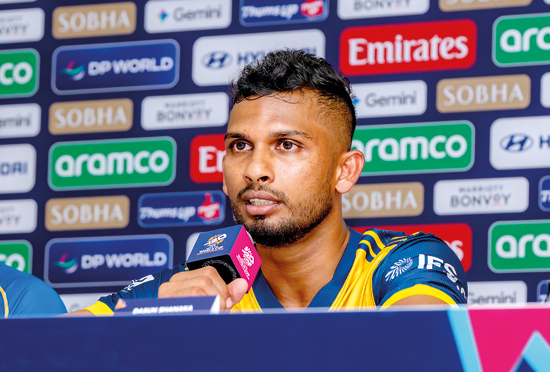
Captain Dasun Shanaka, playing his fifth World Cup, is optimistic as he stated the obvious–that if the batters can score runs, there’s a greater chance of Sri Lanka qualifying for the semis. But the issue has been that case where batters have failed as a unit, even though there have been flashes of individual brilliance leading to odd wins.
“I have a lot of confidence in this team,” he said at the pre-match press conference.
“Our two fast bowlers are bowling very well, and the spinners are performing strongly too. In the batting department, Pathum’s role is crucial, as is Kusal Mendis’. Kusal Janith, Kamil Mishara, Charith Asalanka, and Kamindu Mendis have all been consistent performers. They have played league cricket around the world and gained valuable experience. As captain, if I can fulfil my role as a finisher, I believe we can do well”.
Shanaka’s own form since taking over the leadership is mediocre. Against England in the home series, he managed only 25 runs in three innings and his struggle against spinners was in full exhibition. But Shanaka insists he is ready to lead from the front.
“I will personally take on the responsibility. I’ve spoken with the team management as well. As a batsman, bowler, and captain, I have a responsibility to serve my country. I am ready to do that.”
Sri Lanka has talent. Pathum Nissanka is as good as any player in world cricket today but has been through ups and downs. Pavan Rathnayake, though early into his career, has shown great character to earn a place in the World Cup squad. Wanindu Hasaranga’s quality is well established, so as Dushmantha Chameera. But together, these players have not produced consistent, match-winning performances, leading to the team’s current predicament. The sudden changes to leadership, coaches and even selectors haven’t helped and public frustration is visible at the grounds and on social media.
To change this Sri Lanka need to win—win consistently, and convincingly. They have little room for error. After their opening clash today, Sri Lanka will take on Oman in Pallekele on February 12, Australia, again in Pallekele on February 16, and Zimbabwe back in Colombo on February 19. Even if Ireland and Oman appear manageable on paper, recent evidence suggests Sri Lanka can no longer take any opponent lightly.
This tournament may not end with silverware or may not even end with a knockout appearance. But for Sri Lanka, their success might be measure on whether they finally play like a team that belongs on this stage.