

Columns
Walk for peace by Buddhist monks touches millions of American hearts
View(s):As Americans stand on the sidewalks in towns, cities and counties to watch, enthralled, ‘the walk for peace’ by a small train of Buddhist monks as they traverse through states, something strange is astir.
The message conveyed by this small band of silent evangelists, beating a noiseless drum, has struck the very heart and gripped the soul that lay in the gutter amidst the toxins and waste of affluence to answer the primordial call for peace and come alive and rise with hope.
As these monks from Thailand, Laos and Vietnam go from town to town and county to county across several states in the USA, carrying with them nought but the serene and sublime thought to strike a gentle blow for inner peace and calm of mind, it cuts across social divides and draws en masse those on whom it has touched a spiritual cord.
They preach no sanctimonious sermons nor give any lofty religious advice. They ask for no dollars in donations nor comfortable homes to bed for the night. They politely decline offers of hospitality and sleep under the stars at night. But just before the break of dawn, they arise and chant their stanzas and, mindful of every act, gesture and thought, embark on their sublime mission to light the landscape with peace, compassion and healing.
They did not ask; they did not demand to be heard in the eerie stillness of a darkening American night but let the silent vibes of peace their aura exuded subliminally seep into the people’s collective conscience for them to hark and awake and find the calming balm of inner peace in a fast-paced world of incessantly taunting stress and strife.
The Eastern caravan’s message of finding inner peace, compassion, and healing has become the rage that’s sweeping the states and touching millions of American hearts.
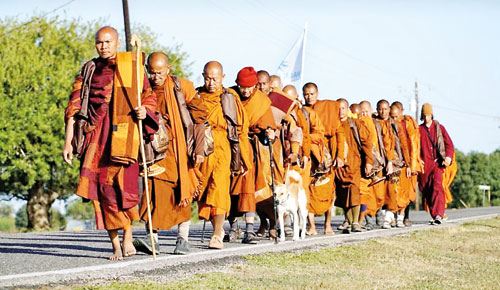
NINETEEN BUDDHIST NONKS AND A DOG CALLED ALOKA: The long 2300 mile walk for peace that ends at the White House
The walk for peace auspiciously began in the state of Texas in October last year. But before the story of how it flowered from bud to bloom can be told, it is necessary to go three years back in time to India, the land of the Buddha’s birth.
The story focuses on a Kolkata stray following the monks during their initial peace walk in India, in 2022. They first noticed a dog which, for some inexplicable reason, started following them near Kolkata airport. They shrugged it off, assuming it would stop no sooner – in the manner of car-chasing dogs – the novelty wore off. But to their amazement and surprise, the dog struck them unto the last.
He was there with them at the final post that ended their marathon 112-day ‘walk for peace’ trial run across ancient Buddhist sites found in India.
The monks soon realised the dog was no ordinary stray that had joined a stretch of the long and tiring journey for curiosity’s sake alone, nor was it just a passenger that had tagged along for the ride, but one that was on the same religious pilgrimage with the monks, silently walking for peace without a bark.
They named him Aloka, the Sanskrit name for light, the mind-illumining light that leads the world from darkness.
That day, in the far-off plains of North India, a star is born. Aloka, the Pilgrim Dog.
The engaging saga moves from India to the American stage. Upon the monks returning to their home base, the Huong Dao Vipassana Bhavana Center in Fort Worth, Texas, they were busy untying India’s bureaucratic knot to quicken the process of getting Aloka back with them in the States. After a long delay, Aloka finally made it to the States, enduring a further six months in quarantine.
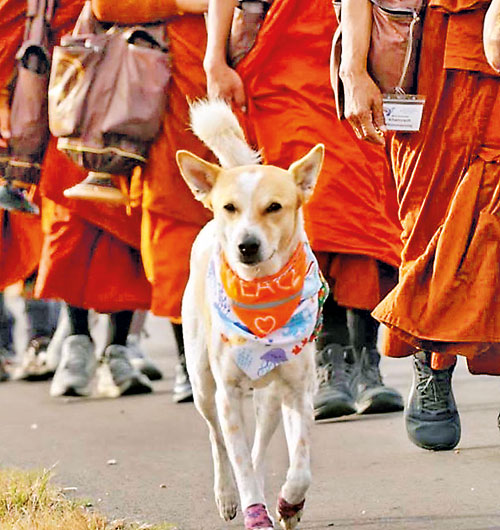
Aloka, the Pilgrim Dog
At long last, the ‘Walking for Peace’ Buddhist movement was ready to set foot on the asphalt roads of the richest and most powerful nation on earth, with a sublime message to convey in a noble, silent walk for peace.
They aimed to cut across the competitive hustle and bustle of everyday strife and transcend the stresses and frictions that inevitably arise to shatter the calm of modern-day existence.
They sought to quieten jingoist drums beating in the distance but resounding nationwide. They sought not the fleeting baubles of wealth, nor transient fame that soon fades, nor the unmatched glory of possessing invincible power to dominate the world eternally, but silently asked the people to spare a moment to pause and find in that mystical silent stillness the peace that lives within us all.
With the noble goal steadfast in mind, on October 26th last year, they auspiciously began their 2300-mile-long walk for peace from Fort Worth in Texas and planned to reach, after crossing 10 states, the nation’s capital, Washington, D.C., on February 13th this year.
As they were waved off, Texas Representative Nicole Collier told the local newspaper, the Star-Telegram, ‘When I heard about this 2,300-mile walk, I was amazed. It really touches the hearts and minds of people. We live in a time when the noise often drowns out understanding, where division can feel louder than unity—but this is what community and interfaith solidarity look like.’
In a written statement, Bhikkhu Pannakara, spiritual leader of the Walk for Peace, outlining the purpose and aim of their walk, said, ‘We walk not to protest, but to awaken the peace that already lives within each of us. The Walk for Peace is a simple yet meaningful reminder that unity and kindness begin within each of us and can radiate outward to families, communities, and society as a whole.’
‘This walk is more than a journey – it is a heartfelt offering to the community,’ Dr Neeraj Bajracharya, general secretary of the Nepalese Buddhist Association of Texas, said in a written statement. ‘Walk for Peace invites all people, regardless of faith, culture or background, to come together in the spirit of compassion, mutual respect and understanding.’
While nineteen Buddhist monks with Aloka are leading the walk for peace, the American media has reported the routes they will take and the states they will visit. It said, ‘The walk began in Fort Worth, Texas, and follows a route through the southeastern United States, passing through states, including Louisiana, Mississippi, Alabama and Georgia. Their path goes through both North and South Carolina and Virginia before concluding in Washington, D.C., before the Lincoln
The Vietnamese Theravada leader of the Walk for Peace, Bhikkhu Pannakara, and two others have bravely decided to walk barefoot on asphalt roads the entire 2300 miles to Washington, D.C., and show by example what little sacrifice he and his two fellow monks make by stoically bearing the pain to gain a higher spiritual quest.
This is not the first time Bhikkhu Pannakara has walked barefoot for miles, the government liaison and press coordinator for the walk, Neeraj Bajracharya, declared after the monks had passed the halfway mark. ‘Bhikkhu Pannakara completed a 112-day barefoot walk across India. However, Bajracharya said that walking in the US has presented distinct challenges, particularly due to road conditions. Bhikkhu Pannakara’s feet require daily bandaging after injuries sustained from rocks, nails, and broken glass.’
This, however, is not the first instance where the walk has claimed its toll in blood. On the 25th day of the walk, even before it had left the Texan start, senior monk Bhante Dam Phommasan met with a serious accident while walking for peace on the busy highway.
A driver in a pickup truck failed to slow down and struck the escort car. The acting police chief said, ‘A driver in a white pickup truck did not stop fast enough to avoid a pilot car travelling alongside the monks. The pickup struck the pilot car, which then hit two of the monks, including Bhante.
Bhante Dam Phommasan was severely injured in the accident and required air transport to hospital. At the hospital, the doctors examined his injured leg to determine the degree of his leg injuries. Doctors gave him two options. One was to perform multiple surgeries to try to save the leg. This would, of course, require a fairly long time in post-operative care, and for Bhante Dam Phommasan, the walk for peace would have halted midway for him.
The other option was to amputate the leg. It would require less time in a hospital bed, and, hopefully, he might be able to rejoin the walk again. Doctors were stunned when he glared back at them and said, ‘Amputate my leg if it means I can go back and join the ‘walk for peace’ again. My leg is a small price to pay to spread peace and compassion to a people in so want of it.’
These are the gripping words that make martyrs of men and saints out of sinners.
Such selfless dedication to the noble cause of spreading the sublime truths of loving-kindness, compassion, and equanimity – not by endlessly parroting stanzas but by one courageous act to awaken the peace that sleeps within us all – is the inspiring stuff of the Bodhisattvas.
Bhante Dam Phommasan has returned to walk for peace but only for 10 minutes, 6 times again. He follows in the truck during the intervals, determined to be not only in the spirit but also in the still bleeding flesh, too.
Another similar tale of courage and selfless determination – either by intent or instinct – is found in the stout heart and cheery wag of Aloka, the ‘Pilgrim Dog’ who has become the star of the roadshow. By his optimistic nature, he has unwittingly grabbed the spotlight to himself and stolen millions of American hearts that makes him deserve to see his name etched on LA’s Star Walk of Fame.
However, accidents can happen in the best of mongrel families, and it happened to Aloka himself. On January 12 he underwent surgery at the Charleston Veterinary Referral Center in South Carolina after he was diagnosed with a cranial cruciate ligament tear in his right hind leg. This was an aggravation of a chronic condition he had suffered in India when he was hit by a car while walking for peace with the monks three years ago.
On January 15, he was on the road again, limping but determined to stay the course.
The torrents of Karma had dragged him from the backstreet slums of India, across the Indian and Atlantic Oceans, to the native land of the Red Indians to repeat his karmic destiny by engaging in meritorious deeds and receiving its untold blessings.
During the early days, the walk for peace had attracted only a ripple of crowds to gently splash on the sidewalks and gently ebb away again. But as the monks walked for peace from county to county and from state to state, they noticed that the crowds were getting bigger, the waves were rising higher, and what was more remarkable was that those who stayed behind and joined the Pilgrims’ Progress were massively increasing in numbers at a terrific rate.
The fitting climax to end the 120-day, 2300-mile-long walk to Washington, DC, on February 13 to visit the US Capitol and the White House.
If there is a trace of a blot on the walk for peace by Thai, Laotian and Vietnamese monks and a stray dog from India, where Buddhism was born, it’s the conspicuous absence of a single Theravadan monk from the thrice-blessed resplendent island of Lanka.
Buying or selling electronics has never been easier with the help of Hitad.lk! We, at Hitad.lk, hear your needs and endeavour to provide you with the perfect listings of electronics; because we have listings for nearly anything! Search for your favourite electronic items for sale on Hitad.lk today!
Leave a Reply
Post Comment