

Columns
- Attorney General under fire amid social media trolls and protests
- President’s Jaffna speech draws criticism from opposition parties; Ranil Wickremesinghe says attack on Buddhism violates Constitution
- Frustration grows in UNP and SJB over slow progress in unity efforts
By our Political Desk
“Governing isn’t as easy as it looks when you are in the opposition,” is the closing line of award-winning filmmaker Asoka Handagama’s newly released film titled ‘Sanda Dadayama (moon hunt). It’s a film with a political twist and wouldn’t have drawn as much attention if not for the outburst by Janatha Vimukthi Peramauna (JVP) Administrative Secretary, Politburo member and Agriculture, Livestock, Lands and Irrigation Minister K.D. Lal Kantha, who took issue with the filmmaker for allegedly directing the jibe at the ruling party and vowed that such attempts would not go unanswered.
The occasion on which the old Bolshevik in Lal Kantha was ignited was at an event in Colombo titled ‘Reading Lenin’, organised by the National Trade Union Centre (NTUC), a pro-JVP trade union collective. Addressing the event, he threatened to hit back at whoever stands in the way, whether they are in “black robes, national suits or the saffron.”
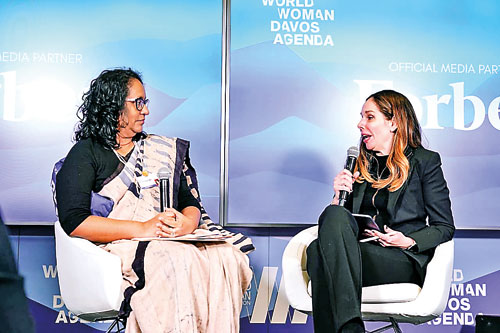
Amid protests and counterprotests over educational reforms in Sri Lanka, Prime Minister Harini Amarasuriya took part in the World Economic Forum in Davos, Switzerland
“It is true our government is in power, but we still don’t have state power. We will bring about a revolution soon and seize state power as well,” he told the audience. It’s not the first time that Lal Kantha has got himself embroiled in controversy with his outlandish statements, but as a senior member of the government and the Cabinet, what he utters indicates a growing tendency toward intolerance by those in government and those affiliated to it and somehow having their way.
Two of the jarring examples have to do with the appointment of two AGs—a new Auditor General and the growing efforts to undermine Attorney General Parinda Ranasinghe.
In the case of the Auditor General, the permanent appointment of a person to the post of AG has been delayed since the last Auditor General, W.P.C. Wickramaratne, retired in April 2025. Instead of appointing the next senior-most officer in the department, Dharmapala Gammanpila, to fill the vacancy, President Anura Kumara Dissanayake sent the name of a person from outside the service to the Constitutional Council for confirmation and appointed Mr Gammanpila as only the Acting AG. The CC has since turned down two of the President’s nominees to the post, and since December there has been no one even in the acting capacity, with the CC refusing to confirm anyone to act as AG and insisting that a permanent appointment be made.

A handful of masked protesters held a demonstration in Hulftsdorp against the Attorney General. Pic by M.A. Pushpa Kumara
On Friday, three new civil society members were named to the CC with the agreement of the Prime Minister and the Opposition Leader. They are Colombo Univerisyt Law Professor Wasantha Seneviratne, former presidential secretary Austin Fernando and former ministry secretary Ranjit Ariyaratne. Whether the President will be able to push through his nominee for the AG when the CC meets with the new members will be known soon.
While there may be some resolution in the horizon to the deadlock over the Auditor General’s post, a storm is gathering over the fate of Attorney General Parinda Ranasinghe, who has become the target of a vicious campaign to undermine his authority amidst accusations he is soft-pedalling cases against those in the previous administration. A small crowd gathered in Hultsdorf and carried placards against AG Ranasinghe this week. It gave rise to criticism that the government is attempting to undermine the office of the AG.
The Bar Association of Sri Lanka (BASL) was the first to draw attention to social media posts which it saw as unfair interference in the independence of the office of the AG.
“It must be noted that the Attorney General performs a quasi-judicial role in respect of criminal matters. The Attorney General has to decide whether or not to charge/indict a suspect based on the material available and submitted to him by the investigating authority. In doing so, the Attorney General will be required to consider whether such material is admissible in law and whether, based on such material, there exists a reasonable prospect of a conviction,” the BASL said in a statement. It added that the decisions of the Attorney General are reviewable by way of the exercise of writ jurisdiction before the Court of Appeal or by way of the exercise of the fundamental rights jurisdiction before the Supreme Court.
“It must also be understood that judicial officers and quasi-judicial officers have to take decisions according to law, which sometimes may not necessarily reflect the popular view. In the case of Victor Ivan v. Sarath N. Silva, Attorney-General and Another (1998) 1 Sri.L.R. 340 at 349, it was observed by Justice Mark Fernando that “a citizen is entitled to a proper investigation – one which is fair, competent, timely and appropriate – of a criminal complaint, whether it be by him or against him. The criminal law exists for the protection of his rights – of person, property and reputation – and lack of a due investigation will deprive him of the protection of the law,” the BASL statement said.
It also added, “Whilst every citizen has a right to critique the decisions of public officials, including the Attorney General, it must be done in a manner that will not undermine the independence of the office of the Attorney General and to the detriment of the rule of law. The officers of the Department of the Attorney General should not be subject to unwarranted and unfair interference from sections of the public or media who do so to achieve their partisan ends.”
“The BASL firmly believes that it is the duty of the Government and the Law Enforcement agencies to ensure that there is no unwarranted interference with the exercise of the powers of the Attorney General. The Government must ensure the protection of the independence of key institutions, including that of the office of the Attorney General, which is essential to protect the rule of law in our country. We strongly urge that the independence and integrity of the office of Attorney General be protected at all times to ensure the protection of the cherished principles of justice and freedom.”
Opposition Leader Sajith Premadasa also raised the issue of moves to undermine the office of the AG and said the sanctity of the independence of the AG should be protected.
Justice Minister Harshana Nanayakkara, who too has faced attacks on social media over this issue, said the government would take all measures to ensure that the independence of the AG was maintained. “There were times when stones were hurled at the residences of Supreme Court judges. We know what happened to Chief Justice Shirani Bandaranayake (who was impeached in January 2013). We will ensure that no such situations are repeated under this government,” he said.
When Premadasa sought a response from Mr Nanayakkara over social media criticism which referred to him as a “drinking partner” of the AG, the minister dismissed such talk, saying he did not take social media slandering seriously, saying such jibes were also often directed at the Opposition Leader. “This post was given to me by the President, and I have full faith in him and the government,” Mr Nanayakkara said.
However, despite the Justice Minister’s assurances of the independence of the AG, a senior government source said that some credible allegations against the conduct of AG Ranasinghe had reached the government, and they were “being looked into”. He refused to elaborate but indicated the hard-line approach of some government sections that want the AG as a lawyer for the government rather than a lawyer for the state. Whether President Dissanayake will want to go the Mahinda Rajapaksa way by bringing an impeachment motion against AG Ranasinghe will become clear in the weeks ahead.
It is not just Minister Lal Kantha and others in the government who are attracting criticism over recent public statements. President Dissanayake too is being attacked by sections of the opposition and even some Buddhist clergy over a statement he made during his visit to Jaffna undertaken last week. In Jaffna, the President received a seemingly warm reception during his trip, which coincided with the Thaipongal Festival. He attended several major events during his visit to the North, but it was a comment he made during the Northern Province ceremony of his government’s flagship ‘Ratama Ekata’ (A Nation United) anti-drug programme that drew the most attention in the South.
In his address during the event, the President claimed that some elements were deliberately attempting to stir communal tensions under the guise of religion. He insisted his government would not allow racism to rear its ugly head again. “There are clashes involving a religious site. Some are passing the Sri Maha Bodhi on poya days and are coming to observe sil (religious observances) in Jaffna. Such actions are not driven by religious feelings but by hatred,” the President said.
Government sources noted that the President was referring to the controversy surrounding the Tissa Viharaya in Thayiddy, Jaffna. There are allegations that the present temple has been built illegally on privately owned land. There has also been a trend in recent times of devotees travelling from the South to observe sil at the viharaya on poya days, even as protests are held nearby calling on temple authorities to hand over private lands they are allegedly occupying illegally. Nevertheless, the President did not refer to any place by name, and as such, there were some who accused him of trying to dissuade Sinhala Buddhists in general from travelling to the North to worship at Buddhist religious places, especially Nagadeepa islet, a holy place for Sri Lankan Buddhists.
The President’s comments at the Jaffna event drew immediate condemnation from sections of the opposition, including the Samagi Jana Balawegaya (SJB) and the Sri Lanka Podujana Peramuna (SLPP). In a video statement, Opposition Leader Sajith Premadasa rejected the President’s comments. “Buddhists in our country have the freedom to worship at any Buddhist place of worship in the island,” he stressed. While noting that he agreed that there were small sections of extremists in every community, Premadasa added it should not be used as an excuse to make statements that actually fuelled extremism. The President and his government should understand the provisions of the Constitution and not make statements that run counter to the provisions that give foremost place to Buddhism.
SLPP National Organiser Namal Rajapaksa accused President Dissanayake of causing “irreparable damage” to religious and communal unity through his statement. “He (Dissanayake) is the one actually promoting racism through such comments. This country is entwined with Buddhism and Buddhist philosophy. This fostered an environment that enabled all other religions to co-exist. What the President is doing as Head of State is trying to give the impression that there is enmity between the Sinhalese and Tamils. Even during the war, we only fought against the LTTE, not the Tamil people,” Mr Rajapaksa said.
Former president and United National Party (UNP) leader Ranil Wickremesinghe also remarked on the government’s actions, which some critics claim are violating the constitutional provision which gives foremost place to Buddhism. Mr Wickremesinghe was attending an act-of-appointment (Aktha Pathra) presentation ceremony in Galle. The event was held to present the scroll of office to Ven. Pelawatte Chandima Nayaka Thera, the Chief Incumbent of two temples, including the Mandlapura Sri Mihindu Maha Viharaya in Galle. A Buddhist monk who spoke before the former president attacked the government over what he claimed were increasing attacks on Buddhism and Buddhist monks.
“Every one of you now has a duty to protect Article 9 of the Constitution,” Mr Wickremesinghe said, pointing to several politicians who were in the audience. He was referring to the constitutional provision which states that the Republic of Sri Lanka shall give Buddhism the foremost place.
“The rulers of this country are bound to give foremost place to Buddhism. Even during the British colonial era, this principle was accepted and acted upon. If the priority given to Buddhism is lost, party leaders will have to discuss the next steps with the Chief Prelates,” Mr Wickremesinghe noted during his speech.
UNP-SJB talks
While both Mr Wickremesinghe and Mr Premadasa appeared to be on the same page when it came to criticising the government regarding its alleged anti-Buddhist statements, there seems to be no such agreement concerning ongoing reunification talks between their respective parties, the UNP and SJB. There are increasing signs that frustration is mounting within the ranks of both parties over the delay in achieving a breakthrough.
UNP sources say the SJB is yet to respond to its proposals detailing steps to be taken to reunify the two parties. SJB leader Sajith Premadasa has personally taken over the task of leading the talks with UNP representatives regarding reunification. Mr Premadasa’s apparent reluctance to involve other senior party officials, including General Secretary Ranjith Maddumabandara, in the talks has also raised eyebrows among many SJB MPs. As far as the SJB is concerned, reunification talks have now turned into a ‘one-man show’ involving their leader.
SJB insiders, though, are of the view that talks being held between their leader and UNP representatives will bring them no closer to an agreement, and they insist that the two leaders meet face-to-face in order to put aside their personal differences and agree on a framework for reunification.
A senior UNP source, however, insisted that their leader Wickremesinghe was “ready” to meet Mr Premadasa and claimed that it was the latter who was dithering over the matter by delaying sending a formal response to the UNP’s proposals. He added that UNP representatives engaged in reunification talks had already raised concerns with Mr Wickremesinghe regarding the SJB’s delay in sending a response to their proposals. He further claimed that some SJB MPs had also urged Mr Premadasa to respond to the UNP’s proposals without further delay in order to move the reunification talks forward.
The UNP source added that Wickremesinghe had advised party members to wait for an SJB response to the UNP proposals and that, in the meantime, they should refrain from making any statement that might impact negatively on the ongoing talks.
There is also concern among both UNP and SJB members that a prolonged deadlock on reunification talks may push the UNP closer to other opposition parties, particularly to the Sri Lanka Podujana Peramuna (SLPP), with which it worked from 2022 to 2024. The SLPP, under its National Organiser Namal Rajapaksa, has been reorganising and steadily rebuilding the party over the past year. The party’s performance saw a marked improvement during last year’s local council elections, and though its support base is still a far cry from the heights of 2019/2020, there is clear evidence that it is enjoying a resurgence. Even some former SLPP ministers and MPs, who had supported the Wickremesinghe presidency and had even contested from the New Democratic Front (NDF) under the former president during the 2024 general election, have now drifted back to the SLPP, no doubt conscious of the steadily growing popularity of the party under young Rajapaksa.
A decision by Mr Wickremesinghe to move towards forging closer ties with Namal Rajapaksa would be more damaging to the SJB than the UNP, given that the SLPP and the UNP have anyway been working together on some aspects in recent times, even after the Wickremesinghe presidency period ended. The two parties worked with several other opposition parties in organising anti-government demonstrations and rallies last year. As such, an election tie-up between the UNP and the SLPP, despite their political and ideological differences, cannot be ruled out. After all, there are no permanent enemies in politics – only permanent interests. Given this situation, if UNP-SJB reunification talks lead nowhere, a likelihood of at least some in the SJB opting to rejoin the UNP come election time is also a distinct possibility.
Even as President Dissanayake was in Jaffna, Namal Rajapaksa was in Anuradhapura, the heartland of Sinhala Buddhism and the long-time constituency of the President. He went further, making a point to attend a party event in President Dissanayake’s own birthplace in Thambuttegama last Sunday (18). The event was a ceremony to present appointment letters to SLPP organisers in the Kalawewa electorate. As this newspaper reported last week, the night before the meeting, there was a heated argument between SLPP supporters and the Thambuttegama Police, including the station’s Officer-in-Charge (OIC), over the police’s refusal to permit party decorations, including flags, around the meeting venue. “The event organisers called me at about 2.00am and told me police were removing the flags they had put up for the event. I told our supporters that the police had also been rendered helpless and that the government must be pressuring them to stop this. As such, I instructed them to try to resolve this amicably without engaging in a confrontation,” Mr Rajapaksa told the Sunday Times.
The SLPP National Organiser also commented on the ongoing debate surrounding the National People’s Power (NPP) government’s controversial education reforms. While there must clearly be a change with regard to education, that change should not be what the JVP wants; it should be what the children of this country need, he remarked. “The government, however, seems to have forgotten that they are actually in power. For the first time in history, a government is protesting on its own behalf. Some people just can’t shake off old habits. Even after coming to power, they are putting their supporters on the streets to demonstrate,” he added.
Mr Rajapaksa was referring to the demonstrations now being held in Colombo and other locations in the country demanding that the government reverse its earlier decision to postpone implementing its education reforms for Grade 6 till 2027. The education reforms were initially due to be implemented for Grade 1 and 6 this year, with reforms for Grade 6 being launched on January 21 and Grade 1 on January 29. While reforms for Grade 1 will still go ahead as scheduled, the government was forced to walk back implementing the reforms for Grade 6 following the raging controversy created by the discovery that an address of an adult website had been included in the Grade 6 English module issued under the new reforms. The Deputy Director of the National Institute of Education (NIE) was sent on compulsory leave this week, while two other officials were also suspended in connection with the incident following revelations of an initial inquiry.
Those holding demonstrations in support of the education reforms now argue that the government can easily go ahead with the Grade 6 reforms, either by removing the offending pages from the English module or by implementing the module system for other subjects. While parents of Grade 6 students are involved in the demos, there is no doubt that they have the government’s backing and the organisational strength of the JVP. Demonstrations calling on the government to reverse the move to postpone the reforms for Grade 6 have been held both in front of the Education Ministry and the Presidential Secretariat.
The fact that government elements are now openly involved in the movement launched in support of the education reforms was made apparent through a series of public seminars now being held by a suddenly sprung-up organisation known as the ‘National Movement for Educational Reforms’. Several of those who were announced as members of this new movement’s executive council are from trade unions connected to the government. They include Dhammika Alahapperuma, President of the Ceylon Teachers’ Service Union (CTSU), whose General Secretary is Deputy Minister of Labour Mahinda Jayasinghe.
The organisation held its first press conference on January 16 and a series of district-level seminars throughout January and February. Its first seminar was held in Kandy under the theme “The Future is You: Learn – Conquer the World.” Several government ministers and deputy ministers also took the stage during the event to speak in support of the reforms. Seminars were also held in Anuradhapura, Tangalle and Badulla this week, with more to follow in Nuwara Eliya, Gampaha, Matara, Kalutara, Kurunegala and Ratnapura. Interestingly, the seminars are being carried live via the social media channels of the JVP.
Opposition parties have largely dismissed the protests being held in support of the reforms, arguing that they are being organised by the JVP and do not have the support of the vast majority of parents of Grade 6 students. The protests, however, are continuing. Claims by sections of anti-government elements that see these as a split between the Harini Amarasuriya-led NPP and the Anura Kumara Dissanayake-led JVP appear far-fetched and wishful thinking, as the public backing for the Amarasuriya reforms (despite them being postponed by the President Dissanayake-led, JVP-dominated Cabinet) comes from the same source – the Pelawatte head office of the JVP.
Buying or selling electronics has never been easier with the help of Hitad.lk! We, at Hitad.lk, hear your needs and endeavour to provide you with the perfect listings of electronics; because we have listings for nearly anything! Search for your favourite electronic items for sale on Hitad.lk today!
Lal Kantha’s remarks bolster claims of Govt.’s authoritarian drift
View(s):