


SAARC at 40
View(s):SAESM was a pioneering initiative that gave Economics students from across South Asia the opportunity to present research papers on shared regional issues and to build networks around a common vision: integration for “One South Asia”.
I had the privilege of leading a group of 15 Sri Lankan university students to New Delhi for the inaugural SAESM. At that time, resources were scarce, and bringing delegates from different South Asian countries to one venue was a major challenge. The support of the World Bank had not yet initiated, and we had to rely on the goodwill of various funding sources.
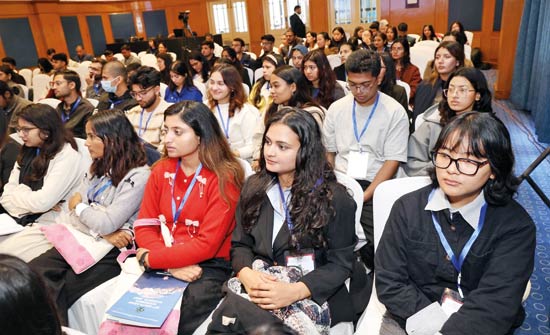
Economics students from South Asia participating at 20th SAESM in Kathmandu in November 2025.
For the Sri Lankan contingent, flying directly from Colombo to Delhi was unaffordable. Instead, our journey was arranged to fly to Chennai and then take the train to Delhi. Although it was a fast train, the journey lasted 36 hours over two nights. That experience gave me, for the first time, a true sense of the vastness of India.
From those modest beginnings, SAESM has grown steadily over the past two decades, overcoming numerous regional and global challenges. It has become an annual event eagerly anticipated by Economics students across South Asia. The most recent gathering was held in Kathmandu in November, just last month.
Today, SAESM stands out as one of the very few regional initiatives in South Asia that has not only survived but thrived—remaining vibrant, relevant, and impactful.
On December 9, 1985
A few days ago, Mihir shared with me a caption from the December 9 issue of The Indian Express that immediately caught my attention. Under the column titled “40 Years Ago”, the newspaper had reproduced the front page from December 9, 1985.
The highlighted story recalled a historic moment:
“The seven South Asian leaders launched the world’s most populous regional grouping with the hope that it would improve the security environment in the region and that cooperation among them in the economic and cultural fields will result in a better life for their people. On the final day of their first-ever summit, the heads of state of Bangladesh, Bhutan, India, the Maldives, Nepal, Pakistan and Sri Lanka adopted a charter giving birth to the South Asian Association for Regional Cooperation (SAARC).”
That charter embodied a vision of unity and progress. Yet, four decades later, South Asia remains the least economically integrated region in the world. Despite its vast population and geographical proximity, the region continues to lag behind in trade, investment, and factor market integration—even when compared to Africa, which has made greater strides in regional economic cooperation.
Stages of integration
 Integration of nations can go deeper through agreements on Free Trade Area (FTA), Customs Union, Common Market and Economic Union. An FTA is the very basic level of integration, which allows “free trade” in goods and services. By the way, if you think of Sri Lanka’s FTAs, I must say that Sri Lanka does not have any agreement as such covering free trade in both goods and services!
Under a Customs Union agreement the member states, in addition to free trade in goods and services, adopt common tariffs with non-member states. Under a Common Market agreement, in addition to FTA and Customs Union specifications, there should be free movement of people and money. Under the Economic Union, the member states have a macroeconomic policy harmony and perhaps even a single currency regime.
Initial focus of SAARC was not on economic integration through trade and investment as the South Asian countries other than Sri Lanka had not yet initiated their liberalisation reforms. Accordingly, SAARC on ‘technical cooperation’ covered agriculture, communications, education, culture and sports, environment and meteorology, health and population, drug trafficking, rural development, science and technology, tourism and transport, and women’s development.
SAPTA and SAFTA
In the early 1990s, the wave of liberalisation and globalisation reached South Asia as well. Against this backdrop, SAARC began to place greater emphasis on regional cooperation in economic and trade matters.
This led to the establishment of the SAARC Preferential Trading Arrangement (SAPTA) in 1995. SAPTA was designed to promote intra-regional trade and economic cooperation by offering preferential concessions among member states. These concessions covered tariffs, para-tariffs, and non-tariff barriers. Negotiations were conducted on multiple bases: product-by-product, across-the-board tariff reductions, sectoral agreements, and direct trade measures.
A decade later, in 2005, SAARC members advanced further by signing the South Asian Free Trade Area (SAFTA) agreement. Its objective was to deepen mutual trade and economic cooperation by eliminating barriers, fostering fair competition, ensuring equitable benefits, and laying the groundwork for broader regional integration.
Under SAFTA, tariff rates were to be progressively reduced to below 5 per cent—by 2013 for India and Pakistan, by 2014 for Sri Lanka, and by 2016 for the least-developed member countries. Each country retained the right to maintain a “sensitive list” of imports excluded from tariff concessions. In addition, export goods could qualify under SAFTA if they met domestic value addition requirements: 40 per cent for India and Pakistan, 35 per cent for Sri Lanka, and 30 per cent for the other members.
A flat period
The two decades that followed SAFTA have been a flat period for regional integration in South Asia. With little progress beyond the agreement, widening political divisions among member states further weakened the prospects for economic cooperation, leaving integration stagnant.
Yet SAARC once had an ambitious roadmap. The Report of the SAARC Group of Eminent Persons titled “SAARC Vision Beyond the Year 2000” and presented at the 1997 Maldives Summit—just two years after SAPTA—outlined a bold plan for deeper integration.
The report envisioned the creation of a South Asian Customs Union (SACU) by 2015 and a South Asian Economic Union (SAEU) by 2020. Given the political and economic realities of the region, these goals were always ambitious, perhaps overly so.
Had they been realized, South Asia today would have stood as the world’s second economic union, after the European Union. In practice, however, SAARC never advanced beyond SAFTA in 2005.
Four decades after its founding, South Asia remains the least-integrated region globally. Intra-regional trade accounts for only about 5 per cent of total trade, in stark contrast to over 70 per cent in the EU, 60 per cent in East Asia, and 15 per cent in Africa.
Outside SAARC
Despite weak integration with their immediate neighbors, South Asian countries have steadily strengthened their economic ties with the rest of the world. In this respect, India has advanced far more than any other country in the region.
Over the past 35 years, India has pursued continuous policy reforms and entered its first bilateral FTA with Sri Lanka in 1999. Since then, it has maintained momentum, expanding into both bilateral and multilateral agreements—many of them comprehensive—covering more than 25 countries.
As of now, India is in the final stages of negotiating a FTA with the EU covering 27 more countries with both sides reaffirming their commitment to conclude the deal soon. By contrast, Sri Lanka has not moved beyond its basic FTAs with India (1999) and Pakistan (2005). It has never demonstrated a firm commitment to pursuing either unilateral trade liberalisation or comprehensive free trade agreements over the past 25 years.
Today, about 95 per cent of India’s trade lies outside South Asia. Of the remaining 5 per cent within the region, the largest share is with Bangladesh, followed by Nepal and Sri Lanka. Trade with Pakistan, Bhutan, the Maldives, and Afghanistan is comparatively negligible.
The establishment of SAARC in 1985 was an ambitious attempt to foster regional integration. Yet four decades later, South Asia remains fragmented. High logistics costs, protective barriers, infrastructure gaps, and a persistent trust deficit have undermined the region’s potential for closer economic cooperation.
While some South Asian countries have sought to offset the disadvantages of weak regional integration by engaging more deeply with the global economy, others have struggled to make comparable progress, leaving the region uneven and economically divided.
(The writer is Emeritus Professor at the University of Colombo and Executive Director of the Centre for Poverty Analysis (CEPA) and can be reached at sirimal@econ.cmb.ac.lk and follow on Twitter @SirimalAshoka).
Hitad.lk has you covered with quality used or brand new cars for sale that are budget friendly yet reliable! Now is the time to sell your old ride for something more attractive to today's modern automotive market demands. Browse through our selection of affordable options now on Hitad.lk before deciding on what will work best for you!