
17th October 1999
Front Page|
News/Comment|
Editorial/Opinion| Business|
Sports|
Sports Plus| Mirror Magazine


Forest, land: No action -talk only
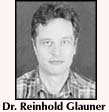
Coming to Kandy on September 29 and visiting the central plantation forests, was Dr. Reinhold Glauner of the Federal Research Centre for Forestry and Forest Products in Hamburg, Germany.
Dr. Glauner, who flew in from Malaysia, had spent time in that country on the "Sabah Project" - training forest managers and workers in the Sabah Forestry Department.
 He
is also an adviser to the German Government on Tropical Forestry and said
that the Institute for World Forestry he is attached to comes under Germany's
Ministry of Food, Agriculture and Forestry. Dr. Glauner was here to assess
the progress of the GTZ-state Forestry and Water Resources Development
Project (EFWRDP) based in Aniwatte, Kandy, and suggest plans for the project's
future.
He
is also an adviser to the German Government on Tropical Forestry and said
that the Institute for World Forestry he is attached to comes under Germany's
Ministry of Food, Agriculture and Forestry. Dr. Glauner was here to assess
the progress of the GTZ-state Forestry and Water Resources Development
Project (EFWRDP) based in Aniwatte, Kandy, and suggest plans for the project's
future.
In doing so, he also canvassed the views of the Planters' Association and expressed his satisfaction and confidence in the work of the EFWRDP. Speaking of his work in Malaysia, he said that the project there was a co-operation between the Government of Malaysia and the Commission of European Countries.
"Tropical forests are an asset for present and future generations," he said. "They are of real economic importance as a source of tropical hardwoods; as a genetic bank; an important factor of global environment and a climatic stabilizer. If they are managed well, they form a renewable resource for wood, for non-timber produce, act as a habitat for endangered species, control erosion and maintain environmental stability.
"In Malaysia, and in Sabah, the forestry sector is of vital importance. It generates about 50 percent of the state's revenue and provides employment for about 20,000. However, of late, all this was being jeopardized by poor planning, destructive timber harvesting and other malpractices that had led to a continuous depreciation. What was necessary was to upgrade the skills of the forestry personnel and carry forward a sustainable Forestry Management System."
He said that even here, it was vital that there be sound forestry management planing, reduced impact harvesting methods, silvicultural treatments and enrichment planting. "We must have a sustainable utilization of all forest resources."
Dr. Glauner introduced formal training courses for forest managers and workers primarily towards reducing logging damage. He held training courses in chainsaw operation ergonomics and forest management that had to be environmentally compatible and socially beneficial.
He said his impression was that the Central Province plantation forests presented a more beautiful landscape than Malaysia, but he also found a marked lack of real economic drive. Also, land management here is more difficult because, unlike in Malaysia, there are too many "bits and pieces" with private and state ownership of land head-butting each other all the time.
"It seems that getting things done here needs much extra effort. There is a lack of entrepreneurship, discipline and too much of sitting down to deliberate, propose, oppose and discuss when what is needed is a hands-on approach to get moving. The infrastructure here is not yet ready to take the full blast of a global market," he said
Dr. Glauner left on October 10, saying that what impressed him most was the vast economic potential of our forests. "Sustainable Forest Management is what is now needed," he said.
Five candles on the "Kandy News" cake
It was a late evening some time in August 1994 when Shirley Jayewardena, her husband Ananda and Professor S.W.R de A. Samarasinghe took an after-dinner drive. Conversation was desultory, then it turned to the Kandy they were driving through; Queen of Sri Lanka's cities. Quite the proudest too...and yet? It was then that a sort of flash bulb popped. "Let's start a newspaper for Kandy!"
"Good idea, but I have scarcely the time," the Professor said.
"Don't you worry. I'll run it!" Shirley said - and that, in a car, with Kandy melting past them in street-light and shadow - was how the "Kandy News" was conceived. Gestation was short and frenzied and full of sheer willpower and derring-do. In October 1994, the first copy rolled off the press, wholly experimental maybe, but with immense promise.
Shirley Jayewardena can be, at times, filled with an almost intimidating enthusiasm. She is a go-getter, true, but also the sort of person whose personal dynamism refuses to take any 'no', be it said softly, apologetically or firmly, for an answer. Difficulties are simply there to be surmounted, and the hurdles she has taken in these five years could leave our track stars gasping.
The "Kandy News" was first distributed free. Slowly, as confidence occupied its every page, it was given for a mere Rs 2/- per copy, then Rs 5/- and is now in every Kandy news-stand and all over the Central Province at Rs 10/-.
The paper took on a particular identity and, as we know, is the only provincial newspaper in circulation today without considering what comes out of Jaffna. It fills an enormous void and is quite fearless in its stance. So downright fearless that a tourist hotel in Kandy did not wish to take in copies for the guest rooms, complaining that tourists would be regaled with the ills of the city and go away with a dim view of the place that is so much touted in their itineraries.
"At the start," Shirley said, "funding was the biggest headache, but we got over that too. I had this single compulsion - to make the paper win through. It didn't worry me when some people said I was accepting lots of small-time advertisements and making my advertising pages like chequered flags. Why worry? No newspaper can run without advertising support."
It was a shoestring start - just two editorial staff and everyone a "gopher" going for this, going for that, but there was this tremendous will to succeed and nothing was going to throw a wet blanket on the venture.
The Board comprises Professor Samarasinghe as Chairman and Chief Editor, Shirley as Managing Director, Ananda Jayewardena, Miss Dilini Gunasekera, Winkle Pathirana, and Ms Anoja Devendra. Deputy Editor is Kularatna Bulathgama, a man with a sound journalistic background and the editorial department's moving spirit. It's a young staff of 11 now and, as Shirley says, the paper encourages talent and accepts many youngsters as trainees in computer-journalism. "We conduct our own in-house courses," she said.
It was a bold and welcome decision to go bi-lingual in 1997 and the plans to do so won the approval of the Asia Foundation. It was also good to receive funding aid from the Foundation - aid which enabled the Board to install a new state-of-the-art Web Offset in October of that year. "Again, in October," Bulathgama remarked, "October is a fortunate month for us."
The fifth anniversary of Sri Lanka's only provincial newspaper is being celebrated with a bumper issue. "We've come a long way," Shirley said, "and the nicest compliment is that we are sometimes quoted and acknowledged in the national press."
Here, in Kandy, the paper is in the forefront of various commercial and social events as media sponsor. "We will always be part of Kandy." In fact, just to walk into the offices of the paper at Kotugodella Vidiya makes one feel that one is really in Kandy - looking out and looking in!


Front Page| News/Comment| Editorial/Opinion| Plus| Business| Sports| Sports Plus| Mirror Magazine
Please send your comments and suggestions on this web site to

