

Sunday Times 2
Iran war: Presenting Trump with Tolstoy’s War and Peace
View(s):By Ameen Izzadeen
It is unlikely that US President Donald Trump has ever read Leo Tolstoy’s War and Peace. Trump, who relies on brute force while proclaiming himself a man of peace—one who shows little concern for the suffering of the world’s poor caused by his administration’s military misadventures—is unlikely to be moved by Tolstoy’s masterpiece, let alone glance at a copy of the monumental novel first published in 1869. Surely, a copy in the White House library must be gathering dust.
Tolstoy’s admirers insist that his philosophy-infused literary work is not merely about war; it is about the search for meaning in a world marked by suffering and change. True peace, the novel suggests, is found in love, humility, and acceptance rather than conquest or fame. History, Tolstoy emphasises, is shaped less by great leaders than by countless ordinary lives. The book underscores the futility of war and the necessity of inner peace.
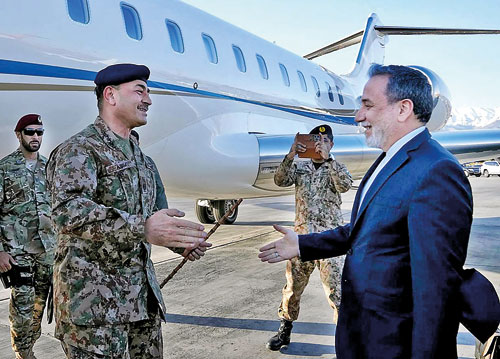
Iran’s Foreign Minister Abbas Araghchi (R) welcoming Pakistan’s Army Chief Asim Munir upon his arrival at the airport in Tehran on Wednesday. AFP
Iranian leaders, inclined toward spirituality and philosophy and often scholars themselves, are far more likely to have read Tolstoy. Consider Ali Larijani, assassinated last month in a US-Israeli missile strike. A mathematician with a doctorate in Western philosophy, he authored two books on Immanuel Kant. Leaders such as Larijani resemble Plato’s philosopher kings. The title of Ayatollah is not merely bestowed—it must be earned through years, if not decades, of rigorous research and demanding academic work in Islamic studies.
No such philosophical inclination is visible in Trump or his partner in war crimes—Israeli Prime Minister Benjamin Netanyahu. Yet, like the proverbial devil, they show no scruples about quoting scripture to justify war and destruction.
This week, to the shock of billions of Christians, Trump posted on his Truth Social platform an AI-generated image depicting himself as Jesus Christ healing the sick. The image, widely seen as an insult by Christian devotees, came against the backdrop of his growing public criticism of Pope Leo, the spiritual leader of the world’s Catholics, after the pontiff opposed his war. The implicit message of Trump’s post was: “I am a better Christian than the Pope.”
Isn’t there something troubling about Trump’s state of mind? During his first term as president, more than 20 leading US psychologists, after analysing his statements and behaviour, questioned his mental fitness to serve as president. They warned that Trump posed a significant risk of nuclear conflict and was suffering from a personality disorder known as malignant narcissism.
In a recent statement, Pope Leo said, “God does not bless any conflict. Anyone who is a disciple of Christ, the Prince of Peace, is never on the side of those who once wielded the sword and today drop bombs.” His message was widely seen as a direct criticism of the Trump administration’s efforts to provide religious justification for the war against Iran—a crusade of sorts—and to hail Trump as chosen by God to lead the world.
The Pope’s profound spiritual message fell on deaf ears—especially of a leader who resorts to profanity in public to vent his frustration over the reversals of war. Trump and his officials escalated their attack on the pontiff, accusing him of supporting crime and a terrorist state—a US-Israeli reference to Iran.
On Wednesday, Trump shared on his Truth Social platform another AI-generated image of himself being embraced by Jesus Christ.
As Trump flaunts his narcissism and behaves recklessly, the world teeters precariously between war and peace. He insulted European leaders, forcing them to stand for hours like schoolchildren behind him at the Sharm el-Sheikh gathering—dismissed by many as a sham, also known as the Gaza Peace Summit. It is no surprise that he is now being shunned by even his staunchest European allies—including Britain, once regarded as America’s lapdog.
Since assuming power in 2025, Trump has weaponised tariffs to disrupt the world economy, dismissed climate change concerns, upended international law, violated Venezuela’s sovereignty, and is now waging an illegal war against Iran while imposing an illegal blockade on Cuba. The blockade on Cuba has escaped global censure largely because the world is preoccupied with the far larger blockade of the Strait of Hormuz, through which more than 20 per cent of global oil supplies flow, along with vital fertilisers essential for food security.
War and chaos have defined the first 16 months of Trump’s second term. The devastation he may unleash in the remainder of his four-year tenure is deeply troubling.
It is said that “Whom the gods would destroy, they first make mad” (Quos Deus vult perdere, prius dementat). In other words, the loss of reason precedes destruction. The United States, which has contributed immensely to the progress of humanity, does not deserve such an end at the hands of a leader who seems to have lost reason. If the US could distance itself from the destructive influence of Zionism and embrace the social justice principles of Christian liberation theology, it could still reassert itself as a true world leader.
Talking peace with a leader least concerned about social or global justice is as challenging as sending a camel through the eye of a needle. Pakistan has undertaken this difficult task, not so much due to its passion for peace but due to circumstances it has found itself in. As a nuclear power, Pakistan maintains friendly relations with all stakeholders: Iran is its brotherly neighbour; China is its all-weather friend; and with Saudi Arabia, it has a defence pact resembling NATO. Moreover, it represents the developing world. Like Sri Lanka and other oil-dependent developing countries, Pakistan too suffers the adverse impacts of the conflict.
In recent years, Pakistan has learnt the diplomatic art of balancing relations between rivals China and the US. Its leaders also appear to have mastered the way to appease Trump’s narcissistic mind and win his praise.
The US cannot win this war by force; only peace offers a path to victory. The Trump administration lacks focus in both war and peace. After Saturday’s talks collapsed, Trump imposed an additional blockade on the Strait of Hormuz to block Iran’s maritime trade and warned of military action. Yet ships carrying supplies to and from Iran—mostly Chinese vessels—continue to sail through the strait undeterred.
Iran holds many trump cards—its vast missile arsenal, strategic geography, and readiness to face the worst outcomes of war, whatever the cost. It could also close the Bab al-Mandab choke point in the Red Sea, intensifying global economic pain.
Amidst this no-win reality, Pakistan’s army chief, Asim Munir, held talks in Iran yesterday, while Prime Minister Shehbaz Sharif visited Saudi Arabia and other Gulf nations.
The 21-hour marathon talks last Saturday did not collapse because of any unreasonable Iranian demands but rather due to the lack of focus in the US position. The American delegation, led by Vice President J.D. Vance, appeared more inclined to please Netanyahu than to safeguard long-term US interests.
The good news is that Pakistan’s renewed peace efforts may succeed this time, as it holds leverage over Trump’s desperation for an off-ramp – as has been seen in his Lebanon peace effort – and Iran’s willingness to pursue comprehensive regional peace. If the war ends in peace, Pakistan could even present Trump with a copy of Tolstoy’s War and Peace at the signing ceremony.