

News
Retailers drive prices of some essential food higher; middlemen also blamed
View(s):By Nidarshani Wickramasinghe
Prices of essential commodities, including dhal and sprats, have moved higher, with most traders using the rising fuel price as an excuse.
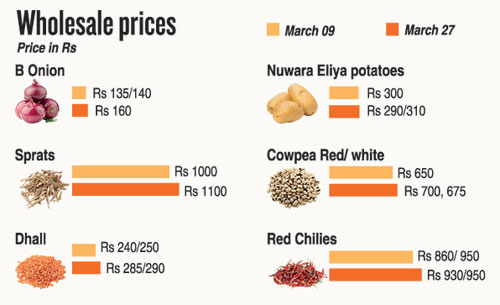
When compared with wholesale prices three weeks ago, overall, prices of most items have increased, with a notable rise in dhal, red onion, and sprats.
The average retail market prices show that dhal is being sold at around Rs. 350 per kilogram, while sprats have surpassed Rs. 1,300 in some areas in contrast to about Rs 270 and Rs 1,100, respectively, three weeks ago.
The Essential Food Commodities Importers and Traders Association and the Consumer Affairs Authority had mixed reactions on the price increases.
The Essential Food Commodities Importers and Traders Association said that due to the war in West Asia, intermediaries are artificially creating shortages.
There is no shortage of essential food items, and the rise in the retail price of lentils is a consequence of artificial scarcity created by intermediaries, the traders said.
“We have no stocks left. Everything we bring in is immediately distributed. Middlemen are responsible for this shortage. Dhal is imported from Australia. The stock brought in last September was sold, even at a loss. By the end of March, a new shipment of lentils will arrive. This time, there are only a few containers, about 25-35. Anyway, by the first week of April, dhal prices will drop to around Rs 265-Rs 270. There won’t be a significant increase,” the association’s secretary P. Subramaniam said.
He noted that even if there is an increase in oil prices during the Sinhala and Tamil New Year, commodity prices may rise by a maximum of Rs. 20.
“There will be no shortage of essential commodities. We are already supplying the required amount,” he said.
Consumer Affairs Authority Director Asela Bandara acknowledged that there is a temporary shortage in supply in the market. “People panic and buy everything because they fear there will be a shortage. We assure the public that there will be no difficulties during the festival. There is no need to panic over false information.’’
Trade, Commerce, Food Security, and Cooperative Development Minister Wasantha Samarasinghe told the Sunday Times that because there is no controlled price for dhal, strict interventions cannot be made regarding higher retail prices observed in some places. However, if unnecessary stockpiling or hoarding occurs, the Consumer Affairs Authority will act.
He also said that 90% of the stocks of essential commodities for the Sinhala and Tamil New Year have already been procured.
Additionally, relevant associations have informed the minister that prices of milk powder, flour, biscuits, ice cream, chocolate, and bakery products will not increase in the festival season.
During a visit to the Narahenpita Economic Centre, the prices at the Lanka Fisheries Corporation stall revealed that there was no significant rise over the week.
Sri Lanka Customs said there is no shortage of essential commodity imports. Media spokesperson Chandana Punchihewa told the Sunday Times that the daily customs revenue is around Rs 10 billion, and no significant variation in this revenue has been observed.
However, due to yard capacity constraints, there may be occasional delays in releasing incoming containers.
“The examination yard is small. In the past, 75-100 containers were checked at a time. Now this number is about 200. Food containers are released only after all certifications from the food inspector, SLAI, and plant quarantine are received. We are expanding yard capacity.”
The best way to say that you found the home of your dreams is by finding it on Hitad.lk. We have listings for apartments for sale or rent in Sri Lanka, no matter what locale you're looking for! Whether you live in Colombo, Galle, Kandy, Matara, Jaffna and more - we've got them all!