

News
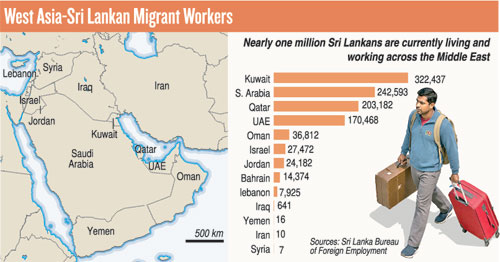
Only 250 of one million Sri Lankans in West Asia seek repatriation
View(s):- Economic fears and trust in local safety measures keep migrant workers in conflict zones despite tensions
By Ishu Bandara
Despite over one million Sri Lankans working in West Asia, only 200 to 250 have officially requested repatriation amid the regional conflict
According to official data as of March 25, the requests by country are as follows: Kuwait 178 (the highest in the region), Bahrain 28, Israel 13, the UAE 2, Iran 2 and Lebanon 1 request. Qatar has recorded a few requests, while no requests have been reported from Saudi Arabia, Oman, Jordan, or Palestine.
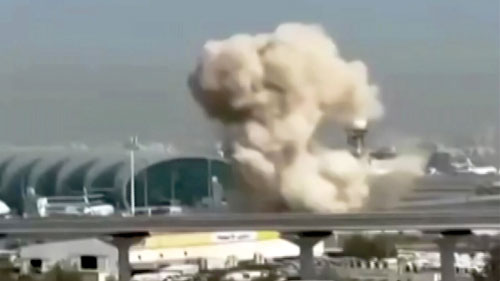
An Iranian drone attack on the Kuwait airport. The highest number of requests from Sri Lankan migrant workers to return to SL is from Kuwait (Pic Courtesy AFP)
The Sunday Times however has noted discrepancies between data provided by the Ministry of Foreign Affairs and the Sri Lanka Bureau of Foreign Employment (SLBFE) regarding the Sri Lankan population in West Asia. The reports cite conflicting totals of 1,014,437 and 1,050,609, with further inconsistencies appearing in country-specific breakdowns.
The Sunday Times learns that the main reason for the majority opting to stay on is the fear of losing their jobs if they return to Sri Lanka making it difficult to support their families. Many workers have also taken bank loans to go abroad and cannot run the risk of losing their income.
Some officials say that workers in places like Israel are used to the situation and follow precautions such as seeking safety cover in bunkers when necessary. In sectors like hospitality, where jobs are being reduced, some workers choose to stay on half salaries or wait for new job opportunities in other countries rather than return to Sri Lanka.
Piyumi Wellalage, who has been working in Jerusalem for more than two and a half years, told the Sunday Times that the country has faced many war conditions at different times. “However, what I want to highlight is that the ruling parties have managed the situation well without significantly affecting the people.
“After coming to this country, they treat us as the same as their own citizens. Laws, facilities, and infrastructure are well maintained for the benefit of everyone in the country, without discrimination between locals and migrants,” she said.
“Every resident in this country, whether a migrant or not, who has a mobile phone is automatically connected to the ‘Home Front Command App’. This is an official app that provides security updates to residents of Israel. It sends alerts, guidelines, and life-saving information in real time based on each person’s location.”
She also said safety rooms are available in almost every house. In many homes, washrooms are designed as safety rooms with high density walls, while some buildings also have underground shelters.
“ In each city, air defence systems such as the Iron Dome and Iron Beam are installed in specific locations. These systems intercept missiles and destroy drones and mortars. So we do not feel afraid at all. Some incidents have occurred where debris has fallen, but those have only caused minor injuries,” she said.

Piyumi Wellalage
Other migrants in Saudi Arabia and other countries in West Asia who did not wished to be named said they trust the authorities and continue to live with peace of mind despite the situation.
Commenting on standby measures to bring employees to Sri Lanka if the need arose, Thushara Rodrigo, Director General of the Public Diplomacy Division at the Foreign Ministry said: “The government is monitoring the situation through its 24/7 Emergency Response Unit. A hotline (1989) has also been set up by the Ministry. When the conflict first started, there were many inquiries, but now it has reduced to around 10 to 15 calls per day, mostly from family members in Sri Lanka asking about their relatives,” he said.
Mr. Rodrigo said most workers do not want to return home because they fear losing their jobs and believe it would be difficult to find new employment. He said the workers follow the instructions of their respective local governments and stay in safe areas.
“If an all out war occurs, the evacuation plan will involve categorising and prioritising people, including families with children, the chronically ill, pregnant women, and the elderly,” he said.
He emphasised that large scale transportation by sea, or ferries, is currently too risky due to security threats, leaving air travel as the only viable option though challenging. He also mentioned ongoing discussions on how to cover ticket costs.
When asked if there are any plans to support the high cost of air tickets, Mr. Rodrigo said, “providing ticket discounts using taxpayers’ money requires careful consideration, as it involves public funds.” “Sri Lanka is in constant contact with India, Bangladesh, and Pakistan to share experiences and coordinate evacuation preparations,” he further added.
As learnt by the Sunday Times, flight disruptions and high ticket prices resulting from the Middle East crisis are being addressed through alternative land routes, coordinated transit via third countries, and ongoing negotiations between the Sri Lankan government and recruitment agencies.
He said with airspaces in Bahrain, Iran, and Kuwait closed, and operations in Israel and the United Arab Emirates restricted or intermittent, the government and diplomatic missions in those countries are implementing several measures.
For countries with closed airspaces, land borders are being used as the primary alternative. Workers in Bahrain and Kuwait are being directed through the Saudi land border, while those in Iran have been moved by road to the Iran, Armenia border or through Turkey to access functioning airports. The Sri Lankan Mission in Israel has coordinated the departure of nationals via Egypt, working in coordination with the embassy in Cairo.
He further added, “Sri Lankan Airlines resumed direct flights to Saudi Arabia on March 9, to maintain a corridor for workers, even as many foreign airlines suspended operations in the region. Some regional airlines, such as Jazeera Airways, have established alternative air and land routes via Saudi Arabia to ensure the movement of people and goods despite disruptions.”
Speaking on how to reduce the impact of job losses in West Asia he said the government is exploring diversification of the labour force into countries with labour shortages, such as South Korea and Japan.
One of the other major impacts of the war situation is the sharp rise in air ticket prices, which has created a heavy burden for both workers and recruitment agencies.
Mohamed Farook Mohamed Arshad, Secretary of the Association of Licensed Foreign Employment Agencies (ALFEA) and Board Director of the Sri Lanka Bureau of Foreign Employment (SLBFE), told the Sunday Times that ALFEA held a meeting with Deputy Minister Arun Hemachandra on March 26 to discuss industry challenges. He said the government gave a positive response and promised support for the welfare of workers already in the Gulf and those planning to travel.
He said they requested air ticket discounts or concessions through SriLankan Airlines, as prices have increased significantly. They also asked for support such as reduced fees for family background checks and training for workers whose travel has been delayed.
“Hotel occupancy in the UAE has dropped to nearly 10% because tourists are avoiding the region. Employers are giving workers two options: either stay and receive half salary until the situation improves, or leave and return to their home country. Major projects in Saudi Arabia have also been stopped as a precaution,” he said.
However, he noted that Sri Lanka’s quota of workers may increase in the future, especially in Israel, because countries like Nepal, Thailand, and Vietnam have stopped sending workers or their citizens have left, while many Sri Lankan workers have chosen to stay.
He believed that migrant workers should “not panic,” stating that the government and recruitment agents are well prepared to assist them.
He also noted that life for many workers, especially domestic workers, remained as usual and they do not feel the intensity of the war as much as people observe from outside.
However, according to the Foreign Ministry, minor injuries have been reported among five workers in Israel, two in Qatar, and two in the UAE. One worker in the UAE was hospitalized with leg injuries following attacks on oil refineries. In Israel, 12 Sri Lankans had their accommodation damaged during an attack in the Dimona area on March 22, but they were not physically injured and were later moved to temporary housing provided by their employer.
One Sri Lankan crew member of the vessel MT Valiant Roar, who was held in Iranian custody, was released and sent to Armenia on March 26.
The Central Bank has noted an increase in remittances in March 2026, as workers are reportedly sending their savings back to Sri Lanka for safekeeping rather than keeping cash in unstable areas.
Sri Lanka recorded its highest ever annual foreign remittances in 2025, reaching $8.1 billion, which stands as an all-time record. In comparison, monthly inflows in 2026 were approximately $786 million in January and $700 million in February.
The government has set up several hotlines to help workers who may lose travel documents or funds. Workers can contact the Emergency Response Unit (ERU) through a hotline 1989, WhatsApp/Botim +94777390031, or email emergency.sl@mfa.gov.lk. Embassies have been instructed to assist those who lose passports or money, acting as a safe point for emergency travel documents.
Missions are also using community WhatsApp groups, temples, mosques, and churches to stay in contact with workers and provide real-time instructions from local authorities.
The best way to say that you found the home of your dreams is by finding it on Hitad.lk. We have listings for apartments for sale or rent in Sri Lanka, no matter what locale you're looking for! Whether you live in Colombo, Galle, Kandy, Matara, Jaffna and more - we've got them all!