


Milan Rathnayake — Sri Lanka’s possible missing link in victories
Modern limited-overs cricket is unforgiving to imbalance. Teams that enter global tournaments with a long tail or an overworked bowling unit rarely survive the business end. The importance of a genuine all-rounder is no longer a luxury but a necessity, particularly in a format where flexibility often outweighs flair. Sri Lanka’s victory against England in Colombo on Thursday underlined that truth yet again, and it also pointed clearly to what lies ahead.
Dunith Wellalage’s Player-of-the-Match performance was a timely reminder of how one cricketer can tilt a contest. His 25 not out off 12 balls lifted Sri Lanka to a competitive 271-6, while his two wickets helped choke England at critical moments in a tense 19-run win. On slow, spin-friendly surfaces in the subcontinent, Wellalage will remain central to Sri Lanka’s plans where control and batting depth will be priceless.
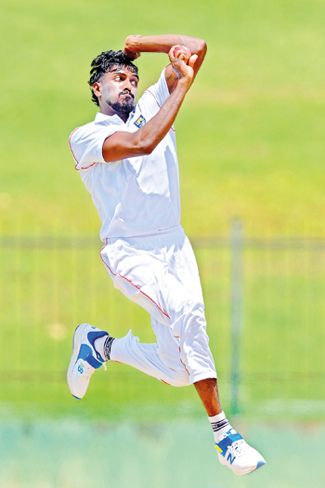 The next 50-over World Cup, however, presents a very different challenge. Played away from home in conditions that traditionally reward seam movement and bounce, Sri Lanka cannot afford to rely solely on spin-bowling all-rounders. That is where Milan Rathnayake enters the conversation, not as a stop-gap option, but as a cricketer who needs to be invested in early and consistently.
At 29, Rathnayake is not a rookie in the domestic sense, but he remains an international novice with just one ODI to his name. Yet the selectors have persisted with the right-arm medium pacer as the all-rounder Sri Lanka are searching for. In his debut Test against England, Rathnayake scored 72 with the bat and returned match figures of 2 for 97 from 25 overs.
What he offers is something Sri Lanka have struggled to develop since the latter stages of Angelo Mathews’ prime: a fast-bowling all-rounder who can lengthen the batting without weakening the attack. In overseas conditions, that skill set becomes invaluable.
Sri Lanka’s current ODI combination is heavily influenced by home conditions. Two specialist seamers are often deemed sufficient, with spin expected to shoulder the bulk of the overs. Batting depth is addressed by adding spin-bowling all-rounders, a model that works on slow pitches but quickly unravels when bowlers are required to hit the deck hard and batters are tested by lateral movement. Rathnayake offers an escape from that rigidity.
Charith Asalanka, the ODI captain, understands this better than most. Speaking at the start of the current ODI series, he made it clear that Sri Lanka must think beyond immediate results and prepare for the demands of a World Cup played on quicker surfaces.
“Milan Rathnayake brings a lot to the table and we need to give him a long run,” Asalanka said.
“If he can do a role for us like what Angelo Mathews did, that would be ideal for the team. We haven’t decided what composition we are going with. We used to play seven batters, but if we can tinker with that and look at a seam-bowling option, that would be great.”
That reference to Mathews is telling. At his peak, Mathews allowed Sri Lanka to play an extra batter or bowler depending on conditions, without compromising either discipline. His decline through injuries left a structural hole in Sri Lanka’s ODI set-up, one that has never truly been filled. Rathnayake may not replicate Mathews’ career numbers, but he does not need to. His value lies in balance rather than brilliance.
History supports this argument. Few World Cups have been won without meaningful all-round contributions. Sri Lanka’s own triumph in 1996 was similarly shaped by an all-rounder redefining his role. Sanath Jayasuriya’s aggressive opening batting changed the tempo of ODI cricket, while his left-arm spin delivered crucial breakthroughs, including three wickets in the semi-final against India. Though Aravinda de Silva owned the final, Jayasuriya’s 221 runs and six wickets embodied the disruptive power of a multi-dimensional cricketer.
Lance Klusener’s impact in 1999 remains the gold standard for the modern seam-bowling all-rounder. His unbeaten 31 off 16 balls in the semi-final against Australia came after a rare wicketless outing, yet his overall tournament returns were staggering: 281 runs at a strike rate well ahead of its time and 17 wickets, earning him the Man of the Tournament award.
The 2011 World Cup perhaps marked the last great flourish of the classical ODI all-rounder, with Yuvraj Singh’s 362 runs and 15 wickets, and Shahid Afridi’s 21 scalps, defining the tournament. Since then, the numbers tell a sobering story. Only Shakib Al Hasan has consistently matched elite standards with both bat and ball in the post-2011 era. Genuine seam-bowling all-rounders are even rarer, with only a handful, including Ben Stokes, Hardik Pandya, Cameron Green and Mitchell Marsh, offering teams the flexibility Sri Lanka now seek.
Sri Lanka need their own version of that buffer. Rathnayake may not yet be a finished product, but World Cups are not won by waiting for perfection. They are won by backing the right skill sets early enough for them to mature. With home conditions unlikely to demand his services immediately, the temptation will be to leave him on the bench. That would be a mistake.
“In seam conditions, we need a three-man pace attack and the third has to be a seam-bowling all-rounder. Rathnayake fits the bill very well. He is a good batter and we need to make sure that he gets the required experience to bowl his full ten overs in a match,” said Pramodya Wickremasinghe, Chairman of Selectors.
“But when playing at home, it is tough to go in with three fast bowlers. Away from home, we can do that, and we are looking to give him as many games as possible.”
Wickremasinghe said tours to the West Indies, England and Afghanistan ahead of the 2027 World Cup could expose Rathnayake to seam and bouncy wickets. If Sri Lanka are serious about competing away from home, Milan Rathnayake must be more than a squad player. He must be a project, a long-term investment and, potentially, the difference between a balanced side and one that falls just short when conditions stop being familiar.