


Rooted in history: A scholarly walk through our garden heritage
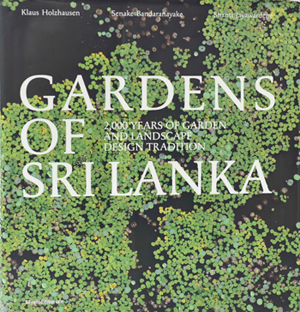
View(s):It was many years in the making but from this collaboration of three scholars – a landscape architect, an archaeologist and an architectural historian has emerged a work that presents the very distinct garden concepts that have been in evidence in this country from ancient times. ‘Gardens of Sri Lanka – 2,000 Years of Garden and Landscape Design Tradition’ is absorbingly, satisfyingly content-rich, leading the reader through a fascinating heritage of garden design – Sigiriya seen alongside the famed gardens of Europe such as Versailles in France and Tivoli in Italy or even Pasargadae of Cyrus the Great in Iran.
It was pre-eminent archaeologist Prof. Senake Bandaranayake’s meeting with German-Swiss landscape architect Klaus Holzhausen during one of the latter’s visits to Sri Lanka in the late 1990s and their shared interest that paved the uphill way to this book. Holzhausen’s work has been primarily in Switzerland where he has designed important public spaces. Architectural historian Dr. Shanti Jayewardene, best known for her authoritative work ‘Geoffrey Manning Bawa: Decolonizing Architecture’ came into the project at Prof. Bandaranayake’s invitation to initially contribute the chapter on Monastic Gardens and after his death in 2015, took on a far greater role. Prof. Bandaranayake’s wife Manel Fonseka played an invaluable part in seeing her husband’s chapters through and acknowledging the many who helped in different ways, Holzhausen refers to it as a truly Sri Lankan-Swiss collaboration.
 Holzhausen was unable to be present at the launch in Colombo last October at the Swiss Embassy and in her remarks Dr. Jayewardene reflected on how it was Prof. Bandaranayake’s vision that imagined this book which after a long gestation had finally been completed in his memory. “He used to tell me ‘Shanti, it will be a wonderful book’ so I hope it will take you to those wonderful worlds he dreamt of,” she said.
The book explores the thought behind the different forms –terrace gardens to rock-shelter monasteries, the urban landscapes of Kandy and encompasses more modern examples as the landmark works of Bawa.
Prof. Bandaranayake notes that Sri Lankan chronicles first written down in the narrative form were from between 3rd and 6th centuries CE and echo Buddhist canonical literature referring to royal and suburban public parks and groves donated by the Buddhist kings as sites for early monasteries. The same traditional ancestry as that of park or grove applied to the alternative monastery type – the ‘giri vihara’ or mountain monastery where on a rocky, boulder-strewn slope, rock shelters were fashioned from the rock face or massive boulders. The terrace garden sees a series of successive terraces on boulder strewn slopes. Amazingly, vestigial remains of such boulder and terrace gardens appear in the Sri Lankan archaeological record at hundreds of sites dating from the 3rd century BCE to the 1st century CE.
The World Heritage site of Sigiriya, is no doubt, the best known example of the country’s garden traditions. In Prof. Bandaranayake’s words, Sigiriya embodies “on a grand scale” three distinctly different but intermingled modes of garden design: boulder gardens, terrace gardens and water gardens, “representing almost the entire range of the vocabulary of Sri Lankan garden design”.
As in Anuradhapura, the Buddhist monasteries in Polonnaruwa also display the subtle combination of site selection, level changes, monumental and ancillary buildings, open garden spaces and hydraulics, all regular features of Sri Lankan architectural planning, this brought out in pioneering archaeologist Prof. Senerat Paranavitana’s research who also observed the combination of symmetry and asymmetry and ambitious scale of the work.
There was sadly, a lack of continuity in these grand traditions after Anuradhapura and Polonnaruwa and a dearth of archaeological research, but the ancient garden design is seen in sites such as Mulkirigala in the South and also in several Buddhist monasteries in the hinterland of Colombo, Galle (Yatagala) and Matara, these offering in Prof. Bandaranayake’s words “an opportunity to study in a living form archetypal Sri Lanka garden types that have lasted over centuries”.
Writing on ‘Royal Gardens’, Prof. Bandaranayake draws the reader into a different world – the Issarasamanaramavihara, the ancient monastic settlement in Anuradhapura dating back to the 3rd to 1st centuries BCE. In the ‘Ranmasu Uyana’, the only surviving remains of a pure walled garden, he describes design concepts of great beauty and intricacy, which await further study and exploration. The beginnings of garden archaeology in this country date back to the 1940s with the identification of the Ranmasu Uyana.
In the section on Monastic Gardens, Dr. Jayewardene and Holzhausen beautifully evoke the giant scale of the complexes such as Abahayagiri and Jetavana that were used for secular and religious ceremonies. “………..the vast terraces of Abhayagiri, for instance, accommodated around 30,000 people” and were sites for enacting grandiose spectacles that proclaimed the power of the state and the Sangha. This chapter looks too at the restrained design aesthetic that is seen in sites such as Rajagirilenkada, Mihintale, the rock temple at Dambulla, Kudumbigala in Yala, the Abhayagiri water gardens, Ritigala and Arankale.
How the British in particular, ‘exported’ their garden culture to the island to the detriment of the existing extensively forested lands as well as rice fields, medicinal groves, and royal and monastic gardens is tellingly portrayed in The Colonial Encounter by Dr. Jayewardene, Holzhausen and Gianni Biaggi de Blasys (who sponsored the book). Five main garden forms that emerged are identified: the botanic gardens and parks (notable examples being Peradeniya and Hakgala), the bungalows and gardens on the cinnamon and rubber estates; the bungalows and gardens in the hill country tea estates; school gardens and the sports or leisure grounds such as Galle Face Green.
The Peradeniya Garden design, that of Richmond Castle, the Roehampton Estate bungalow garden, the Uduvil School gardens all are given space in this section where the controversial Count de Mauny is also prominently featured for his neo-Palladian villa and ‘exquisite garden’ on his Weligama island Taprobane. The Atapattu Walawwa in Galle built during Dutch times which has retained its Sri Lankan essence also merits mention.
The section on Modern and Contemporary Gardens by Dr. Jayewardene, Holzhausen and Gianni Biaggi, has, of course, to begin with the Bawas, Geoffrey and Bevis and their signature creations – Lunuganga and Brief. Interestingly we learn that Bevis also was also responsible for the landscape design of the Sigiriya Village Hotel (the older part), the second part of the design being the work of Laki Senanayake more recognised for his art whom the authors recognise as a major contributor to contemporary garden design. Laki’s distinctive Dambulla home Diyabubula, is in their view, “a very convincing modern interpretation of the Sigiriya water garden”.
Included in this section is the Boulder Garden Hotel designed by architect Lallyn Collure where “the integrations of the subtle design interventions into the natural rock formations have been perfectly achieved. The entire complex is in keeping with the ancient Sri Lankan tradition yet distinctly modern”.
Amply illustrated, with extensive drone photography giving the reader a wide-ranging view of the design complexities detailed in the text, the coffee-table book will hopefully impel a younger generation of archaeologists and historians to further research and discovery, while prompting Sri Lankans to look with new eyes at the wonders hitherto taken for granted.
The book is available for online purchase.
| Book Facts | |
Senake Bandaranayake and Shanti Jayewardene
|
| Senake Bandaranayake Memorial Lecture | |
| Dr. Shanti Jayewardene will deliver the Prof. Senake Bandaranayake Memorial Lecture on ‘Gardens of Sri Lanka and Influences on Contemporary Design’ on Thursday, January 29 at 6 p.m. at the auditorium of the College of Surgeons Sri Lanka, No. 6, Independence Avenue, Colombo 7. The lecture is under the aegis of the National Trust of Sri Lanka and is open to all.
|
Searching for an ideal partner? Find your soul mate on Hitad.lk, Sri Lanka's favourite marriage proposals page. With Hitad.lk matrimonial advertisements you have access to thousands of ads from potential suitors who are looking for someone just like you.