


Revisiting Popham’s love letter to his beloved Dambulla arboretum
“Gas-Mahaththeya” he was fondly called by countless villagers around Dambulla, reflecting they saw more than an eccentric Englishman in this grand old man, who restored a barren land where, in Keats’s words, “The sedge (was) wither’d from the lake/ And no birds (sang)” into a sylvan forestland as of old…
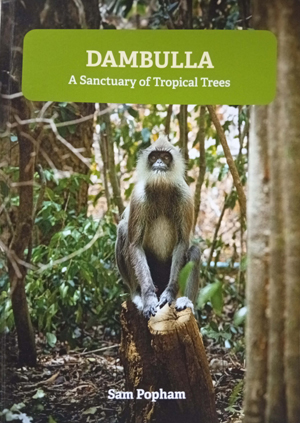
Dambulla: A Sanctuary of Tropical Trees, a slim book by the late Sam Popham about his life’s labour, the arboretum he so painstakingly rewilded, is now being relaunched in beautiful format. It tells the tale of the 36 acre ‘Popham’s Arboretum’ visited by many today. But it is also a text that explores, more with poetry than science, man’s timeless love for ‘green aisles’.
 In this slender volume you find, at the beginning and the end mostly, a Wordsworthian attempt to explain the strange allure of “the pathless woods, the lonely shore, the deep sea” that has always fascinated man.
Where does it begin?
For Popham, it began with the English countryside as a vicar’s son- “a wooded scene full of dells, spinneys and copses with streams flowing through cattle-sprinkled, tree-encircled meadows and scattered villages” to the Duke of Richmond’s park with “lime avenues and oak meadows” and later as a sailor, the “ancient olive groves in a Mediterranean island… date palms (in) shady oases in scorching deserts… Ceylon’s coconut fronded shores… thick jungle all around Trincomalee’s harbour…”
The last two chapters particularly analyse this call of the wilderness, and the book is interspersed with quotes from Milton to John Still (of Jungle Tide fame); William Hazlitt to Thoreau.
First published in 1993, the new edition now out has been given a wonderful facelift by wildlife photographer Penny Metal pervaded by the aura of the forest – dark, shadowy, green. You can almost hear the cicada-call turning the pages!
An old Etonian and graduate of Magdalene College Cambridge, Popham who died at 99 in 2022, was an ardent lover of trees and famously fell out with friend Geoffrey Bawa (who built the bungalow he lived in at the arboretum) over the building of the Kandalama Hotel – the bane of conservationists at the time.
Apart from being a love letter to trees, the book records the much under-appreciated labour of Popham in rewilding (a word that did not even exist at that time in the early 1960s) a stretch of dry jungle to its pristine glory: in his own words, ensure that “the descendants of the original dry jungle that grew all over our area… of the rock temple of Dambulla… have an abode of their own, within earshot of the sonorous boom of the temple davula (great drum) and hemmed by scenic mountain ranges of outstanding beauty…” He adds: “They have taken to this arboretum ardently, and their accomplishment supports Wordsworth’s claim that:
“Nature never did betray
The heart that loved her.””
It involved hard labour. Popham’s task was not to replant. Simply put he nursed the pristine forest back to life by identifying the natural seedlings of the great trees that once stood here (satinwood, Ceylon ebony and ironwood among others) and cutting back the ‘vicious’ weeds that killed those seeds. He also suppressed creepers but mostly “egged Nature on to call the tune; … left the trees to get on with the task”.
The book records with loving care the trees that grew in the arboretum and one detects some fondness even when Popham enumerates the “nasty” scrub-jungle species that thrive on soil denuded by destructive chena cultivation, his pet hate.
A true dendrophile (lover of trees) Popham dwells lovingly on timber, wood and the texture of his trees.
There is a chapter on the catastrophic cyclone of 1978, which put to test not only the strength of timber of each tree species (Popham compares their resilience) but also his own love for his arboretum (he had to travel two days in a Land Rover through jungle tracks to get there from upcountry where he was at the time of the cyclone). The book also has a “Requiem for a jungle défunte” (a tribute to the jungle that once covered the whole island so that “a monkey could cross from coast to coast without touching ground”) with nostalgic early 20th century vignettes by Leonard Woolf and also a chapter on soil.
The new edition comes replete with photos of the trees and some of the thousand creatures that call the arboretum home from pangolin and Green pit viper to slender loris, dwarf kingfisher and heli wandura. The editor of the new volume, Peter Popham (a distant relative of Sam) says the book is “full of the importance, and beauty, of the tropical forest – and a wonderful message of hope for our world today.”
Peter who arrived in the country Friday for the re-launch, remembers Sam as “funny, very determined, with a strong will –which was how he created the arboretum…
“He moved back to England about 25 years ago when he retired and I saw him many times (there). We talked about his arboretum and his happy years in Sri Lanka…
“I am very pleased to come to Sri Lanka. I understand the arboretum today is doing very well – with many visitors… I look forward to seeing it again in the next few days –- six years since the last time I came here…”
Sam Popham’s Dambulla: A Sanctuary of Tropical Trees priced at Rs. 1,850 is available at Barefoot Bookshop and Rohan’s Bookshop, Liberty Plaza.
Searching for an ideal partner? Find your soul mate on Hitad.lk, Sri Lanka's favourite marriage proposals page. With Hitad.lk matrimonial advertisements you have access to thousands of ads from potential suitors who are looking for someone just like you.