


Gal-ge: Forgotten shrine to Lanka’s guardian god
The visitor to Devundara (Dondra) inevitably visits the Vishnu Devale, the Buddhist vihara built by Parakramabahu VI and the lighthouse and the beach. Much less known is the granite structure called Gal-ge or Galgane. Located on a windswept high ground, this edifice however is the most intriguing of all given its true identity.
First discovered in 1914 by E. R. Ayrton, the building was declared an archaeological reserve in 1927.
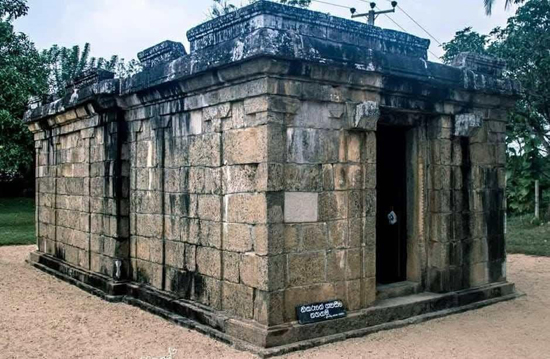
In a fascinating treatise published in 1953 which he called ‘The Shrine of Upulvan at Devundara’, the doyen of our archaeologists Prof. Senarat Paranavitana laid bare the secrets of the Gal-ge, a rectangular building 26 feet in length and 16 feet in width.
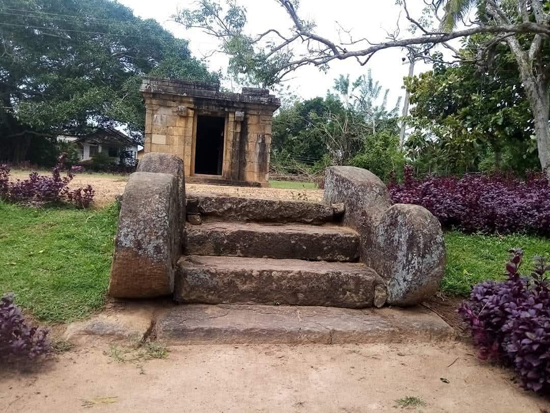
Isolated spot: Steps leading to the shrine, pictured below
Prior to Paranavitana, it was assumed that the current shrine to Vishnu had always been dedicated to that Hindu deity, ‘Upulvan’ being then assumed to be just another name for Vishnu. It was also taken for granted that the old shrine was built exactly on the same spot where the quaint blue shrine for Vishnu today stands. The identity of Gal-ge, set some 500 metres away from the main shrine, was thus a complete enigma.
In his book, Paranavitana was able to prove with characteristic brilliance that the shrine was originally dedicated not to Vishnu but Upulvan, who has been the guardian deity of Lanka ever since, according to legend, from the day Prince Vijaya landed on our shores and Sakra, the king of gods entrusted him (Upulvan) with the protection of Lanka.
The don also dispelled the idea that the name Upulvan meant the “one with skin like blue lotus” (Vishnu being blue-skinned), pointing out that the name recognised the deity as being none other than Varuna (Van or Vanna meaning Varuna), an old vedic god who travelled with the first Aryans to Lanka and who then was propitiated locally.
Paranavitana details in his volume how the identity of Upulvan could have been eclipsed by that of Vishnu centuries, nay millennia later; how the fledgling Vishnu shrine established there could have gained importance due to the many Indian traders who fraternised the area in the late medieval period and how, slowly, Vishnu replaced the local Upulvan.
He also points out how the original shrine to Upulvan was not located where the modern shrine stands.
The Shrine of Upulvan, before the fatal year 1587, was a magnificent edifice with buildings encrusted in gold and embedded with gems. 500 nautch girls danced for the god every day and the main statue of Upulvan was made of gold, with his eyes being two rubies whose glare, it is said, was so bright it caused ships to be wrecked.
A tale is told of how a goldsmith was employed to work on the statue so the glare of the rubies did not fall on the sea, and how consequently no goldsmith can reside within Devundara.
In February of 1587, the Portuguese destroyed this grand shrine completely, plundering the jewels and the valuables, building a church where the shrine was.
In his book, Paranavitana provides sufficient evidence to prove that the original shrine of Upulvan was built not where the current shrine stands but near the place where the Gal-ge is today.
The anonymous stone cabin is thus, according to Paranavitana, the sanctum sanctorum of the Upulvan shrine, the only structure of the original Upulvan devale that had been built of granite, the rest of the palatial buildings of brick and other less enduring material having succumbed to the Portuguese carnage.
Going back to the Seventh or Eighth Century, the building has South Indian touches mixed with ancient Sinhalese architecture.
The sad plight of this once resplendent holy of holies, today relegated to the backyard, is all the more striking as it stands on its anonymous spot in an isolated clearing…
Searching for an ideal partner? Find your soul mate on Hitad.lk, Sri Lanka's favourite marriage proposals page. With Hitad.lk matrimonial advertisements you have access to thousands of ads from potential suitors who are looking for someone just like you.