

Columns
- Govt. caught unawares; Herath rushes from Parliament to foreign office to answer phone call from Delhi
- Events during the visit show it is India in control, with an underprepared Sri Lankan side remaining largely silent
- Indian EAM’s trip preempts visit by a Chinese Communist Party delegation to Lanka
- Ruling NPP suffers setback in CMC budget vote; one-time allies accuse mayor of sidelining them from council affairs
By our Political Desk
The sudden phone call from India’s External Affairs Minister Dr S. Jaishankar last week saying he was coming to Sri Lanka as his Prime Minister Narendra Modi’s special envoy must have taken the Sri Lankan government by surprise. Foreign Minister Vijitha Herath was in Parliament, where the government was voting on additional funds for the recovery process from Cyclone Ditwah, when he was sent a note that his Indian counterpart was wanting to get through to him urgently. Minister Herath rushed back to his ministry to take the call to be told of the visit.
Confirmation of the Jaishankar visit to Sri Lanka came from the Indian side. The Indian External Affairs Ministry in New Delhi announced on Monday that its minister will visit Sri Lanka the next day. “The visit underscores India’s Neighbourhood First Policy,” it said. The Ministry of Foreign Affairs in Colombo was silent on the visit. The Sunday Times heard of the visit earlier and announced it last week (Dec. 21). President Anura Kumara Dissanayake’s movements, if any, had to be restricted for the visiting dignitary. He was coming not as Minister of External Affairs but as Modi’s special envoy, which gave him a higher status, protocol-wise. If there were other appointments already pencilled in, the diary had to be cleared.
It was no coincidence that the Indian VIP was arriving in the midst of a previously scheduled visit by a Chinese delegation. Thus, Dr Jaishankar, whose government wanted it known they were the ‘first (foreign) responder’ to the Ditwah disaster, and rightly so, made it to Colombo in an Indian private jet 24 hours before the Chinese delegation arrived.
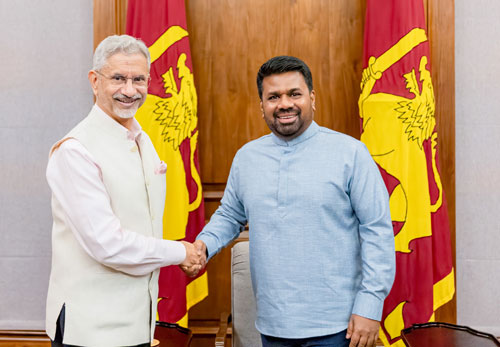
President Dissanayake greeting Indian External Affairs Minister S. Jaishankar ahead of bilateral talks at the Presidential Secretariat in Colombo on Tuesday
It was Deputy Tourism Minister Ruwan Ranasinghe who was rushed to Katunayake to greet Dr Jaishankar on arrival. Video clips showed the deputy minister walking behind the visiting VIP and the Indian High Commissioner after the welcome. Here too, an announcement came from Dr Jaishankar’s own X post. “Landed in Colombo this evening… Look forward to my meeting with Sri Lankan leadership tomorrow,” he tweeted. Still, there was no announcement from the Sri Lankan government.
On Wednesday (Dec. 23), Dr Jaishankar met President Dissanayake and handed him a letter from Prime Minister Modi. Again, it was Dr Jaishankar who tweeted, “Pleased to call on H.E. President @anuradissanayake in Colombo today. Conveyed Prime Minister @narendramodi’s warm wishes and message of solidarity in the aftermath of Cyclone Ditwah.” It went on to list the work his government had done under its ‘Operation Sagar Bandhu’ and announced a commitment of USD 450 million to Sri Lanka—of which USD 350m is on a credit line and USD 100m a grant. The fact that India was the ‘first responder’ was emphasised in the tweet, apart from mentioning “the building on our civilisation ties”.
He referred to the Indian Humanitarian Assistance and Disaster Relief (HADR) as a ‘glowing tribute’ to India’s military, humanitarian, medical material, logistical and technical prowess, promoting the country’s policy goal as a first responder and net security provider from a regional force to a global maritime vision.
The Indian minister in his post referred to Sri Lanka as its closest maritime neighbour.
Soon after meeting President Dissanayake, the Sri Lankan media was told there would be a “press statement’ by the visiting minister—again, the invitation came from the Indian High Commission in Colombo. But it was an invitation to attend by listening to the live coverage on YouTube from the comfort of their newsrooms—not in person. There was no invitation from either the Presidential Secretariat (where the statement was read out), the Foreign Ministry or the Media Ministry of the host government. The entire visit seemed to be orchestrated by the visitors. Not only was this unprecedented, but when the Indian minister came to the podium to read out his speech, there were clapping and cheers from inside the Sri Lankan Presidential Secretariat, which continued after he finished reading out the text.
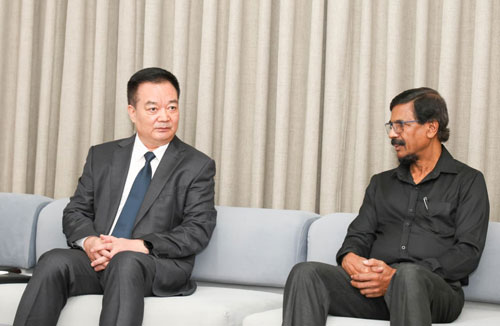
Chinese delegation chief Wang Junzheng in conversation with JVP General Secretary Tilvin Silva at the party's Pelawatte headquarters
The Indian High Commission was careful to say it was a ‘press statement’ that the minister read out. The Sri Lankan Foreign Ministry at last decided to say something on the visit and sent a “Statement to the Media” quoting the Foreign Minister Herath’s welcome address at the event. It was a ‘statement to the media’ read to it through YouTube in the presence of a largely Indian delegation.
Later in the day, the visiting special envoy met with Prime Minister Harini Amarasuriya, who was feted big-time in India only weeks ago, and Sri Lankan northern political leaders. The official photograph released shows the local leaders seated in a row listening attentively to the minister seated on the opposite side.
With its neighbourhood in crisis and the situation in Bangladesh worsening vis-à-vis India, and China seemingly making gains in the region, especially in the Indian Ocean, a constructive role in Sri Lanka, for the second time in recent years, enhances India’s global image as a stabilising force in the neighbourhood and an effective strategic and defence partner for external powers.
Dr S Jaishankar also took the time to meet Tamil political leaders from the North and the upcountry plantation sector that witnessed significant damage, including loss of lives, during Cyclone Ditwah.
The Tamil nationalist parties’ delegation, led by Ilankai Thamil Arasu Katchchi (ITAK) president C.V.K. Sivagnanam, reiterated India’s diplomatic push to ensure the government holds the much-delayed Provincial Council election at the earliest.
In addition to ITAK, representatives from the Eelam People’s Revolutionary Front (EPRLF), the People’s Liberation Organisation of Tamil Eelam (PLOTE), the Tamil Eelam Liberation Organisation (TELO) and the All Ceylon Tamil Congress (ACTC) took part in the meeting.
Collectively, they pointed out that India has a ‘moral duty’ to ensure PC polls were held on time, stressing that the ‘PC system’ was the brainchild of India, and later it was introduced into the country’s constitution through the 13th Amendment.
“We have pointed out the need to have the PC polls on time since most of the PCs’ terms expired over a decade ago. As a party that has secured successive mandates from Tamil people for power devolution based on a federal structure within an undivided country, we stressed India’s role in this,” ITAK President Sivagnanam said.
Chinese CCP delegation in Colombo
Hot on the heels of the visit by the Indian External Affairs Minister, a high-profile delegation from the People’s Republic of China led by Wang Junzheng, Member of the 20th Central Committee, Communist Party of China, and Secretary of the CPC Committee of the Xizang Autonomous Region, arrived in the country.
The Chinese delegates met with President Dissanayake at the Presidential Secretariat hours after Dr Jaishanker’s meeting. NPP sources were keen to stress that the Chinese visit was mainly to strengthen party-to-party ties, namely between the Chinese Communist Party (CCP) and the Janatha Vimukthi Peramuna (JVP), the main constituent party of the NPP.
The Chinese delegates told the President that China will collaborate with Sri Lanka to enhance the understanding and friendship that was established between the leaders of both nations during President Dissanayake’s official visit to China and will continue to support the ongoing projects in Sri Lanka and initiate new projects.
They also pledged additional support for Cyclone Ditwah recovery efforts, but there was no announcement of financial support by way of grants or loans.
The Chinese Embassy also hosted an event at the Colombo Shangri-La Hotel where the members of the Chinese delegation shared insights on China’s 15th Five-Year Plan (2026-2030). Among those in attendance at the event were former president Maithripala Sirisena and Opposition Leader Sajith Premadasa.
The Chinese delegates also met with the JVP General Secretary Tilvin Silva at the JVP headquarters at Pelawatta on Wednesday. The two sides discussed the long-standing friendship and cooperation between the Communist Party of China and the JVP.
The JVP General Secretary, who undertook an official visit to China in June, briefed the Chinese delegation on the history of the JVP, the current political situation in Sri Lanka, and cooperation activities in line with the Memorandum of Understanding signed during President Dissanayake’s official visit to China.
Both sides also exchanged views on the need for, and measures to, strengthen cooperation between the Communist Party of China and the JVP in the coming year.
CMC budget defeat
On the domestic political front, a string of recent budget defeats at local councils where the ruling NPP had secured razor-thin majorities would have given government leaders cause for concern that the budget of the all-important Colombo Municipal Council (CMC) could also be in trouble. Among some members of independent groups whose support has been crucial to securing the NPP a majority at the CMC, there had been grumblings and rumblings over the past few weeks that the ruling party had since been sidelining them in council affairs and that their views had not been considered seriously during the drafting of the 2026 budget. Tensions had also mounted during powerful standing committee meetings where it was alleged that the NPP was not giving heed to concerns raised by councillors from other parties and groups supporting the administration. The level of concern in the NPP hierarchy that things were not going well was apparent when President Dissanayake himself hosted a meeting for nine CMC members from smaller political parties and independent groups on December 19 in a last-minute attempt to address concerns raised by some of them.
Even President Dissanayake could not save the day for his party this time. When the final votes were tallied late on Monday (22) night, the CMC’s Budget 2026 had been defeated by a majority of three votes, with the final count being 60 to 57 in favour of the opposition. “You didn’t defeat the NPP budget; you defeated the budget of your conscience,” Mayor Vraie Cally Balthazar told those who had voted against the budget as they broke into applause after the final result was announced. She insisted that her party had reached out to all parties and groups over the past six months and intervened irrespective of party politics whenever any issue came up. “We know our administration is perfectly just,” she added.
Despite the brave face following the defeat, Ms Balthazar did not respond to a request for comment. Instead, in a message posted on her Facebook page on Tuesday, she said her administration presented a strong, people-focused budget to uplift the city. “Though shaped through a consultative process that included opposition input, it was voted down for political reasons rather than substance. The process now moves to a second reading, where amendments can still be submitted. My mandate as mayor remains unchanged. This budget will take effect in two weeks, and the work we set out to do will continue.”
The CMC’s budget is due to be presented for a second time next Wednesday (Dec. 31).
Mayor Balthazar had been elected via a controversial secret ballot at the CMC’s inaugural meeting on June 16, defeating the Samagi Jana Balawegaya’s (SJB) Riza Zarook, who had challenged her with the backing of several other parties and groups. The final vote following a highly charged secret ballot was 61 to 54 in favour of the NPP candidate. The SJB and several other parties who had formed a combined opposition had strongly protested the method of selecting heads of local councils via secret ballot, arguing that members should be allowed to choose the heads of their councils via an open vote. They had also argued that a secret ballot opened the vote up to bribery, with various perks and, in some cases, even cash being offered for councillors to switch sides. Nevertheless, as far as the CMC was concerned, Mr Zarook’s candidacy had also not been universally endorsed by all members of the combined opposition, with at least one United National Party (UNP) councillor writing to his party’s general secretary opposing his nomination for mayor.
Ms Balthazar’s election as mayor was a historic win for the NPP, which had won control of the CMC for the first time in history. It was also a personal triumph for President Dissanayake, who, in a highly unusual move by a head of state, had been actively involved in wooing members of smaller political parties and independent groups to support the NPP’s mayoral candidate. The President’s personal involvement underscored the importance both he and his party had placed on securing control of the CMC, where, though the NPP had emerged as the largest party with 48 members, it still lacked the 59 seats to secure an absolute majority in the 117-member council. As such, Monday’s defeat was not just a setback for the NPP in general but also a source of personal embarrassment for the President, who has been forced on multiple occasions over the past year to intervene to dig his government and party out of awkward situations of its own making.
CMC sources disclosed that since Ms Balthazar’s election as mayor, the 48-member NPP had received the support of 11 members from smaller political parties and independent groups, as well as a member from the UNP now functioning as an independent, giving them 60 seats in the council. The recognised political parties supporting the NPP are the United Peace Alliance (UPA), which has two members, and the Democratic National Alliance (DNA), which has one member. Aside from the dissident UNPer, who claims he acts as an independent member, other members are from four different independent groups, with one group having three members, two groups having two members each and one member being the sole representative of his independent group. During Monday’s vote, three among them joined an assortment of other parties and groups that included the SJB, the UNP, the People’s Alliance (PA), the Sri Lanka Podujana Peramuna (SLPP), the Sri Lanka Muslim Congress (SLMC), Sarvajana Balaya (SB) and the National Freedom Front (NFF) to defeat the NPP’s budget.
Those who had previously supported the NPP but switched sides on Monday were two members from Independent Group 05, which had contested under the ‘cricket bat’ symbol, and the lone member from Independent Group 02, which had contested under the ‘football’ symbol.
While Mayor Balthazar claims her party had reached out to all and that her administration is “perfectly just”, those who had voted to defeat her budget dispute this and claim their ‘No’ vote was designed to send a message to the mayor and the NPP.
Suranji Laksiri, leader of the independent group that contested under the ‘cricket bat’ symbol, said he and the other CMC member in his group voted against the budget over disappointment that some elements of the NPP within the CMC were going down the same “corrupt path” that it had accused former council administrations of taking. Mr Laksiri, who had earlier been the Colombo organiser of the SJB, said he decided to step away from the party and contest the CMC election independently earlier this year owing to a desire to forge his own political path. “I initially voted (for Mayor Balthazar) out of trust placed in President Dissanayake and as a sign of my respect for him. I campaigned on an anti-corruption platform, but unfortunately, there are signs that even some of the newly elected people, who had replaced the earlier group, are doing the same thing.”
Mr Laksiri said he had questions as to whether “thieves” at the CMC are being caught or if they are actually multiplying under the new administration. “Our ‘No’ vote was a message to tell them they should not become like the other lot (that they replaced). What they should do now is catch the wrongdoers from earlier and move forward.” He questioned why the NPP had not been more active towards cracking down on corruption at the CMC. “As things stand now, if the same things are still happening, there is no difference whether we stand with them (NPP) or the other lot (Opposition).”
He stressed he still had respect for both the CMC’s mayor and deputy mayor, “but it looks as if they are being forced to do nothing. That will not do. We supported the NPP to strengthen the President, not for various people to strengthen their own power and enrich themselves.”
Explaining his ‘No’ vote, Upali Weliwatta, Group Leader of the independent group that had contested under the ‘football’ symbol, said he voted against the budget because the NPP administration had failed to keep its promises over the past six months. “There was no sense of collaboration after the election of the mayor. The 48 members of the NPP ran the CMC administration arbitrarily and according to their own whims and fancies, disregarding the views of independent groups like us. In this situation, we didn’t want to stand by and let them continue to the next year as if we approve of all that has been happening,” he said.
He complained that though the NPP had invited independent groups such as his to submit their proposals for the budget, none of their proposals had been incorporated. “We waited for them to talk to us, but nothing happened until the last moment, when the President invited us for a meeting on December 19. At the meeting, the President gave instructions on how to implement our proposals, but those from the NPP argued against doing so. As such, I thought, if they are saying ‘no’ to the President himself, there is no further point in us continuing to support them.”
Mr Weliwatta said he believes President Dissanayake is intent on doing something different, but the question is whether those around him are as intent on enacting a system change as he is. He said the NPP had yet to reach out to him positively after Monday’s budget defeat and added, as things stand at present, he intends to vote against the budget when it is presented again on Wednesday.
For the main opposition, SJB, which has 29 members in the CMC, the budget’s defeat “reflects a reality that goes beyond politics,” said SJB Municipal Councillor Roy Bogahawatta, who has been a CMC member for 24 years. He pointed out that the budget was defeated when three members who had supported the NPP opted to vote against the budget. “The NPP administration in the CMC is a coalition. As such, it is incumbent on the NPP to invite these smaller parties and independent groups for the consultation process of the budget and give due consideration to their proposals. Some have complained they had not even been given a time to meet the mayor to raise their concerns. If even those who supported the NPP aren’t given that courtesy, if their proposals are not given consideration in the budget, and if the CMC administration is being run from Pelawatta (the JVP-NPP headquarters), do you really expect councillors to vote in favour of such a budget?”
He claimed those who voted to defeat the budget were being vilified on social media by “mudslinging groups” being operated by the NPP but insisted that blame for the budget defeat rested solely with the NPP itself. The opposition is fully aware that under the Municipal Council Ordinance, defeating the budget will have no impact on the CMC administration and that the mayor and deputy mayor can continue in their roles for two years, he pointed out. “Our message to the NPP administration is to listen to us at least now. You can’t continue disregarding everyone while being drunk on power.” He added that the opposition intends to also defeat the budget when it is presented a second time.
The government has attempted to play down the impact of the CMC’s budget defeat, pointing out that the budget will be presented a second time and that even if that is defeated, the council administration can continue for two years. There are, however, negotiations ongoing behind the scenes to avoid a second humiliation by persuading enough members to support the budget when it is presented on Wednesday.
The United Peace Alliance (UPA), with two members in the CMC, is one of the political parties that has continued to stand with the NPP and voted in support of the CMC’s budget on Monday. The party represents the interests of the Muslim community in Colombo. “After the election of the mayor via secret ballot, she invited all of us to come and help with the administration. We decided to accept that invitation. We were given chairperson positions in one or two standing committees, and we continued our work from there. We feel that you cannot judge an administration’s record in just six months. They need to be given more time,” argued Party General Secretary and Councillor Kaleelur Rahman. He said the UPA was not prepared to take decisions blindly, noting the budget’s defeat would not affect the NPP’s hold on the CMC either.
The budgets of a significant number of other NPP-controlled councils have been defeated over the past three weeks; some more than once. The budget of the Hikkaduwa Urban Council, for example, was defeated for the third time on Wednesday (24) by one vote, while the Peliyagoda Urban Council’s budget too was defeated by a single vote on the same day.
In the face of these embarrassing and demoralising defeats, the NPP members of some local councils whose budgets had been defeated once have allegedly resorted to what opposition parties claim are irregular and fraudulent methods to get these budgets passed. On Tuesday (23), opposition councillors at the Horana Urban Council, where the ruling NPP’s budget had already been defeated once, accused the NPP of adjusting the council hall’s clock ahead by five minutes to convene the meeting and pass the amended budget before councillors from other parties walked in.
Meanwhile, the passage of the budget of the Galle Municipal Council descended into chaos on Wednesday (24) when opposition councillors held a revote by preventing the council’s secretary from leaving the hall after disputing the earlier result.
When the budget was first presented to the Galle MC on December 15, it had been defeated by a majority of two votes. When the votes were first tallied on Wednesday, though, the count was 21 votes in favour of the budget and 15 against. Amid protests from opposition members, Mayor Sunil Gamage then adjourned the council meeting and left the chamber after announcing that the budget had been passed by a majority vote. Furious opposition councillors then rushed to prevent the council secretary from leaving with him. What followed were ugly scenes witnessed in full view of the media as opposition councillors manhandled the secretary and, despite the efforts of both the police and council officials, forced her back into her seat. Opposition members then held a revote, with one of their own in the mayor’s chair. The final tally this time was 17 votes against the budget, with 19 members listed as absent. The opposition then declared that the budget had failed to pass. They argued that their result should be treated as official, as it was the one that the secretary had placed her signature on. Mayor Gamage, however, argued that the budget was duly passed and condemned opposition parties for taking the council’s secretary “hostage” and said they have already lodged a police complaint over the matter. It is still not clear which result is going to be treated as official, and the matter is under legal review.
Nothing drastic is going to happen in any of the local councils, including the CMC, where budgets for the next year have been defeated, said Manjula Gajanayake, Executive Director of the Institute for Democratic Reforms and Electoral Studies (IRES). He noted the situation is the same for municipal and urban councils as well as pradeshiya sabhas. “Normally, at the local government level, a defeat of a budget is not considered a big issue.”
In 2014, the then United People’s Freedom Alliance (UPFA) amended the Local Authorities Act, allowing local council administrations to continue for the first two years despite the defeat of their budgets. As such, heads of institutions appointed in Colombo and elsewhere can continue to operate and move forward without interruption until December 2027.
Nevertheless, having so many ‘hung’ councils where parties and groups have been forced to rely on others to form administrations reflects an underlying problem where laws designed for one electoral system are being applied for a different system, Mr Gajanayake noted. The legal provision introduced by the UPFA in 2014 was originally designed for a proportional representation (PR) system, but it is now being applied to a mixed-member proportional representation system (MMP). “The same law is being used for two incompatible electoral systems. In local government elections prior to 2018, even when two political parties received the same number of votes, one would often gain two bonus seats.
In many areas, because of the PR system, these two bonus seats allowed one party to achieve a clear victory. However, under an MMP system, the total number of seats held by different groups often equals or exceeds the number of members in the ruling party.” As such, he opined that the solution would be to repeal the provisions related to the budget process under the Local Authorities (Special Provisions) Act, No. 21 of 2012, as amended by the UPFA. Repealing the amendments would allow the local councils, under whatever party, to continue with their full four-year term.
No Auditor General yet
Away from the limelight of hosting foreign visitors and the drama of budget defeats, the delay in nominating a suitable candidate for the post of Auditor General by President Dissanayake continued to draw concerns from different quarters this week.
The Bar Association of Sri Lanka (BASL) wrote to the President on Tuesday expressing its deep concern regarding the prolonged failure to appoint a permanent Auditor General following the retirement of the former Auditor General in April 2025.
The BASL said the urgency of this appointment is heightened by the present circumstances, as Sri Lanka is emerging from a financial crisis with the support of the Extended Fund Facility of the International Monetary Fund and other international agencies.
In addition, the country is currently receiving foreign financial assistance in response to the disaster situation caused by Cyclone Ditwah. In this context, financial accountability and transparency of state institutions are of paramount importance.
The BASL also noted that the person nominated thus far by the President for the post of Auditor General has not gained the acceptance of the majority of the Constitutional Council. “It is therefore imperative that a candidate of proven competence, integrity, and independence – who commands wide acceptance within the Constitutional Council – is appointed, rather than a partisan figure,” the BASL letter said.
SJB MP Harsha de Silva, who chairs the Committee on Public Finance (CoPF), also wrote to the President this week expressing serious concern over the failure to appoint a permanent AG, warning that the absence of this constitutionally mandated position is undermining parliamentary oversight of public finances.
In his letter, Dr de Silva pointed out that the post has remained vacant since December 7, following the conclusion of the tenure of the Acting Auditor General on December 6, leaving the country without either a substantive or acting Auditor General.
As such, the Audit Service Commission is unable to function due to the lack of a chairman, creating what he described as a critical institutional gap at a time of heightened fiscal vulnerability.
SLPP General Secretary Sagara Kariawasam says there were many sensitive audit reports due, including the one on the release of over 300 containers from the Colombo Port, and alleged that the government is dragging the AG appointment till January, when the term of the three civil society members on the Constitutional Councils comes to an end. “Once the new appointments are made, the government will have a majority and will be able to have any nominee of their choice approved by the Constitutional Council,” he said.
The failure by the President to nominate someone from the Audit Service to the top post has led to allegations questioning the government’s motives and its commitment to accountability and transparency.
Buying or selling electronics has never been easier with the help of Hitad.lk! We, at Hitad.lk, hear your needs and endeavour to provide you with the perfect listings of electronics; because we have listings for nearly anything! Search for your favourite electronic items for sale on Hitad.lk today!
Jaishankar’s Lanka visit on short notice as Modi’s special envoy underscores powerful geopolitical message
View(s):