

Columns
Bitter end to a year of economic stabilisation and growth
View(s):There could not have been a more cruel and devastating end to this year of financial stabilisation and economic growth than the devastation and destruction caused by Cyclone Ditwah on November 29.
The catastrophe tends to make one describe this year too as another annus horribilis (a horrible year). In fact, it was a year of economic stability and growth until Ditwah struck.
Economic growth
In reality, 2025 was a year of economic stabilisation, growth and hope for the foundation for further growth and development.
The economy was on a growth trajectory of over 5 per cent when the unexpected Ditwah disaster devastated 21 of the country’s 25 districts.
Extensive damage
The damage and destruction caused by Cyclone Ditwah was more extensive than the 2004 tsunami that devastated Sri Lanka’s coastal belt and killed more than 35,000 people. In contrast, Cyclone Ditwah devastated most parts of the country.
The economy that grew by 4 per cent in the first quarter of this year grew by 4.9 per cent in the second quarter and by 5.4 per cent in the third quarter. In spite of the destruction and devastation by the cyclone, the economy is likely to have grown by about 5 per cent in 2025. The enormous negative impact at the end of the year will not be captured adequately by the growth statistic for the year. Although this year’s GDP is likely to be around 5 per cent, the economic impact and consequences of the cyclone are horrendous.
Widespread destruction
The extensive devastation caused by floods and landslides is more widespread than the ravages of the tsunami 21 years ago that struck only the coastal areas. This cyclone has set back agricultural production, industries and services in many regions of the country. Its impact will be serious in 2026.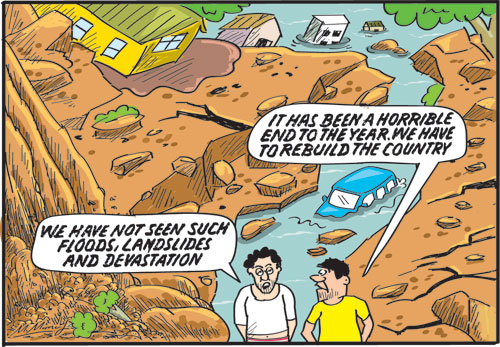
Losses
The loss of human lives, dwellings and belongings is immeasurable. Over 600 lives have been lost, thousands of houses destroyed, and roads, rail tracks and bridges damaged. Fortuitously, irrigation facilities have not suffered much damage, and the southern areas of the country have not been adversely affected.
Economy
This year is ending not as a year of economic stability and growth, as it was in the first 11 months, but as a year of destruction, despair and sorrow. In 2004, we described the year as ‘annus horribilis’. The end of both years has been miserable.
Just as we rose from the tsunami disaster, we have to rise from this severe human tragedy and economic setback.
Nation building
The enormity of the task of rebuilding Sri Lanka is such that we cannot do it by ourselves alone. The World Bank has estimated the destruction at a massive US$4 billion. Substantial foreign assistance is mandatory.
Enormous assistance
The foreign assistance we received from international organisations and a large number of countries in funds, personnel, aircraft and equipment was enormous and beyond expectations. However, as the UNDP Representative in Colombo pointed out, much more is needed. Will the international community respond?
Economists appeal
Meanwhile, 120 eminent economists, including Nobel Prize laureate Professor Joseph Stiglitz, have called upon the international community to assist Sri Lanka. The group of 120 top economists has called upon the international community and financial institutions to suspend Sri Lanka’s debt repayment. This would be a huge relief on our external finances.
Relief
The country’s debt repayment obligations, coupled with the weakening of the country’s balance of payments due to adverse impacts on the country’s exports, necessitate financial assistance. International financial assistance is vital not only for the reconstruction of the country but also for the stability and revival of the economy. As the UNDP Resident Representative in Colombo said in no uncertain terms, the country requires international financial assistance to stabilise the economy.
The government must be aware of the need for financial assistance. It should take steps to convene an aid consortium under the chair or co-chair of friendly countries or international organisations. There can be no doubt that the reconstruction of the country requires substantial foreign assistance.
Summary and conclusion
This year’s end is a bitter one owing to the destruction by Cyclone Ditwah. However, it was a year of economic growth and improved performance and a year of economic expectations. The economy was on a growth trajectory of a little over 5 per cent when the huge disaster of a cyclone hit the country. The devastation was more extensive than the tsunami of 2004.
This year is ending not as a year of economic stability and growth, as it was in the first 11 months, but as a year of destruction and one when a high proportion of people are in despair and sorrow. As in 2004 when we rose from that mammoth disaster, we have to rise from this. Hopefully we will receive international assistance to rebuild the nation and overcome our external debt repayments.
Buying or selling electronics has never been easier with the help of Hitad.lk! We, at Hitad.lk, hear your needs and endeavour to provide you with the perfect listings of electronics; because we have listings for nearly anything! Search for your favourite electronic items for sale on Hitad.lk today!
Leave a Reply
Post Comment