


Reinstated Chief Selector revs up cut short plans, with total accountability
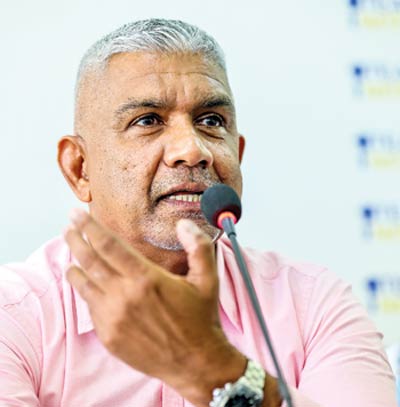 Wickremasinghe’s first tenure from 2021 to 2023 was defined by one word: risk. He dismantled the comfort of experience and accelerated a youth policy that exposed a generation of players to international cricket before they were fully ready. The results were painful.
Sri Lanka won only two matches at the 2023 Cricket World Cup, failed to reach the knockout stage and, most damagingly, missed out on the Champions Trophy for the first time in their history. Wickremasinghe paid the price.
Yet he insists that what looked like failure was, in reality, investment. “Although I was criticised, I took the risk of bringing in young blood into the national team at the expense of seniors,” he said in Colombo at his first appearance as Chief Selector, flagged by his fellow selectors Indika de Saram, Vinothen John, Tharanga Paranavithana and Rasanjali de Alwis.
“Although we lost, I saw with my own eyes the development of the team, but it would take time.”
Time, he argues, has now done its work. The players who were once dismissed as raw and undercooked are no longer novices.
“We had a youth policy in 2023. We got a lot of young players at that time. They were not an experienced side. Now it’s the same side and they have collectively played over 1000 matches,” Wickremasinghe pointed out.
Pathum Nissanka, once the symbol of an experiment, now has close to 100 international games and is widely regarded as Sri Lanka’s most reliable batter. This shift in context explains Wickremasinghe’s calm approach to his second stint. There is no appetite for upheaval. That is why he has chosen to retain the preliminary T20 World Cup squad selected by the previous committee led by Upul Tharanga.
“For now we’ve got to continue with what the previous committee was doing. They had been following a plan. If I were to come in and change a lot of things, that would not be ideal,” he said.
The same thinking underpins the decision to keep Dasun Shanaka as T20 captain until the end of the World Cup, following consultations with Head Coach Sanath Jayasuriya and High Performance head Jerome Jayaratne.
But beyond the immediate tournament, Wickremasinghe’s approach hardens significantly. This time, selection will not end with naming squads.
“Selectors select the team and when they win, someone else takes the credit and when you lose the blame is directed at us,” he said.
The solution is shared responsibility. Coaches, trainers and the High Performance Centre will now be accountable stakeholders, working to clearly defined KPIs. After the T20 World Cup, a core group for the next World Cup cycle will be handed to the coaching staff with specific performance targets. Fitness benchmarks, strike rate improvements and role clarity will no longer be vague aspirations.
“If they don’t achieve those targets, we will hold them responsible. It’s their job to push the players,” Wickremasinghe said, a statement that quietly challenges a culture where accountability often dissolves into excuses.
The most ambitious element of Wickremasinghe’s vision lies at youth level. His plan is to identify around 45 of the best Under-19 players and subject them to a comprehensive, long-term development programme. This would include not only cricket skills but education in English, IT, cricket laws, coaching qualifications, biomedical analysis and even management skills. The idea is to produce cricketers who are adaptable, informed and secure beyond the field.
“In T20 cricket you need young blood, not players you have to hide,” Wickremasinghe said.
“If we can produce three or four world class players, we will definitely start winning.”
For all the talk of long-term vision, Wickremasinghe is clear about the immediate challenge.
“Our short-term goal is the T20 World Cup. We have only six matches to find our best 15 or 16 players. We will take full responsibility if the team fails,” he said.