


Colomboscope 2026: Await varied explorations of rhythm
When Colomboscope 2026, takes place from January 21 to 31, 2026, the annual arts festival will bring together a diverse constellation of more than 50 artists whose practices traverse geographies and disciplines. They will all be responding to this edition’s theme of Rhythm Alliances with works that probe memory, rhythm, and the shifting relationships between the material and the metaphysical.
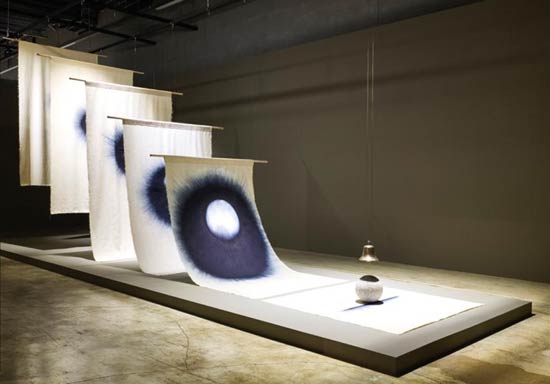
Indigo installation: Kaimurai's work also seen in picture below
Within this expansive lineup, artists explore a range of topics, from embodied rituals to ecological transformations, memory, sound, and spiritual lineages. Among these varied and compelling voices are Gayan Hemarathne and Kaimurai (Abishek Ganesh J), two artists whose meditative processes and deep engagement with ancestral knowledge offer distinct yet resonant interpretations of the festival’s theme.
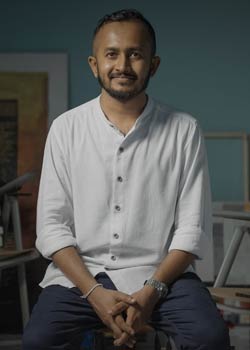
Gayan Hemarathne: Drawing on Buddhist philosophy
For Sri Lankan artist Gayan Hemarathne, the path to art was neither linear nor conventional. A self-taught painter who grew up in Anuradhapura, surrounded by ruins, stupas and centuries-old inscriptions, Gayan’s journey weaves together engineering, archaeology, Buddhist philosophy, and a lifelong, quietly persistent urge to create. An engineer by profession, he honed his artistic practice while enrolling at the Postgraduate Institute of Archaeology at the University of Kelaniya, driven by his connection to his hometown and its abundant historical sites.
“Growing up in Anuradhapura, I was surrounded by archaeology,” he explains. “During my studies, I felt I could draw some of these ideas, so I started again with canvas. That is how everything came together.” This dual foundation of engineering and archaeology created a methodical yet intuitive practice rooted in material experimentation and historical research.
Today, that early instinct has matured into a unique visual language built through stitching, cutting, and layering canvas; reinterpreting archaeological data; and translating Buddhist verses into tactile, meditative artworks. He has also developed a unique Sinhala font inspired by ancient inscriptions, which he stitches directly onto canvas. Many works incorporate Pali verses, protective Buddhist gathas, or philosophical concepts derived from his studies.
His first solo exhibition, “Magga” (Path to Enlightenment), held at Curado Art Space in May 2024, brought these strands together. The show explored Buddhist teachings through archaeological motifs, mathematical order, and the presence of stitched scripture.
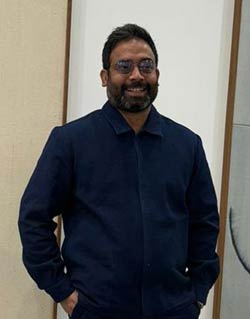
Abishek - Kaimurai: Method of hand
For Rhythm Alliances, Gayan’s contribution centres on the Buddhist concept of renunciation, known as Abhinishkramana, the spiritual departure from worldly life in pursuit of enlightenment. His installation includes both sculptural and painted works, extending his stitched-canvas technique into three-dimensional form. The pieces draw on monastic robes, ritual texts, archaeological data from the Buddhist tradition, and the ethical misinterpretations of Buddhism in contemporary society.
He expresses concern that many people today invoke Buddhism superficially or even politically, without understanding its true meaning. “Most people use Buddhism wrongly,” he says. “We have pure Buddhism and pure teachings, but they are not taken correctly.” In a contemporary landscape, where religious symbolism is often misused or misunderstood, Gayan offers a rare alternative: sincerity and a deep respect for the traditions he draws from.
Bengaluru-based artist Abishek Ganesh Jayashree, known by his artistic identity Kaimurai, considers creation to be less an act of intention than it is an act of surrender. His practice, shaped by organic forms, ancient South Indian ritual, temple architecture, Carnatic music, and the spectral landscapes of the Western Ghats, emerges from a place where the physical and metaphysical meet.
 Unlike many of his contemporaries, Abishek did not enter the art world through the gates of an art school. He trained at the National Institute of Fashion Technology and spent 15 years in the apparel industry, working across design and textiles. But along the way, a material began to call him back to something older in himself: natural indigo.
His curiosity about the pigment—its process, its history, its misrepresentation in the denim industry—led him to farms, to artisans, and eventually, back to a childhood expression he had abandoned. “Before design school, even before college, I would draw these lines—just lines—without knowing what they meant,” he recalls. “When I started working with indigo, those memories resurfaced. It all came together.”
His process is intensely meditative, where the hand leads and the mind follows. “My hands take control over my mind,” says Abishek. “It feels like I’m not present. The hands just do the work,” he says. It is from this intuitive, almost ritualistic method that he adopted the name Kaimurai, meaning “method of hand”. The name pays homage not only to his own process but to the many invisible hands behind the materials he uses.
For Colomboscope, Abishek turns to one of Carnatic music’s most well-known lullaby ragas, Neelambari. It is a raga traditionally associated with soothing, sleep, and transition—states of suspension that echo deeply with the artist’s own process. He also draws inspiration from the soft, rhythmic tapping gesture mothers use to lull a child to sleep, a gesture that appears again in Carnatic rhythm as tala.
At the centre of the installation is an abstracted totil (traditional fabric cradle), rendered in indigo lines. Beneath it sits a mundu, a clay pot used in the Hindu funerary ritual to collect cremation ash. These form the conceptual undercurrent of the piece: a setting from an “imagined memory”, a space suspended between beginnings and endings. “It’s about the cycle of birth and death,” he says. “When we are born, the mother puts us to sleep. When we die, people try to wake us up.”
Each of his exhibitions, whether at Art Dubai, Bikaner House, or now Colomboscope, is an attempt at creating a temporary sacred space—a totem of memory, a ritual constructed through indigo, repetition, and sound. It is a space where the viewer is invited not to understand, but to feel.
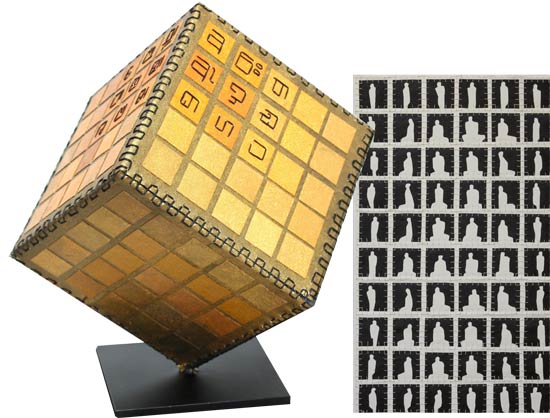
Gayan's works incorporating unique Sinhala fonts and stitching techniques
At Colomboscope 2026, the works of Gayan and Abishek as Kaimurai exemplify the festival’s spirit: art as reflection, ritual and resonance. Though their materials, techniques, and visual languages differ, both cultivate deep attention, drawing from the innate and the rhythms of their respective traditions to create contemplative spaces where viewers can pause, sense, and reflect. Their art reminds us that contemporary practice can still honour both the tangible and the unseen threads of human experience.
Searching for an ideal partner? Find your soul mate on Hitad.lk, Sri Lanka's favourite marriage proposals page. With Hitad.lk matrimonial advertisements you have access to thousands of ads from potential suitors who are looking for someone just like you.