

Columns
- Requests UN chief for relief assistance, meets top US official and says “with the help of friends like the US, we will rebuild our infrastructure and livelihoods”
- In a wide-ranging interview with Newsweek, Dissanayake highlights Sri Lanka’s climate vulnerability and says his government will not play balancing acts with friendly countries
- Senior Chinese government official is due in Lanka soon; FM Herath holds bilateral talks with another visiting dignitary from China
- Ranil warns of food security crisis; opposition parties undertake separate disaster relief work; Govt. denies NPP interference in disaster relief
By our Political Desk
In the wake of the widespread destruction caused by Cyclone Ditwah, the country has had to depend heavily on the generosity and goodwill of its friends and partners in the international community. While India was the first to step in to provide much-needed assistance for the rescue and recovery work in areas devastated by the floods and landslides, China, the United States, Pakistan, Russia, and the United Arab Emirates (UAE) were among others that rushed to Sri Lanka’s help.
President Anura Kumara Dissanayake personally took on the role of coordinating the relief efforts with the international community, taking and making calls to brief them on the situation in the country. President Dissanayake also wrote to United Nations Secretary-General António Guterres, asking for assistance. In response the UNSG had pledged all possible assistance from the world body and its affiliated agencies. Soon after, the UN also announced this week that it has allocated US$4.5 million (LKR 1.38 billion) from the Central Emergency Response Fund (CERF) to strengthen Sri Lanka’s response to Cyclone Ditwah. In addition to this, the UN launched its Humanitarian Priorities Plan to support Sri Lanka’s efforts to provide immediate life-saving assistance and restore normalcy to the lives of people affected by the disaster. Under this effect, the UN, along with local and international partners, is seeking to mobilise US$35 million in the next four months to provide immediate life-saving assistance, UN Resident Coordinator in Sri Lanka Marc-André Franche said.
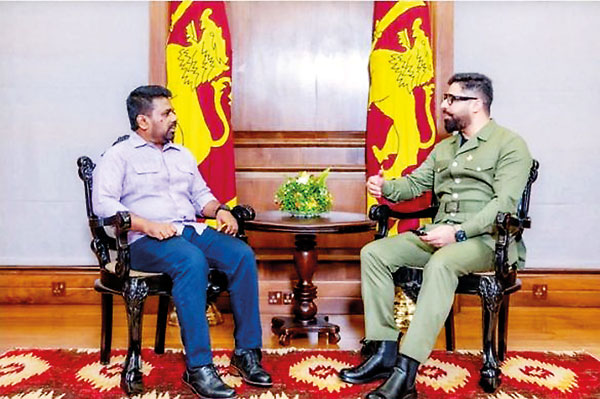
President Dissanayake taking part in the interview with Newsweek magazine
President meets US Under Secretary of State
In addition to the telephone calls, the President welcomed the US Under Secretary of State for Political Affairs, Allison Hooker, who called on him to discuss ‘a wide range of bilateral issues, focused on deepening economic and commercial ties, strengthening defence cooperation, and supporting Sri Lanka’s economic and maritime sovereignty’.
“Grateful for the strong support from the United States, expressed yesterday (December 11) by Under Secretary Allison Hooker. Sri Lanka faces a complex recovery, but with the help of friends like the U.S., we will rebuild our infrastructure and livelihoods,” the President said on his official X handle. In a separate tweet, the President expressed his deepest gratitude to the US and President Donald Trump for standing with Sri Lanka at a time of need. “The swift C-130 deployments and immediate $2 million emergency assistance reflect the strength of our enduring partnership, firmly rooted in shared democratic values and close ties between our people,” the President said.
The US rushed two of its C-130J Super Hercules aircraft and personnel from the US Air Force 36th Contingency Response Group (CRG) to provide American airlift capability in support of the cyclone response. The US troops who came to Sri Lanka were those operating out of Guam and other units, as well as the US Air Force’s 374th Airlift Wing (Yokota Air Base, Japan) and the US Marine Corps’ III Marine Expeditionary Force (Okinawa, Japan).
The US Under Secretary of State also visited the Sri Lanka Air Force Base in Katunayake to thank the US Air Force personnel involved in relief and rescue efforts in Sri Lanka.
The US assistance comes less than a month after the United States and Sri Lanka signed a memorandum of understanding formalising the defence partnership between the Montana National Guard, the US Coast Guard District 13, and the Sri Lanka Armed Forces under the Department of War’s State Partnership Programme (SPP). Military and civil disaster readiness and response and military-civilian coordination for disaster preparedness, response, and recovery are part of the agreement. Deputy Defence Minister Major General Aruna Jayasekara (Retd) was expected to table the full text of the US-Lanka MoU in Parliament last month, but it was not done even though the first series of joint activities under this MoU is planned for the summer of 2026. The activities will focus on disaster response, maritime domain awareness, and professional military education.
India continued its response to Sri Lanka’s situation this week, with more than 1,000 tonnes of humanitarian aid reaching the country under Operation Sagar Bandhu. In a major public relations exercise on behalf of his country, India’s High Commissioner Santosh Jha too has been keeping busy visiting the cyclone-hit areas and calling on the prelates of the Malwatta and Asgiriya chapters to apprise them of India’s support in the aftermath of the cyclone.
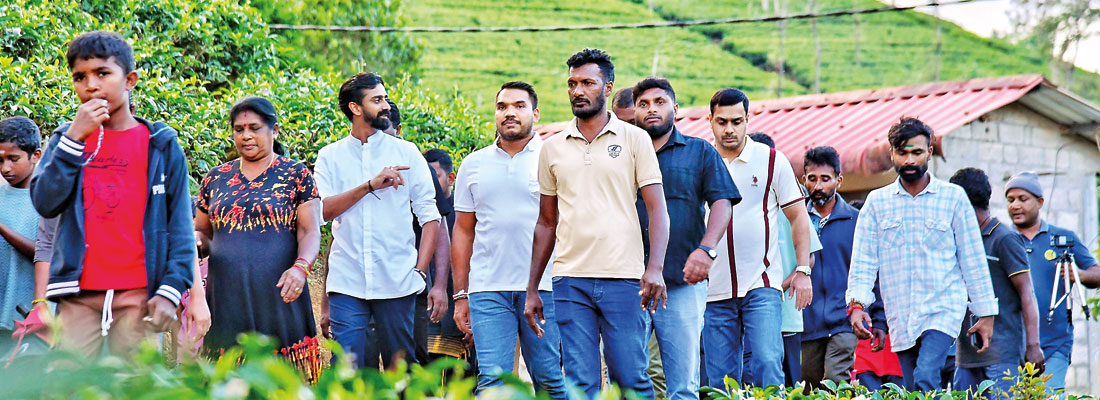
SLPP National Organiser Namal Rajapaksa accompanied by UNP parliamentarian and CWC stalwart Jeevan Thondaman visiting estates that were affected by the Ditwah disaster
Top Chinese official due to visit Lanka soon
China may have been a little late to join India and the US, but a planned high-profile visit by a senior Chinese Communist Party (CCP) official next week will underscore the importance China attaches to its relations with Sri Lanka. Significantly, it comes days after US Under Secretary Allison Hooker’s visit to Colombo.
Zhao Leji, Chairman of the Standing Committee of the National People’s Congress of China and the third-highest-ranking official in the Chinese government, will arrive in Colombo on December 23 for a two-day visit. He will meet with President Dissanayake and other government officials. Foreign Minister Vijitha Herath said that while matters connected to the cyclone will be discussed, there will be broader discussions on future Chinese aid for the country and strengthening of bilateral relations.
This week, Minister Herath also welcomed Yang Wanming, President of the Chinese People’s Association for Friendship with Foreign Countries. They discussed enhancing the longstanding and cordial bilateral relations between Sri Lanka and China. After the meeting, in an X post, Minister Herath referred to China’s “steadfast and invaluable support” extended to Sri Lanka in the aftermath of Cyclone Ditwah.
Among other foreign dignitaries visiting the country following Cyclone Ditwah was Pakistan’s Federal Minister for Maritime Affairs, Muhammad Junaid Anwar. Pakistani search and rescue teams were actively engaged across flood- and landslide-affected regions of Sri Lanka, working with members of the Sri Lankan armed forces and disaster management authorities.
Meanwhile, the government has been coordinating the flow of aid being received, allowing tax-free clearance of relief equipment and related material needed urgently for emergency work.
A special warehouse has been set up by the Customs at the Colombo Harbour for this purpose. “The entire process is transparent, and we want to ensure that none of the received aid goes to waste, as had happened when massive amounts of aid poured into the country after the 2004 tsunami,” Minister Herath said, adding that both the diplomatic community in Colombo and the global community were impressed with the government’s handling of logistics with regard to foreign aid in the aftermath of Cyclone Ditwah.
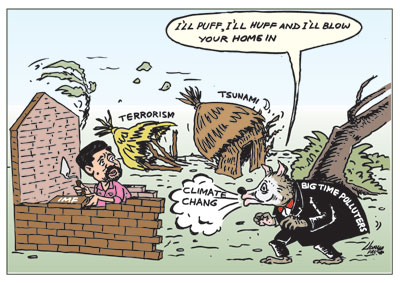
President’s interview with Newsweek
Meanwhile, in an interview with the US news magazine Newsweek, President Anura Kumara Dissanayake, described by the magazine as a “prominent Marxist leader”, opened up about the massive challenge that now lies ahead as the country struggles to recover from Cyclone Ditwah.
In a wide-ranging interview where he also spoke about balancing the competing interests of countries such as India, China and the United States and dealing with institutional corruption and criticism of his government’s handling of the disaster, the President called for a new approach for debt-burdened countries vulnerable to climate change. The following are excerpts:
Newsweek: What exactly does Sri Lanka want from Washington, and what is it willing to deliver in return?
President: Market access for our exports, particularly textiles and value-added products. We also need climate finance – we just lost several billions of dollars due to Cyclone Ditwah. It will take us a few weeks to assess the actual damage. We need grants for climate adaptation: early warning systems, resilient infrastructure, coastal protection. We need technology and investments – we want US companies to invest in Sri Lanka in all possible sectors, including digital infrastructure, manufacturing and renewable energy. We need technology transfer. What we offer is a strategically placed, stable, democratic partner in the Indo-Pacific. We are committed to freedom of navigation. We are keen on port and logistics collaboration. We also look forward to deepening cooperation on shared concerns like maritime security collaboration, counter-terrorism and drug trafficking.
Newsweek: Sri Lanka sits at the crossroads of Chinese-built infrastructure, Indian regional influence and US economic leverage. To what extent does Sri Lanka truly retain strategic autonomy, and how do you balance these relationships?
President: India is Sri Lanka’s closest neighbour, separated by about 24 km of ocean. We have a civilisational connection with India. There is hardly any aspect of life in Sri Lanka that is not connected to India in some way or another. India has been the first responder whenever Sri Lanka has faced difficulty. India is also our largest trading partner, our largest source of tourism and a significant investor in Sri Lanka. China is also a close and strategic partner. We have a long historic relationship—both at the state level and at a political party level. Our trade, investment and infrastructure partnership is very strong. The United States and Sri Lanka also have deep and multifaceted ties. The US is our largest market. We also have shared democratic values and a commitment to a rules-based order. We don’t look at our relations with these important countries as balancing. Each of our relationships is important to us. We work with everyone, but always with a single purpose – a better world for Sri Lankans, in a better world for all.
Newsweek: How do you respond to criticisms of the government’s handling of the disaster?
President: Cyclone Ditwah was catastrophic—lives lost, villages submerged, infrastructure torn apart. Response was rapid, with our forces and local authorities mobilised. Our partners stepped in as well. Although the priority at the moment is to work together and ensure Sri Lanka gets back on its feet, we need meaningful criticism to guide us. Longstanding weaknesses were visible in local preparedness, land-use enforcement and speed of relief delivery. We are in government, and we want to fix the problems. We have launched a comprehensive review of our disaster management systems. Sri Lanka’s pre-monitoring and early-warning systems must improve—especially real-time weather tracking and community alert mechanisms. We have established emergency operations centres in every affected district, deployed all available military and police resources for rescue and relief, and coordinated with international partners who responded rapidly.
We are creating a National Disaster Management Authority with real resources and authority. We will improve our forecasting through better radar coverage. We are pre-positioning rescue equipment and supplies in high-risk areas. We are mapping landslide-prone areas in the central highlands. Of course these districts have experienced landslides before. With climate change, destruction of this scale should have been expected in time. But for years and years Sri Lanka has failed to prepare adequately. At least now, our government will work with all partners to put effective, efficient and accountable systems in place. We will rebuild Sri Lanka, better than it was before.
Newsweek: Is Sri Lanka trapped in a model where climate shocks keep setting the country back for years? What’s your long-term plan?
President: We will be trapped if we don’t act now. This trap is not of our own making. Sri Lanka contributes negligibly to global emissions. But we face existential climate shocks that can destroy years of development progress overnight. But we must break this cycle. We can’t have every flood, every cyclone, every drought set us back to where we started. So we urge our partners to help us build an escape plan to get out of the trap. Help us build climate-resilient infrastructure. This will cost more upfront but will save us from repeated reconstruction. Help us diversify our economy away from climate-vulnerable sectors to sectors like the digital economy, IT services, light manufacturing and climate-resilient industries. Share technology so that communities have time to evacuate and protect assets before disasters strike. Help us build natural climate-change mitigation infrastructure – mangrove restoration, reforestation and wetland conservation.
In this interview, President Dissanayake has acknowledged there were significant shortcomings in the country’s disaster management system and that his government welcomes “meaningful criticism” to guide it. Some of his Cabinet and parliamentary colleagues, however, have peddled a different message on local media for the past two weeks, attacking both media institutions and opposition parties that they insist are levelling undue criticism over the government’s handling of the disaster. While some of those complaints regarding criticism of the government’s response may certainly have merit, it does not mean that the government, including the political authority, can be absolved of all blame.
President Dissanayake is also asking the US for assistance on “climate finance”. US President Donald Trump, though, is a vocal climate change sceptic and has frequently described climate change as a “hoax” and a “con job”. Over the past year, President Trump has also moved aggressively to roll back many environmental protection laws passed by his predecessor, Joe Biden. As such, it is hard to envisage Washington lending any assistance to Sri Lanka on climate adaptation.
It should be further pointed out that Dissanayake is yet to give such a comprehensive interview as he gave Newsweek to any local media outlet in the aftermath of the disaster. Whether this is due to his own reluctance or owing to advice from his confidants is unclear.
Sri Lanka’s first executive president, J.R. Jayewardene, had advised some of his Cabinet ministers who were once fuming over India’s unauthorised air drop of food supplies over Jaffna in June, 1987, saying, ‘Don’t look a gift horse in the mouth.’ Given the massive damage caused by the natural disaster to the country, the National People’s Power (NPP) too has been pushed to a similar situation where it has to welcome with open arms ”those ‘bearing gifts’.
Ranil’s take on disaster damage
The enormity of the challenge to recover from Cyclone Ditwah is also being discussed among leaders of opposition parties. The subject came up during a discussion this week at a wedding attended by former President and United National Party (UNP) leader Ranil Wickremesinghe. One of those present had asked Mr Wickremesinghe whether he agreed with the warnings made by some economists that the disaster may lead to a food shortage.
Mr Wickremesinghe replied that the statement is largely true, because a large number of paddy fields in Sri Lanka were damaged by the disaster. It was not only paddy fields, but other crops also suffered extensive damage. “So, this situation is difficult for our country’s economy to bear because we are not completely economically strong. When something like this happens, it is quite serious. If this is not managed properly, the problem could escalate,” the UNP leader said in response.
Mr Wickremesinghe is facing challenges of his own. A Criminal Investigation Department (CID) team that flew to the UK last month to probe the authenticity of the invitation letter sent by the University of Wolverhampton to him regarding then First Lady Maithree Wickremesinghe’s graduation ceremony, and its investigation is now nearing completion. The findings are likely to lead to indictments being filed in the High Court in the coming weeks. A high-ranking government source said the former president’s secretary, Saman Ekanayake, too, is likely to be produced in court, as he had authorised the release of the funds in his capacity as the chief accounting officer at the Presidential Secretariat for then-Presiden
Buying or selling electronics has never been easier with the help of Hitad.lk! We, at Hitad.lk, hear your needs and endeavour to provide you with the perfect listings of electronics; because we have listings for nearly anything! Search for your favourite electronic items for sale on Hitad.lk today!
President leads global aid drive for Ditwah disaster recovery
View(s):