

Columns
- Foreign Minister Herath refutes allegations Govt. failed to heed early warnings; says
Met Dept. failed to raise red alert in early messages - Former President Wickremesinghe cites Govt.’s failure to activate National Disaster Plan; convenes opposition politicians to review disaster response; SJB, SLPP absent
- Ditwah calamity underscores need for separate disaster management ministry; Wickremesinghe proposes Parliament Oversight Committee; calls for select committee probe
- Rebuilding Sri Lanka fund launched; Govt seeks foreign aid; opposition demands parliamentary oversight
- President assures emergency regulations not to target dissent after deputy minister
Watagala’s comments raise concerns
By our Political Desk
When President Anura Dissanayake convened an emergency Cabinet meeting on Wednesday evening, there were two matters he said those in government should focus on urgently. One was getting aid across to those worst affected by Cyclone Ditwah, and the other was countering opposition allegations that the government had ignored warnings of the incoming natural disaster, thus leading to the heavy loss of lives.
Not all members of the Cabinet were present at the meeting, with those in the worst cyclone-affected districts working on the ground to see to the immediate needs of their constituents, but for those in attendance, it was clear that the situation was far worse than was anticipated when the Cabinet met for its regular meeting two days earlier, on Monday.
For a government that its detractors have been calling tightfisted in the disbursement of public funds, the time had come to bypass the normal bureaucratic hurdles and disburse funds urgently to District Secretaries as well as Grama Sevaka officers dealing with the immediate needs of the affected people. The President told his Cabinet that there was no time to lose and sought their approval for a relief package which he would announce in Parliament on Friday, the last day of the month-long budget debate. The mood in the Cabinet which met that Wednesday was in sharp contrast to the one which met on November 7, 2025, to approve the 2026 budget. When the President delivered the budget speech the same evening in Parliament, he was upbeat as he announced that gross official reserves have exceeded USD 6 billion and it was expected that after almost two decades since 2006, the government revenue would be able to reach the level of 16 per cent of GDP.

President Dissanayake meets party leaders, seeking bipartisan backing for disaster response after Cyclone Ditwah
Those targets will now have to be pushed back and revised given the massive expenses the state will have to incur to rebuild in the wake of the cyclone as well as provide relief to those affected by the disaster. The President announced on Friday that the government has sought an additional USD 200 million from the International Monetary Fund (IMF) in addition to the USD 342 million due under the Extended Fund Facility of the IMF.
At the special Cabinet meeting, the President also discussed with his ministers the need to counter opposition allegations that the government failed to act promptly once it received information of the severe weather conditions building up over the island. The main opposition, Samagi Jana Balawegaya (SJB), has led the onslaught against the government, accusing it of failing to save the lives of people who were killed in landslides by not giving the evacuation order on time and not providing the necessary facilities for them to leave their dwellings.
Foreign Affairs, Foreign Employment and Tourism Minister Vijitha Herath told the Sunday Times that the opposition allegations were ill-founded and there were no warnings of severe weather conditions impacting the country, with the first such warning reaching the government only on November 25.
“The Meteorology Department did not mention cyclonic conditions till November 25. Prior to that what they forecast was heavy rains, but on that too they were vacillating and not giving a definitive picture of what to expect. Once the cyclone warning was issued, the government acted promptly,” he said.

Former President Wickremesinghe explaining to opposition members the disaster response the Govt. should undertake.
The Meteorology Department had held several Zoom meetings since November 18 with officials of the Education Ministry, the Fisheries Ministry and the Irrigation Department to brief them on expected heavy rainfalls of over 150 mm but had not warned that the rainfalls would be heavy enough to disrupt everyday life. The Education Ministry was told that no plans were needed to change the dates of the Advanced Level examination which was ongoing at the time, while the Irrigation Department was told there was no need to release water from any of the major reservoirs, as water levels in them were low, and in case the rains did not come as predicted, they would be unable to release water to farmers. The Cabinet had been informed that water levels in the major reservoirs had been around 42 p.c. earlier last week, and hence there was no need to empty them. In the fisheries sector, as the warnings of heavy rains had been forecast, the fisherfolk had heeded the warnings, and they were unharmed.
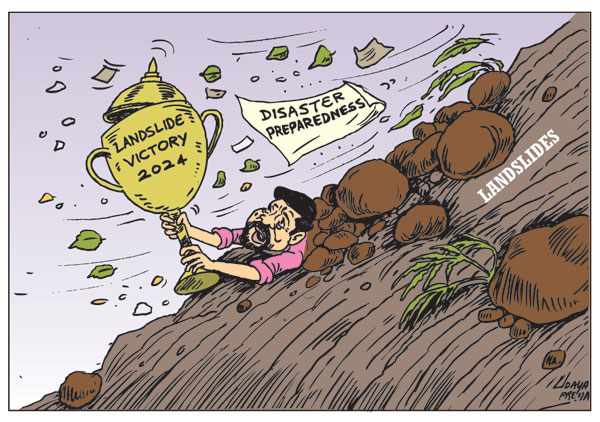
Heads will certainly have to roll, as it’s become clear that at least some of the lives could have been saved had the proper weather warnings gone out on time and a better evacuation plan been in place. But it’s likely it’ll be the officials who’ll be called to account, not politicians. The questions over the disaster preparedness of the government will continue to be raised in the weeks and months ahead. While some opposition political parties are threatening the government with legal action over negligence, whether they will follow through is yet to be seen.
The Meteorology Department, the National Disaster Management Council, the Disaster Management Centre, the National Disaster Relief Services Centre and the National Building Research Organisation (NBRO) all come under the Ministry of Defence headed by the President. All four institutes are crucial when it comes to forecasting possible natural calamities, issuing early warnings and providing relief when such disasters occur. The National People Power (NPP), which has been critical of bloated Cabinets of previous governments, has kept the Cabinet restricted to 25 ministers and 25 deputy ministers. This means some of the specialised areas, such as disaster management, irrigation (irrigation comes under the Ministry of Agriculture, Lands, Livestock and Irrigation) and several others, are cramped into one ministry with one minister to oversee the work of varying subjects. The President is also the Minister of Defence, Finance, Planning and Digital Economy, and in these have been included the meteorology/disaster management departments, which no doubt do not get the due importance they should get. The Constitution provides for the appointment of 30 cabinet ministers and also state and deputy ministers. The President may have to consider appointing a few more, at least for the subjects that need more attention and focus than they get at present. The government has had a somewhat ‘penny-wise’ attitude since taking office, cutting back on ex-presidents’ pensions and planning to stop MPs’ pensions, etc., but cutting back on crucial ministries has left it in a ‘pound-foolish’ situation after the cyclone disaster.
Meanwhile, the government announced this week its decision to establish a ‘Rebuilding Sri Lanka’ Fund, which will be a statutory fund under the Presidential Secretariat. While some opposition lawmakers have questioned the legality of setting up such a fund, questions have also been raised regarding its composition, which consists of several corporate sector heavyweights. Given that all state finances, including those in different funds, must come under parliamentary oversight, making it more representative of the state sector is common sense.
While the government was grappling with its most challenging time since taking office, opposition parties were adding momentum to gathering anti-government political forces. Former President and United National Party (UNP) leader Ranil Wickremesinghe convened a meeting of leaders and representatives of opposition political parties at his Sir Ernest de Silva Mw (formerly Flower Road) office on Wednesday. Party Chairman Vajira Abeywardana claimed that leaders and representatives of over 35 registered political parties took part in the discussion. Among those present were former Speaker Mahinda Yapa Abeywardena and former Ministers Rajitha Senaratne, Udaya Gammanpila, Tiran Alles, Nimal Siripala De Silva, Mahinda Amaraweera, Bandula Gunawardana, Anura Priyadarshana Yapa and Ranjith Siyambalapitiya. Parties represented included the UNP, the New Democratic Front (NDF), the Sri Lanka Freedom Party (SLFP)-led coalition known as the People’s Alliance and the Pivithuru Hela Urumaya. The main opposition, SJB, and the Sri Lanka Podujana Peramuna (SLPP) were not present in an official capacity. Sources said SLPP National Organiser Namal Rajapaksa and Parliamentarian D.V. Chanaka had both been invited but were out of Colombo assisting relief operations and, as such, were unable to attend. SJB parliamentarian and Tamil Progressive Alliance (TPA) leader Mano Ganesan was absent for the same reason. SJB and SLPP sources said their parties do support the initiative taken by Mr Wickremesinghe, though their representatives were absent.
Addressing those present, Wickremesinghe criticised the government’s handling of the disaster, attributing some of its failures to ‘inexperience’, a charge which often riles those at the senior-most levels of the Janatha Vimuthi Peramuna (JVP)-led National People’s Power (NPP) government. He was especially critical of the government for not implementing on November 27 key provisions of the Disaster Management Act of 2005, which was enacted after the 2004 tsunami, and the decision to declare November 28 as a holiday for government offices, which he said immobilised public institutions responsible for responding to the disaster.
The concerns raised by Wickremesinghe regarding the government’s bizarre decision to declare November 28 a holiday for government offices are certainly valid. The notice by the Ministry of Public Administration, Provincial Councils and Local Government declaring the public holiday was issued on the evening of November 27, and while it stressed that the declaration of such a holiday should not impede the summoning of officials working in essential and disaster relief services, no clarity was given on which services were being treated as ‘essential’. President Dissanayake did subsequently issue an extraordinary gazette notification declaring a wide range of services as essential services, yet this was only issued on the evening of November 28. The belated move to gazette so many services as essential opened the government up to yet more criticism regarding its inexperience in handling such a crisis. By appointing inexperienced public servants to high posts to advise the political leadership in the country, they added to the crisis.
There were claims that the government has politicised post-disaster aid distribution by bypassing Parliament, the Cabinet, and the Disaster Management Centre (DMC) and establishing a parallel disaster relief fund. Party leaders and representatives added that the government did not have a proper post-cyclone disaster plan either.
Mr Wickremesinghe, along with other party leaders and representatives, proposed that Parliament set up an Oversight Committee on Disaster Management and Reconstruction, chaired by an experienced MP, and with equal representation from the government and the opposition. This Oversight Committee was to report directly to Parliament. They also called for the establishment of a Parliamentary Select Committee (PSC) to examine lapses that occurred on November 28. The PSC should consist of an equal number of government and opposition MPs and should be chaired by an MP from the opposition. The Committee should submit a report on its findings within six months, it was recommended.
The parties insisted that district secretaries should lead district-level disaster relief and reconstruction efforts, submitting reports to the DMC. Political interference should be removed from relief operations, they emphasised. It was also noted that the current budget was irrelevant in light of what has occurred. As such, a Vote on Account should be presented to cover expenses for the next two months until a new budget is presented.
Among other proposals was one calling for a special meeting of all religious and political leaders, along with prominent individuals from various sectors, to be convened to guide the process of rebuilding the country. It was proposed that the Chief Prelates (Maha Nayaka Theras) of the four chapters be invited to chair the first meeting. It was suggested that former Speaker Karu Jayasuriya be appointed as one of the convenors, while the government can also appoint a convenor of its own.
They further emphasised that the people’s sovereignty and state power should only be exercised through the judiciary, the executive and the legislature. The emphasis was made due to allegations levelled by opposition parties that the Pelawatte office of the JVP had become the central decision-making body during the disaster. “I propose that we say directly that power to make decisions should be removed from Pelawatte (JVP office) and be given back to the legislature,” Mr Wickremesinghe said, speaking to other party leaders and representatives.
SLPP National Organiser Namal Rajapaksa, however, said he has proposed to opposition parties that rather than clash with the government, the most urgent priority is to find out what the affected people needed urgently and use their organisational capacities to help get them what is required. He endorsed the proposal brought forward by Mr Wickremesinghe and other opposition parties to appoint a PSC to probe the disaster and identify whether any lapses took place and who was responsible. “We should not be doing politics at this time. It is only if people survive that we can continue to do politics, so let’s first help save lives and do politics afterwards,” he says.
While the government should be given some breathing space to continue with the extensive rescue and relief operation, Mr Rajapaksa stressed that opposition parties should bring pressure on the government in a few weeks to appoint a PSC to carry out a thorough probe and take steps to ensure there is no repeat of such a catastrophe. “The PSC must identify if there is anyone to blame: whether it is the government or public officials or both. It should not be a repeat of the PSC that was appointed to probe the container issue,” he said, referring to the PSC, chaired by Justice Minister Harshana Nanayakkara, that was recently approved by Parliament to probe the controversial release of more than 300 red-labelled containers without a physical inspection from the Colombo Port in January.
The SJB, led by Opposition Leader Sajith Premadasa, meanwhile, still has not got its act together on sending a coherent signal on where it exactly stands regarding the present situation. Its MPs walked out from Parliament during the budget debate last Monday, claiming the government was blocking attempts to hold an extensive discussion on the failures to heed early warnings of the impending disaster issued by the Meteorology and Irrigation Departments. The SJB again walked out from the chamber on Friday as President Dissanayake arrived to address the House on the disaster situation. It did not turn up during the vote on the Third Reading, which took place later in the evening, where Budget 2026 was passed by 158 votes in favour and 1 against. One wonders exactly what message the SJB is trying to convey by walking out of Parliament at such a crucial juncture when it should be staying to fight for the citizens of the country that it claims to represent.
While the government is facing criticism for its disaster response and contradictory signals regarding the state of emergency President Dissanayake imposed on November 28, allegations about legislation being used to crack down on dissent raise concerns. Addressing the nation on November 30, the President said that emergency regulations issued under the Public Security Ordinance have been enacted “to provide legal and financial safeguards for efficient reconstruction.” He gave a personal assurance to every citizen that the emergency powers “will not be misused for any other purpose.”
Clearly, some in his government had not listened to President Dissanayake’s speech or had chosen to ignore that express assurance he gave to the country’s citizens. Addressing a disaster management meeting at the Malabe Divisional Secretariat on Tuesday, Public Security Deputy Minister Sunil Watagala, no stranger to controversial utterances, instructed senior police officers to use the emergency regulations to act against individuals, including those based abroad, who he claimed were engaged in making false and malicious statements on social media targeting the President and the government.
The comments touched off a firestorm of criticism and condemnation from opposition political parties, civil society organisations and media rights groups, among others. The PR disaster caused by Mr Watagala’s comments was further exacerbated due to none of his ministerial or parliamentary colleagues having the stomach to distance themselves from his comments and reassure the public that emergency regulations would not be used to go after those critical of the government. Again, as has so often been the case with a government that has made a habit of shooting itself in the foot owing to remarks by its ministers and MPs, it was left to President Dissanayake to clear the air. Addressing Parliament during the final day of the Budget 2026 debate on Friday, the President publicly distanced himself from Mr Watagala’s comments.
President Dissanayake again pledged that his government will never use the Public Security Ordinance to violate the democratic rights of the people. “Criticism of me or of our ministers is of no concern to us. It does not matter at all. Ordinary law exists for such matters,” he emphasised. Nevertheless, he said the government would not hesitate to use emergency regulations against attempts to frighten the public, mislead them, disturb the peaceful situation, or create conflict within a vulnerable community in a way that obstructs the plan to recover from the disaster.
An analysis of emergency regulations issued by the President on November 28 indicates they are, in many ways, similar to those issued by former President Ranil Wickremesinghe on July 18, 2022— two days after he was sworn in as Acting President. Mr Wickremesinghe’s government imposed a state of emergency on the grounds that it was needed to restore order amid the chaos that prevailed following the ouster of President Gotabaya Rajapaksa from power. Some in the opposition even claimed that certain sections of the gazette issued by President Dissanayake were “copy-pasted” from the gazette issued by Mr Wickremesinghe three years ago. Indeed, the regulations imposed by President Dissanayake seem to be an updated version of the gazette from July 2022, with certain amendments made to reflect the natural disaster that has befallen the country.
In certain aspects, the gazette issued on November 28 goes even further than the one from three years ago. For example, the 2025 regulation concerning the spreading of rumours and false statements (Reg. 20) is significantly expanded to explicitly include “written, electronic, digital or other means whatsoever, including through any media, information and communication technology, automated system or artificial intelligence system.” Meanwhile, the 2022 regulation sets the maximum penalty for major offences, such as causing death, destruction of property or serious Penal Code offences, at life imprisonment or twenty years, whereas the 2025 regulation raises the penalty to suffering death or imprisonment of either description. In terms of granting bail to suspects arrested under emergency regulations, the 2022 gazette notes that bail cannot be granted “except under exceptional circumstances”, while the 2025 gazette stresses that a person indicted before the High Court under this regulation shall not be admitted to bail “except with the consent of the Attorney-General”.
The government, meanwhile, is also moving to stave off a potentially devastating blow to the vital winter tourist season as a result of the disaster. Foreign Affairs, Foreign Employment and Tourism Minister Vijitha Herath convened a meeting with Colombo-based diplomats at the Foreign Ministry on Friday to thank them for their assistance during the disaster. After thanking the diplomats for the vital assistance rendered by their countries to rescue and relief efforts, Minister Herath said he had stressed that the government would have to soon focus on rebuilding Sri Lanka. This would require extensive efforts to rebuild the road and rail networks damaged during the disaster, bridges and schools. He said he requested diplomats to help assist these efforts and invited them to assume responsibility for providing funding for projects of their choice.
Minister Herath said that he emphasised to the diplomats that the country remained open to tourists and that the situation in the south of the country especially was completely normal, with tourist attractions open as usual. The government has assured the safety of tourists. Nevertheless, he acknowledged there are still issues in the hill country, especially in Nuwara Eliya, but stressed they are welcome to visit the country. No tourists lost their lives in the disaster, and even those trapped were safely evacuated, he pointed out. There was large-scale congestion at the Bandaranaike International Airport in the aftermath of the disaster, with tourists trying to leave the country. Some tourists had to spend an extra day or two in hotels owing to flight delays and cancellations, or because they missed their flights owing to delays in getting to the airport. The Sri Lanka Tourism Development Authority (SLTDA) worked to take care of their accommodation and pay for these extra days at hotels, he added. Mr Herath said the SLTDA also set up a help desk for tourists and, in consultation with airlines, ensured that passengers were not charged any penalty on their airline tickets for missing their flights owing to the natural disaster.
That the country was ill-prepared to deal with a disaster situation is clear from the unfolding events of the past few days. In President Dissanayake’s own words, government institutions had no plans in place to meet an emergency situation such as this. “It is the duty of every ministry, every government department and every state institution to prepare a disaster management plan. But no such plan has been prepared,” he said in Parliament on Friday. Now the onus is on the NPP to bring in new laws if necessary and have a comprehensive plan in place so that when the next natural disaster hits the country, both the country and the people won’t be caught off guard.
Buying or selling electronics has never been easier with the help of Hitad.lk! We, at Hitad.lk, hear your needs and endeavour to provide you with the perfect listings of electronics; because we have listings for nearly anything! Search for your favourite electronic items for sale on Hitad.lk today!
Govt. battered by post-disaster political storm surge
View(s):