


Penning a poem for Remembrance Day
With his ‘A Sonnet for Us All’, now on thePrince and Princess of Wales’s Instagram we spoke to Arji about being a diasporic poet, the ‘jitters’ of having a poem commissioned by royalty and how to get on to those shelves at Waterstones…
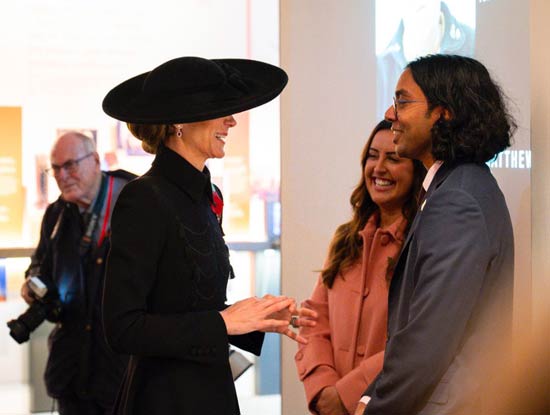
Royal Commission: Arji meeting the Princess of Wales at the National Memorial Arboretum on November 11. Also in the picture is Rachel Smith, Head of Hearing and Participation at the Arboretum
- What are your connections however transitory, with the land of your forefathers? What in your life has made you think of an island in the Indian Ocean?
I was born in Great Britain. Years ago I’d travel to Sri Lanka to visit my cousins and grandparents. Those were amazing times that I hold so dear to all I am today. But as I grew older I realised I struggled to fit in. My Sinhalese is non-existent and my Tamil is close to that so it felt strange to be in Sri Lanka and feel like nobody there saw me as a Sri Lankan. In the same way I felt a bit like that in England but London has always been my place, a place I am immensely proud of. I have always loved the way people constantly tell me they have been to Sri Lanka on holiday, as though I have some sort of part in their happiness. Truth is, often I’ve struggled with so much of the politics there and I’ve always been unsure about going back. Having said that, I immerse myself in the food, religion and culture here in the UK, the diaspora has brought community here in London and I regret not being a more invested part of that. I guess there’s always time though.
- Something about your parents and how they came to Britain from Sri Lanka?
My parents came here to study but due to the war decided to make a life here. My father is from Jaffna and my mum from Colombo. Together they built an incredible legacy based on the Sri Lankan saying ‘keep your head down and work.’ I think that is one part of Sri Lankan culture that I have definitely lived by. I’m so proud of the Lankan community in London, it doesn’t matter if it was a petrol station or a chicken shop when they wanted to work… they really WORKED. They understand graft and no one can take that away from them. When racists have shouted abuse at us we responded by working harder. I believe this is why we have continued to prosper.
My father started as an accountant and went on to have a company in the software boom of the late 90’s. He literally worked his way up and now has built a legacy that has allowed me to nurture this career into the career it is today. This isn’t just a one-off poem. This is my entire life. I’ve woken up every day striving to give to my career what my father gave to his. Both of them gave so much for me to be here now, they loved with all their hearts, they worked with all their might but they also brought us up to have an open mind, to carve our own path and to reach beyond what anybody says is impossible.
- An important commissioned poem such as ‘A Sonnet For Us All’ could be nerve-racking; what was it like sitting down and coming up with a ‘winner’?
I was in Great Yarmouth on a teaching job. I took a day off. One day of writing is a long time now. Basically because I’ve been honing this craft for years. It’s like exercise to me, you got to keep practising, because sooner or later the stars are going to line up and when it hits you have to be ready to let it flow. So, I didn’t have much fear or nerves, I just had a pure belief that this was my destiny and I was living out the practice I had built up throughout the years.
Here’s how that day went. I woke up. I went for a run. I stopped on a bench at about 5k. I started writing. I came back, sat on the sofa in an Airbnb. I went to the cafe for a cup of tea. I wrote some more. I went home, fell asleep, woke up, ran again, wrote some more. I did this till about 10 at night. Following this period I worked a few more half days but the structure was more or less there. I had four different poems but slowly I saw one of them standing out. I’ve loved the journey and I’ve loved to watch the effect it had on others.
- What first got you into poetry growing up?
I always loved rap music. We listened and grew up with rap and I was writing raps with my best friend in school. I made albums, I wrote poems, I just thought it was a cool thing to do. I remember in primary school this guy called Leon Garfield came to my school and he spoke about his career and led a writing workshop. I asked him about what he did all day and he said ‘I just write and get other people to write’. I remember thinking, that’s a really great job, I want to do that. And so I did. I just kept writing. I filled lyric books, I filled the notes app and I read a lot of poems. I’ve been grafting at this thing for ages, making shows, albums, readings, books and teaching too. This poem was just the tip of the iceberg, the graft was hidden below the surface.
- What is your response to those who feel alienated by modern poetry in its abstract starkness and still prefer Tennyson? What is redeeming about modern poetry?
I think that poetry was great back in the day. But poetry is brilliant when it shows us something new. And the contemporary poets are trying to do that constantly. People feel alienated because they have the perception that everything should be ‘understood’. It really shouldn’t be. It’s not about being understood, it’s about transferring a feeling in a way that words have never done before. Imagine for a second you are painting your flat red and you say ‘ok I’m gonna go buy some paint’ and you get to the shop and you realise there are hundreds of shades of red. That is exactly what poetry is. The shades of emotion. People aren’t angry they are a specific shade of angry and that could be captured in a poem. When we think about old poems, we think yes, those poems communicate the feelings of that time, and I love that. But who is communicating the feelings of OUR TIME. Go look for those poets, from Jay Hopler to Anthony Anaxagorou, to Joelle Taylor to Chen Chen. Poets are doing wild things with words, you just have to find them!
- Have you ever let Lanka and its ‘spicy breezes… blowing soft’ as Bishop Heber said colour your poems?
Yes I write a great deal about Sri Lanka. Though I’m careful to not fall into the trap of thinking that that is all I am. Often white audiences want that from me, they want me to fit nicely into a box so that they can sell it easily. I’m looking to disrupt that, mess it up, do the stuff that surprises and shocks. Having said that, my background and culture feeds into everything I do. And I’m very proud of my city and my connection to my origins.
- What advice would you give to budding poets as someone who has been an educator for 15 years?
It’s 20 years now! There are a few bits of advice I always give. Firstly, keep practising. The practice is everything, don’t worry if nobody likes your story, if there are dead manuscripts lining your shelving unit. Don’t worry if you feel like nobody read your Amazon book, and someone gave you a 1 star and said it was ‘bloody awful’. It doesn’t matter because the only thing that matters is that you made something where there was nothing. That is the craft. Over time you will improve at that and without doubt, your writing will become good but never forget the magic of that one simple thing – THERE WAS NOTHING ON THIS PAGE AND NOW THERE IS SOMETHING.
My second bit of advice is build a community. It’s a lonely old world, and the world of writing is a lonely place too. You need a group of writers who can lift you out of that loneliness, who can push you on when it gets difficult and give you advice when it is challenging.
Whatever you do, remember to enjoy it.
| A Sonnet for Us All | |
| ‘When you speak of our country, do not speak of war. Speak of the nurse who held a hand like her own father’s, A lieutenant who embraced a soldier like his own brother. Remember, sometimes those who go into burning buildings burn brighter than the fire inside. Those who rise from burning buildings carry scars we cannot see. If you speak of this country speak of the widow who never stopped waiting, the sailor who kissed or the pilots who meet in the pub to talk of anything but war You see love is a compass, love is a bugle mourning. Love is sacrificing tomorrow so that a stranger can live today. So when you speak of this country, do not think of it as a place. Think of it as a feeling, the feeling of being loved, the duty to pass that love to whoever needs it.’ |
Searching for an ideal partner? Find your soul mate on Hitad.lk, Sri Lanka's favourite marriage proposals page. With Hitad.lk matrimonial advertisements you have access to thousands of ads from potential suitors who are looking for someone just like you.