

Sunday Times 2
A journey through Lanka’s troubled politics
View(s):- “In the Political Arena” Sarath Amunugama Autobiography Volume Three (1992 – 2022) Published by Vijitha Yapa Publications
Reviewed By Nigel Hatch P.C.
Dr. Sarath Amunugama, in the final volume of his autobiographical trilogy entitled “In the Political Arena,” covers the period 1992 to 2022—the contemporary period of politics in Sri Lanka and his frontline role in it.
Amunugama, in his introduction, observes that “the modern history of Sri Lanka is full of paradoxes.” He asks, how did Sri Lanka, which at independence had surplus sterling reserves and was one of the most promising states in Asia earmarked for modernisation and economic growth, end up at the bottom of the pile? How is it that a country predominantly Theravada Buddhist could be engaged in fratricidal warfare for almost half the years since independence and, despite a high literacy rate and vibrant intellectual life, become reduced to a second-rate cultural backwater?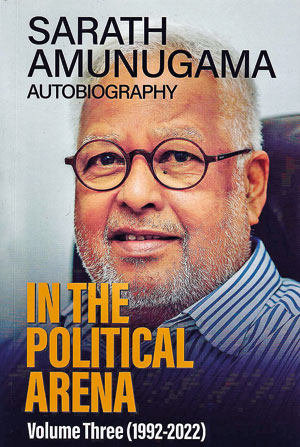
Amunugama goes on to explore these tragedies as a failure of a process of modernisation and that Sri Lanka, 75 years after independence, has yet to discover the growth model that suits us. He quotes David Riesman, “The hatred sown by anti-colonialism is harvested in the rejection of every appearance of foreign tutelage,” and Joan Robins, who sardonically commented, “Sri Lanka is trying to taste the fruit of the tree without growing it.”
Amunugama’s chapter on R. Premadasa is fittingly entitled “Premadasa Rex (1988 to 1993).” Although admiring his discipline and his rise to the leadership of the elite-dominated UNP, he refers to his “disdainful treatment of ministers and MPs.” The sidelining of Lalith (LA) and Gamini (GD), which led to the formation of the DUNF, and the abortive impeachment motion are the subjects of a separate chapter.
Gamini’s (GD) return to the UNP under the leadership of President Wijetunga despite obstacles placed within, and the difficulty in finding a place for him on the national list to enter parliament, is recounted. Amunugama, who had excellent relations with Wijetunga, played a seminal role in this endeavour. He states, at first those national list members were unwilling to resign “for love or money.” But persistence prevailed, and GD entered parliament and was inducted into the cabinet. GD was assassinated by the LTTE whilst campaigning on the final night for the presidency against CBK. The reviewer accompanied Amunugama and Wickrema Weerasooriya to the President’s House for the meeting with Wijetunga and CBK to discuss funeral arrangements. Amunugama notes that the latter, who was PM, was extremely gracious, in contrast to her mother’s approach with regard to the funeral arrangements of Dudley Senanayake.
Political career
Amunugama, whose political career commenced as an elected Member of the Provincial Council from Kandy, and his subsequent election to Parliament in 1994 from the UNP, is perhaps the last man standing who could recount as an insider and participant the momentous events of that period, which were unparalleled in
Sri Lanka’s political history.
The author’s political career as a minister commenced with the decision that he, Wijayapala Mendis, Susil Moonasinghe, Nanda Mathew, and a few others took to support CBK over Ranil Wickremasinghe at the Presidential Election of 2000. Their purported expulsion from the UNP under Ranil Wickremasinghe led to the constitutionally significant decision of the Supreme Court, which held that expulsion unlawful, which is of personal significance to the reviewer, whose role as junior counsel to the late Elanga Wickramanayake is recounted in this memoir in some detail.
The author’s first portfolio was as Minister of Northern Rehabilitation under the CBK presidency. He records how the government funded and maintained the infrastructure of the Northern Province, despite the LTTE waging a separatist war and controlling large swaths of territory, in order to ensure that food, medicines, fuel, and other essential supplies reached the citizens of those areas under LTTE control.
His tenure as Minister of Irrigation reflects his love for the land and the people, which undoubtedly commenced when he was a civil servant and served in all parts of the country, which is brought out also in Volume 1. His sense of humour is replete even in this volume. Anuruddha Ratwatte, who held this portfolio earlier, was unhappy that CBK did not appoint him to this ministry, as he had “looked forward while returning from the war zone to landing his helicopter near the NCP tanks and enjoying a country rice meal wrapped in a lotus leaf. He lost both the war and his lotus leaf-wrapped lunch.” (pg. 251).
Cohabitation crisis
Sri Lanka experienced the politics of cohabitation between CBK as president and RW as prime minister with a cabinet of his choice after his coalition won the parliamentary elections in 2001. CBK faced a torrid time at some cabinet meetings, particularly from those who were at one time trusted lieutenants and had defected from her party and joined the UNP. CBK, who made the mistake of giving up the defence portfolio to a UNP minister, had to seek the first-ever opinion from the Supreme Court under Article 129 as regards these powers. The reviewer appeared for her with the late HL De Silva PC and Rajah Goonesekere (RKW) and succeeded in that case. The Court held that defence was an integral part of the powers of the President.
Events swiftly ensued, and CBK exercised her powers and removed some UNP ministers and dissolved parliament. The reviewer was involved in strategising these events and recalls a weekend at the President’s Bungalow in Nuwara Eliya, where Lakshman Kadiragmar (LK) and Mangala Samaraweera were also present.
Amunugama was one of CBK’s representatives in talks between the SLFP and the JVP, represented by Tilvin Silva, Anura Kumara Dissanayake (AKD), Bimal Rathnayake and Sunil Handunetti. He states, “Very often I was the only one from our side while all JVPers diligently attended discussions,” exemplified by AKD once attending a meeting after coming from Ampara after skipping his meals to be on time (282).
At the ensuing general elections in 2004, CBK’s party in coalition with the JVP secured power and formed a government. Amunugama became the Minister of Finance, a portfolio that had been the domain of several former presidents. He recounts his experience in this portfolio with extensive references to the challenges faced and negotiations with international lending agencies. He comments positively on the four ministers from the JVP.
He states that the alliance with the JVP ended when CBK, persuaded by the World Bank and the IMF, negotiated a power-sharing arrangement with the LTTE for the rehabilitation of the North and East after the devastating tsunami of 2004, called the P-TOMS. This initiative was challenged in court, and this reviewer and RKW led for CBK’s government in separate related cases, whilst HL De Silva, a friend and confidant of CBK, led for the JVP. CBK’s genuine desire for a peaceful negotiated settlement of the ethnic conflict is indisputable. Nevertheless, she had no hesitation on several occasions of directing the navy to blow up LTTE cargo vessels that attempted surreptitiously to smuggle arms during that ceasefire.
Amunugama refers to the significant contribution made by Lakshman Kadirgamar PC, who was an outstanding foreign minister and, at one point, a serious contender to be PM backed by the JVP. The reviewer worked closely with LK on several legal issues, including the ceasefire agreement that RW as PM unilaterally agreed with the LTTE, and difficulties arising from the Norwegian facilitation. He, too, was assassinated by the LTTE.
Politics of judiciary
Amunugama unflinchingly refers to the politics of the judiciary when the mercurial Sarath N Silva (SNS) was Chief Justice. He refers to the “Helping Hambantota” controversy, which was a fund set up by MR to collect money in the aftermath of the tsunami for the rehabilitation of, “presumably, as its name indicates, the Hambantota district.” He states, “The UNP, which worked hand in glove with Mahinda to embarrass CBK, now discovered that their favourite SLPer (MR), whom they nurtured, could become a formidable candidate” at the forthcoming presidential election “(319). Kabir Hashim, a UNP MP, challenged the legality of this Fund. SNS, the then Chief Justice who clipped a year off the term of office that CBK enjoyed in her second term, a decision that he states “was tailor-made for his friend Mahinda Rajapaksa,” dismissed that case. SNS subsequently expressed remorse for this decision after he left office, noting that if MR was found guilty, he could have faced imprisonment. Amunugama, to his credit, admitted in Parliament that the Fund was not properly constituted.
The political ascendancy of Mahinda Rajapaksa, first as the SLFP candidate and then victorious in the 2005 presidential election by the narrowest of margins over RW, also makes fascinating reading. This writer recalls Amunugama’s prescient prognostication that with MR’s nomination, “CBK had signed her political death warrant.” Relations between the two (CBK and MR) had deteriorated over a period of time, and when the UNP had commenced a long march from the South demanding a presidential election, which presaged SN Silva’s judgment on her term of office, she appointed RKW and this reviewer to meet with MR at President’s House. At this meeting MR rightly pressed that a delay in nominating the party candidate would be prejudicial, and we duly communicated that to her.
He recounts succinctly the inner politics of the MR administration during that period, including the disaffection of Mangala Samaraweera, due to not being appointed PM, and CBK’s efforts to cause problems for MR. MR faced a potential revolt orchestrated by Anura B and Mangala, ostensibly with JVP support, but at the last moment, unbeknownst to Anura, the JVP pulled out of the arrangement, leaving Anura, who crossed over in Parliament, with egg on his face. MR removed Mangala and Anura from their posts, and Amunugama notes that Anura never returned to parliament, and it was “an ignominious end to a career tailor-made to take him to the top.” (348)
The high point of MR’s second term (2009-2015) was the military defeat of the LTTE. He rightly identifies MR as a national hero. The ensuing rift between MR and General Sarath Fonseka, part of the troika with MR and his brother Gotabaya that strategised that victory, could have arisen due to Fonseka’s own plans for the military to bolster his image. Fonseka was wooed by the opposition as a presidential opponent to MR but went on to lose that election in 2010. Instead, he was elected to parliament and was unsuccessful at the recently concluded presidential election, where he cut a forlorn figure at poorly attended rallies.
Amunugama notes that after the war there was a commendable level of economic growth under MR, attributable, as in most countries that come out of a long war, to budgetary realignments to development projects and donor funding agencies being more receptive and forthcoming. ”Accordingly, several highway projects, work on ports and airports, and transport and power were undertaken, adding to a rapid growth of GDP.” (387). After the parliamentary elections of 2010, he was appointed senior minister and resumed his role as chief interlocutor with the global financial institutions.
But the decline in MR’s popularity due to the “shenanigans of his relatives” manifested itself in the results of the presidential election of 2015, where he ill-advisedly ran for a third term and lost to Maithripala Sirisena, who was nominated by the joint opposition. As a precursor to this manoeuvre, MR sought an opinion in 2014 from the Supreme Court as to whether he was eligible to run for a third term. A full bench of the Supreme Court presided over by Mohan Pieris, CJ, determined that he was so entitled. Amunugama ruefully states that as regards the removal of the two-term limit for a president by the earlier 18th amendment by MR, “However, we have to admit that our reluctant vote for this aberration is an unforgivable black mark in our parliamentary record.” (416)
Amunugama deals with “The One-Term President Maithripala Sirisena (2015-2020)” in the penultimate chapter. Recounted in this chapter are the deterioration in the relations between Sirisena, “an unreconstructed Marxist with strong socialist views” and RW due to the Bond scam; RW’s sacking as PM; MR’s reinduction as PM for a short period; and the ill-advised dissolution of Parliament, which was struck down by the Supreme Court.
Epilogue
This memoir concludes with an epilogue, which covers the political ascendancy of Gotabaya Rajapaksa (GR), and a succinct analysis of the economic debacle under the GR presidency and the resulting Aragalaya. GR was forced into exile due to that popular and peaceful uprising, and the “bargain basement sale” of the office of PM, which RW ultimately secured, catapulted him as the unelected president for the remainder of GR’s term by a vote in Parliament with the backing of MR and his party. The Supreme Court has now held by a majority that the emergency regulations he used to end the Aragalaya were violative of fundamental rights.
This three-volume memoir is an indispensable reference for the post-independence socio-economic and political history of Sri Lanka and is a rich tapestry of the life and times of a brilliant and now preeminent elder statesman whose contribution to national affairs is sorely missed. Amunugama has spent his adult life in the service of the nation and brought into public life, at the highest levels, integrity, intellectual rigour, and pragmatism. As with the earlier two volumes, Amunugama writes with clarity and effortless style. His love for culture and the arts—books and theatre—is manifest in this volume as well, which is spliced with lovely images from his personal collection of George Keyt’s art.
| Impeachment: How it ended Mr. Nihal Seneviratne, former Secretary General of Parliament, has written to the Sunday Times, referring to the extract published last week from the autobiography (1992-2022) of Mr. Sarath Amunugama; Chapter on the impeachment motion against President R. Premadasa. Mr. Seneviratne states that the extracts published do not state how the motion ended and has sent us an extract from his own book ‘Memories of 33 Years in Parliament’ (page 38). It says: “It was only much later that the Speaker summoned me to his Chambers and then sought to discuss the contentious motion with me. He told me then that he believed some of the signatures of Members were not genuine and were forgeries. I recall telling him that if he had consulted me at the time he accepted the motion, I could have readily helped him to check the veracity of the signatures by comparing them with the signatures in the volume we maintained for Members to sign when they took their oaths. The Speaker only smiled and then asked me to draft a letter to the President telling him that in these circumstances he was not entertaining the motion he had forwarded to the President earlier. We understood then that the motion lacked the 150 valid signatures of the MPs which is required by the provisions of the Constitution. “After the lapse of a month or so on October 8, 1991, at the start of the sitting of the House, the Speaker made the following statement: ‘Further to the announcement made by me to the House on September 25, 1991, regarding the notice of a resolution under Article 38(2) of the constitution, I wish to inform the House that having inquired into the matter, I am now of the view that the resolution does not have the required number of valid signatures, and therefore it cannot be proceeded with.’ With these historic words, the saga of the impeachment motion came to an end.”
| |