


The Brain Economy: Who Owns the Thinking?
View(s):A NATION OF LATENT INTELLIGENCE
We are a country that taught its children to read before it taught them to vote. Our literacy still leads South Asia; our graduates fill seats at leading universities and companies in the world.
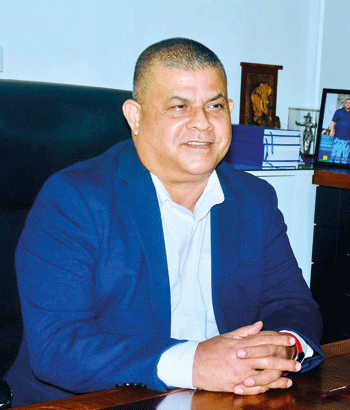
Dr D M A Kulasooriya
And yet we sit 93rd on the Global Innovation Index, invest just 0.11% of GDP in R&D, and watch our most talented young people leave in record numbers. The gap between what Sri Lankan brains can do and what Sri Lanka currently asks of them is the central question of our economy.
Now a second force has entered the room: generative AI has moved from novelty to operating environment in three short years.In the age of intelligent machines, Sri Lanka’s biggest export risks becoming the very thing it was built on: the human mind. The fix is a number every university and boardroom must now learn to read: the Human–AI Ratio.
Higher education is experiencing its most disruptive technological transition since the printing press.
The adoption of artificial intelligence, particularly generative AI tools such as ChatGPT, Microsoft Copilot, and Grammarly, has accelerated at a rate that has outpaced institutional policy, faculty readiness, and pedagogical frameworks. AI is no longer a supplementary feature of higher education. It is the operating environment.
THE QUIET EMERGENCY
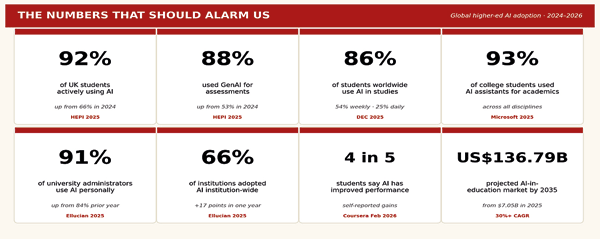
86% of learners worldwide now use AI in their studies. 93% of administrators use it personally. Two-thirds of universities have adopted AI institution-wide: a 17-point jump in one year. Only 42% of students believe their faculty have prepared them to use it well.That is not an inconvenience. It is a cognitive and pedagogical emergency unfolding in real time in our lecture halls, our boardrooms, and our policy desks.
The AI-in-education market is projected to grow above 30% a year through 2035, to nearly US$137 billion. Universities that over-automate will produce graduates who can prompt an AI to think but cannot think for themselves. There is a third path. It begins with a number.
THE HUMAN–AI RATIO (HAR)
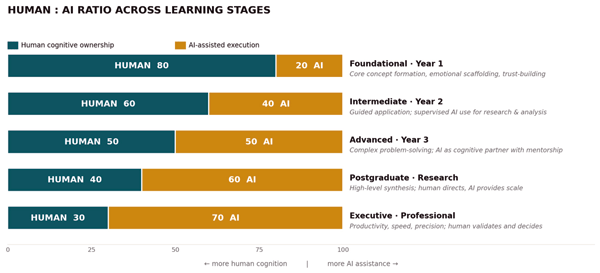
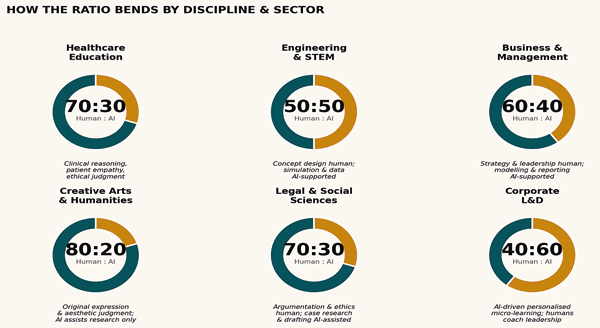
The question is no longer whether AI should be integrated into higher education. It already has been, at scale. The real question is sharper: what proportion of any given learning experience should remain under human cognitive ownership?That proportion has a name. The Human–AI Ratio (HAR).The HAR is not a fixed number. It bends with the learner’s cognitive stage, the nature of the discipline, the complexity of the objective, and the readiness of the institution. A first-year humanities learner is not on the same ratio as a postgraduate engineer; a hospital intern is not on the same ratio as a corporate analyst.The framework, in two views.
“The most dangerous outcome is not the Learner who misuses AI. It is the institution that fails to design a boundary between AI-assisted cognition and authentic human thinking.”
The HAR Premise
THE ALGORITHM, AND THE STAKES
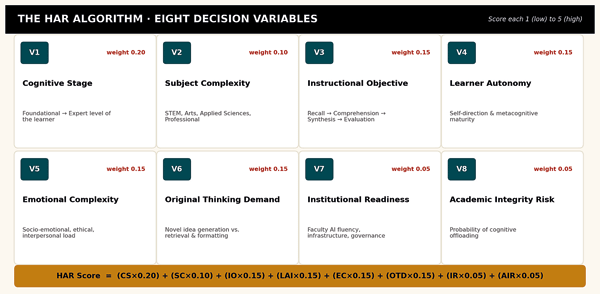
Eight variables every curriculum architect, dean and L&D head should now be able to score.
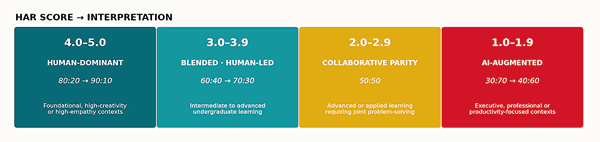
Determining the right ratio for any given learning context is not a hunch but it is a calibration. Drawing on cognitive science, educational research and the Think — Do — Finish (TDF) framework, the HAR Decision Algorithm reduces the choice to eight variables, each scored 1–5. The weighted result, between 1.0 and 5.0, maps cleanly to a Human:AI ratio.
Each variable scored 1–5. The weighted sum maps to a Human:AI ratio.
THE COGNITIVE DIVIDEND
The integration of AI into Sri Lankan education is irreversible. The question before every vice-chancellor, L&D director, minister and policy maker is not whether to integrate AI, it is how to integrate it without diminishing the cognitive sovereignty of the learner.
The Human–AI Ratio is not a temporary policy measure. It is a permanent design principle as fundamental to 21st-century pedagogy as the curriculum itself. Calibrated correctly, it frees human intelligence for what only humans can do: forming original questions, making ethical judgments, and imagining futures that do not yet exist.
AI can process a thousand answers. Only a thinking human being can conceive the right question. That is the cognitive dividend this ratio is designed to protect and the one Sri Lanka can no longer afford to forfeit.
Dr D M A Kulasooriya
Director General
National Institute of Business Management

HitAd.lk is the best and biggest mobile phone market in Sri Lanka, and we guarantee you will find what you need here from our extensive listing of mobile phones for sale in Sri Lanka. Whether it’s a budget-priced smartphone for communication, or higher end features with advanced connectivity, there are many different options from which to choose from on our site!