


A pure and undying love for Batik
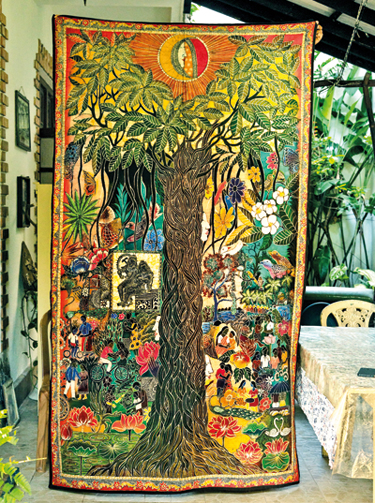
The sweeping Tree of Life: A banyan tree depicting Jezima's whole life story
There is a moment Jezima Mohamed has never forgotten. She was in her twenties, sitting in a cooking class in Matara, Sri Lanka, when she saw it for the first time: a batik textile, alive with colour, the wax-resist cracks running through it like lightning frozen in fabric. She had been painting since she was ten. She had been sewing since she was twelve. But nothing had prepared her for this. “I went mad,” she says simply, her eyes bright at 86. “I thought, my God, I must learn this.”
That moment of electricity — the collision of two loves, painting and fabric, fused into something wholly new — launched a career that would span more than six decades, take Jezima to Switzerland and Germany, earn her royal recognition from Buckingham Palace, and make her home in Matara a living studio, school, and pilgrimage site for visitors from across the world.
And yet, until recently, she has remained almost entirely unknown in her own country.
That is something those who know her work are determined to change.
Jezima was born on January 14, 1940, in Colombo, during the twilight of the colonial era. When her father suffered a stroke at thirteen, the family’s world shifted, and Jezima stepped forward. “I had to work with my mother,” she recalls. “I would go to school, and in the evenings, I would sew.” By 12, she was making her own school uniform. By 18, she had married a teacher who supported her education, and she threw herself into art classes, handicraft courses, and a formal dressmaking programme in Colombo.
It was out of that web of disciplines — painting, sewing, textile-making — that batik became her true calling. The technique, rooted in Indonesian and Malay tradition and woven into the oldest ceremonial flags of Sri Lanka, involves applying wax to fabric before dyeing it, creating patterns of startling beauty. But what captivated Jezima was not just the craft. It was the mystery. “You draw a design, and you never know how it’s going to come out,” she explains. “When it’s finished, the colours are always different. You can never make the same picture twice.” Even after six decades, the surprise still gets her.
For seven years after she began her batik practice in earnest, Jezima worked alone — waxing, dyeing, experimenting — without selling a single piece. Then, in 1979, two American visitors named Susan and Joel stumbled into her home, sent by the local rest house. Joel asked her to make a batik depicting the ancient Isurumuniya temple carvings. Ten days later, when she revealed the finished piece — black and white, intricate, extraordinary — they were stunned. They came back every day to watch her work. What was supposed to be a two-day visit stretched to 15 days.
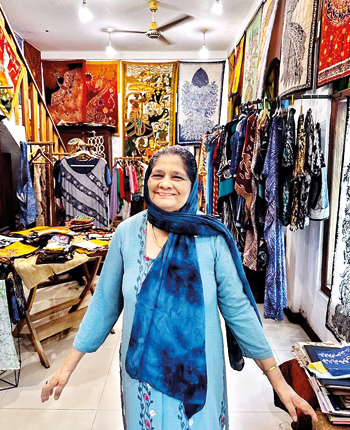
Jezima amidst her creations
“Everyone should come here to learn like this,” they told her. And they did. From 1979 onwards, Jezima’s home became a destination. By 1983, she says, not a single day passed without visitors. Today, guests still arrive from the nearby hotels, drawn by a mention in a German magazine, drawn by word of mouth, drawn by something harder to define — the pull of authentic creative mastery.
In 1973, Jezima sent three hand-crafted silk headscarves to Buckingham Palace for Queen Elizabeth II’s Silver Jubilee. She received a formal reply. She did it again for the Golden Jubilee. And again for the Platinum Jubilee in 2022. A remarkable thread connecting a humble batik studio in Matara to the British monarchy.
She also had her work exhibited in London to an audience of 600 artists, had sold out shows in Switzerland and Germany, and held exhibitions in Las Vegas in 1993 and 1994. Yet for years, her work was systematically overlooked at home. At one major Colombo exhibition, she arrived to find her pieces — pieces that had placed first, second, and third at the provincial level — shoved under a table. “Only Colombo people’s things were on display,” she says, the hurt still present in her voice. Her children urged her never to enter again. She agreed. She didn’t need to.
When asked about her most recent major work — a sweeping Tree of Life created for the Matara Arts Festival — Jezima’s voice softens. A curator suggested a banyan tree. The idea had already been living inside her. “The banyan tree is always in my mind,” she says. “I love my family, my sisters, everyone together. Wherever I go, we all go. Every festival, every function, 26, 28 people in the house. So this banyan tree is my whole life story.” Her pieces sold at the festival for a record 1.6 million rupees.
Every line on every piece she has ever made was first drawn by her own hand. Every colour was her decision. She has never made a piece for the local market, never compromised for volume or price point. “I love to make one piece, spend my time, make something very nice,” she says. “To sell cheap and make money — that I don’t like.”
When I ask where her ideas come from, Jezima smiles. “Yesterday, when I was praying Fajr,” she says, referring to the pre-dawn Islamic prayer, “I got a nice idea for a new picture. Allah always gives me ideas.” It is a line that encapsulates something essential about Jezima : the artist and the woman are inseparable. Her faith, her family, her craft — they are not compartments but a single continuous thread, like the wax lines running through her fabric.
She is now working with a fashion designer based between London and Greece, producing kaftans, kimonos, and wearable art that carries her signature batik into a new generation of wardrobes. She has five children, all married and scattered across the world. She has lost count of the students who have sat at her table and left with wax on their hands and wonder in their eyes.
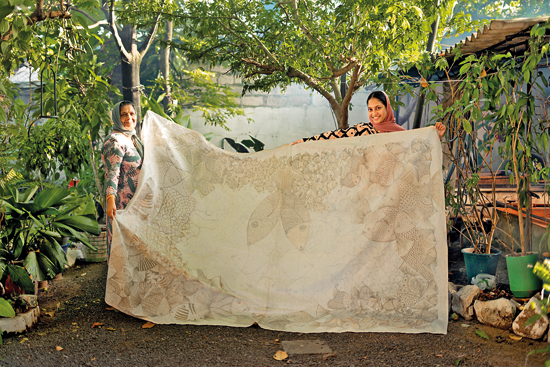
Jezima and grand daughter Nourah hold up a work in progress. Pix by Isira Lakshan
Her message, when I ask for it, is characteristically unadorned. “If you want to do something, you have to go on — through all the troubles, all the problems. We lost everything in 1983. We had to start again. But you can always start again.”
Sri Lanka has a habit of not recognising its own treasures until the rest of the world points the way. At 86, Jezima Mohamed — artist, designer, teacher, matriarch — is living proof that the greatest works of art are made not for markets or medals, but out of pure, unstoppable love. The world already knows.
It’s time Sri Lanka caught up. Follow Jez Look Batiks on Instagram.
Afdhel Aziz is the writer and director behind ‘Jayaflava: Celebrating Sri Lanka’ on National Geographic India and ‘The Genius of the Place: The Life and Work of Geoffrey Bawa’. .
Searching for an ideal partner? Find your soul mate on Hitad.lk, Sri Lanka's favourite marriage proposals page. With Hitad.lk matrimonial advertisements you have access to thousands of ads from potential suitors who are looking for someone just like you.