


Flies, sparrows and crows
View(s):Modernisation of a bus terminal or purchase of new buses or making other physical improvements will not last if people’s attitudes and behaviour remain unchanged. Without a shift in mindset or habitual behaviour—like damaging facilities or littering— this can quickly undo progress. True development depends not only on infrastructure but also on how responsibly people use and protect it.
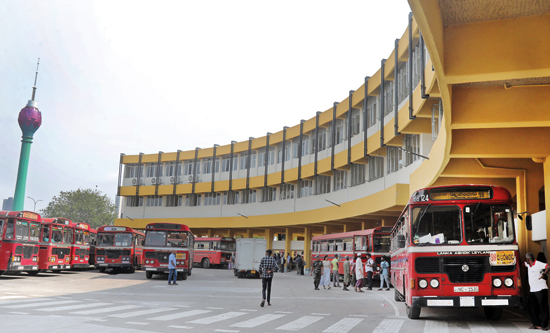
The renovated bus terminal at Pettah. Pic by M.A. Pushpa Kumara.
First World standards
I was immediately reminded of Singapore’s late Prime Minister Lee Kuan Yew’s reflections in his memoir The Singapore Story. At a time when Singapore was still an underdeveloped fishing hub, he envisioned that Singaporeans must be trained to adopt First World standards in every aspect of life because it was going to be a First World country.
He wrote: “If communists in China could eradicate all flies and sparrows, surely we could get our people to change their Third World habits.” His point was that, although immensely difficult, such transformation was possible—and he was determined to achieve it.
Lee Kuan Yew was referring to China’s “Four Pests Campaign” launched in 1958, which sought to eliminate not only flies and sparrows, but also rats and mosquitoes, all considered harmful to public health and agriculture.
Singapore, too, later faced its own challenge. In the 1980s and 1990s, the rapid increase in crows became a serious nuisance in urban areas and threatened other bird species. To address this, Singapore introduced measures to control the crow population.
Law enforcement
When a country introduces laws and regulations to eliminate underdeveloped habits and raise behavioural standards, they must be enforced consistently and over a long period. It usually takes 10–20 years for new behavioural patterns to become firmly established. At the outset, one generation often struggles to shed old habits. Many get caught violating rules and paying fines—if enforcement is effective. Over time, however, younger generations grow up within the new framework and naturally adapt to higher standards.
If, on the other hand, a country tolerates “Third World habits,” these behaviours persist across generations. Sporadic or selective enforcement of laws will not bring meaningful change; only steady, uncompromising application can reshape society.
Spitting in public
 An ideal example is Singapore’s “anti-spitting campaign” launched in the 1960s. Lee Kuan Yew recalled in his memoirs how difficult it was to eradicate this habit. He wrote: “…even in the 1980s, some taxi drivers would spit out of their car windows and some people were still spitting in markets and food centres.”
With his vision of a “clean and green Singapore”, Lee explained the challenge more vividly:
“The physical infrastructure was easier to improve than the rough and ready ways of the people. Many of them had moved from shanty huts with a hole in the ground or a bucket in an outhouse to high-rise apartments with modern sanitation, but their behaviour remained the same. We had to work hard to be rid of littering, noise nuisance and rudeness, and get people to be considerate and courteous.”
Sri Lanka, of course, was never quite as bad. Most Sri Lankan families did not live in makeshift shanty huts with rudimentary sanitation. These conditions reflected Singapore’s poverty, overcrowding, and weak public health infrastructure before modernisation. The comparison underscores how much harder Singapore’s transformation was—and how determined leadership and consistent enforcement were needed to change entrenched habits.
British standards
Singapore’s rise from a Third World to a First World country was not only about abstract economic growth or building physical infrastructure. It was equally about tangible improvements in people’s discipline, behaviour, and living standards.
By contrast, Sri Lanka held a unique advantage at Independence in 1948 compared to many of its Asian neighbours. The British colonial administration had already introduced laws and regulations modelled on British standards, laying the foundation for a disciplined and modern society.
For example, public spitting was prohibited in Colombo under the Municipal Councils Ordinance, first introduced in the late 19th century and consolidated in 1947. Municipal Councils were empowered to pass by-laws on sanitation, hygiene, and public order—long before Singapore began its own campaigns.
Similarly, the colonial government introduced the “dog licence” system through the Dog Registration Ordinance of 1902, requiring households to register and licence their dogs. This was primarily a measure of public order, taxation, and disease control, and had already been in place in Britain since 1878.
After Independence
After Independence, Sri Lankan authorities gradually abandoned the consistent enforcement of many laws and regulations introduced under colonial administration. Instead of strengthening the foundations of a disciplined society, successive governments allowed the return—and even the promotion—of “Third World habits”.
That said, we can agree that the civic sense of Sri Lankan society remains higher than in many neighbouring South Asian countries. This advantage stems largely from the colonial legacy of laws and regulations designed to instill discipline, along with relatively higher educational standards.
Yet it is difficult to ignore the fact that little has been done to improve these standards since Independence. Too often, Sri Lankans have dismissed colonial-era regulations as “bad”, teaching younger generations to define right and wrong according to personal preference rather than shared civic norms.
78 years later
Even today—decades after Independence—it is not unusual to see bus drivers and tuk-tuk drivers spitting on the road while driving, with passengers often doing the same. Some throw trash from moving trains with open windows and doors, and even schoolchildren can be seen discarding snack wrappers from school vans.
This raises a deeper question: did Sri Lanka ever have a leadership vision to move decisively from its Third World status to a First World position?
If such a vision had existed, there should have been sustained efforts to instill First World standards in the people and to strengthen, rather than weaken, the civic rules inherited from colonial administration.
The recent New Year season illustrates the problem. Traffic Police announced the strict enforcement of traffic laws during the festive period. But this immediately raises a valid concern: are traffic laws meant to be enforced strictly only at certain times?
Does it mean that traffic laws are not meant for “strict enforcement” other time? Or will they be “lightly enforced” under normal situations? If so, the very idea of a law loses its meaning, and discipline cannot take root.
Love or law?
There are two things that discipline people – love and law. In societies where people have internalised respect for discipline and the environment, behaviour flows naturally. A person does not litter because they feel it is wrong, not because they fear a fine. People stay in line, or a bus driver stops at a red light because they value order. This is love—a deep cultural affection for decency, discipline, and the common good.
Japan is often cited as an example. After a football match or a festival, spectators clean the stadium before leaving. No one forces them; they do it out of respect. In Scandinavian countries, recycling is not just a law but a way of life. People separate waste because they believe it is their duty to the environment. Love, in these cases, is stronger than law.
Where love is absent or weak, law steps in. Rules, regulations, and enforcement ensure that people behave well, even if they do not feel the inner pull of discipline. Fear and shame of punishment replaces affection for order.
Singapore illustrates this model. Heavy fines for littering, jaywalking, or vandalism have created one of the cleanest and most orderly cities in the world. People comply because they fear the consequences. Law becomes the substitute for love.
Neither love nor law?
The real danger lies in societies where neither love nor law exists. Here, behaviour turns destructive. People act as they please, defining their own rules as they see fit. Discipline collapses, the environment suffers, and public goods and assets are destroyed.
In such places, politicians often worsen the problem. Afraid of losing votes, they allow disorder to continue. Instead of guiding citizens toward a disciplined society, they please the crowd for the ballet at whatever cost to society.
This raises a paradox. Democracy is meant to empower people, but when rulers fear the people or the groups that voted them to power more than they respect the law, discipline collapses. I wonder which of the political leaders of Sri Lanka has secured their position in doing so during the post-independent history of the country.
(The writer is Emeritus Professor at the University of Colombo and Executive Director of the Centre for Poverty Analysis (CEPA) and can be reached at sirimal@econ.cmb.ac.lk and follow on Twitter @SirimalAshoka).
Hitad.lk has you covered with quality used or brand new cars for sale that are budget friendly yet reliable! Now is the time to sell your old ride for something more attractive to today's modern automotive market demands. Browse through our selection of affordable options now on Hitad.lk before deciding on what will work best for you!