


Nalanda Gedige: Where the Theravada, Mahayana and Hindu traditions live side by side
Nalanda Gedige is one of the most intriguing archaeological mysteries in the island; even the country’s first Archaeological Commissioner H.C.P. Bell, in the Archaeological Survey of Ceylon report of 1910, was moved to use phrases like “enshrouded in mystery” and “unique” when describing this enigma.
The Gedige was rediscovered in the 19th Century by early British antiquarians amidst the green paddy fields and hills of Matale. Bell succeeded in buying the land around but systematic excavations were not done (Bell had his plate full with Sigiriya and other major projects).
Though Bell wrote a seven-page report on the Gedige, it was in the 1980s that proper excavations were undertaken. In that decade, the Gedige was under risk of being inundated by the newly-built Bowatenne reservoir, so the whole structure was relocated to a higher spot.
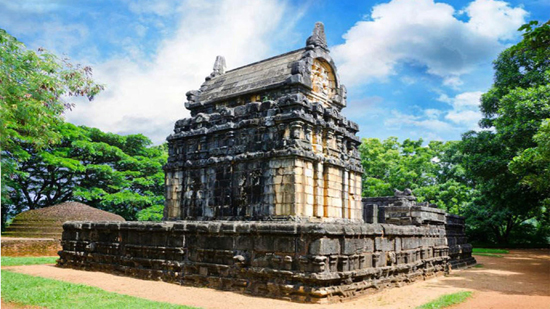
Shrouded in mystery: Nalanda Gedige
Believed to be the oldest all-stone structure left in the island, the Gedige is dated to around the 9th to 10th Centuries AD. Your first sight is awe-inspiring; it looms on you suddenly after walking down a shady path soaring up mysteriously with a nameless stupa by its side. The only building in the island built according to Pallava architecture, it is also the only one in Lanka where the Theravada, Mahayana and Hindu traditions cohabit under the same roof.
The original location of the Gedige is supposed to be the geographical centre of Sri Lanka, and there were concerns when it was moved as to whether it would prove to be unpropitious.
Also apparent here are Tantric influences in the sculpture. The most intriguing sculpture is not that of Lakshmi above the entrance or that of Kuvera (the pot-bellied deity of wealth) but a certain, now worn-out panel on the outer wall, where two men and a woman are engaged in a certain activity Bell describes as – “of which, propter bonos mores, the less said the better”! Recalling Khajuraho, this is supposed to be
the only carnal piece of sculpture found in
Sri Lanka.
The dating of the Gedige suggests that it was probably built when the island was under South Indian yoke after the Anuradhapura kingdom collapsed. In the 1910 report Bell called it the “sole example yet discovered in Ceylon of composite styles of architecture judiciously blended to form a delightfully homogenous edifice”.
The Gedige in the sixties drew the attention of that most colourful of Ceylon’s British chroniclers, Major Roland Raven-Hart, who in Ceylon History in Stone wrote:
“Elsewhere there are plenty of Hindu buildings, and plenty of Buddhist ones, and some muddled mongrels, but here the styles are interwoven. The ground plan is Buddhist, the vestibule pure Hindu, and so is the little windowless shrine: the plain moonstone and crocodile balustrade and rivers of dwarfs and architrave of the doorway are Sinhalese, and jambs Tamilian; even the sculptures are fairly shared. The whole effect is charming and for me, unexpectedly classical, nor did I find the exterior “over-richly decorated” as did Bell, though it is crowded with pilasters and horseshoe false windows and more jolly dwarfs. And the dome must have been a worthy climax when all its four faces were present, each with a horseshoe niche and statue, instead of the one only which was found.”
The stupa that stands by, in lore at least, is associated with King Dutugemunu. A partly deciphered pillar inscription contains a monastic code of conduct or regulations, though the name of the monastery is unfortunately illegible. Part of it says: “…not to allow into the monastery premises robbers, murderers, bullocks, etc., all work of the monastery to be carried out with the consensus of the resident monks, and workers of the monastery who commit undesirable acts to be eliminated”.
Archaeologists have pointed out that the building may have been Hindu and Mahayana at the beginning and that later Theravada Buddha statues were kept within. The location away from the Rajarata kingdom probably helped the Mahayana site to flourish unchecked.
Today managed by the Department of Archaeology, the Nalanda Gedige is easily reached; travelling down Dambulla-Matale Road, turn in next to the Nalanda Hospital and proceed for 1 km. Ample parking is available near the entrance.
Searching for an ideal partner? Find your soul mate on Hitad.lk, Sri Lanka's favourite marriage proposals page. With Hitad.lk matrimonial advertisements you have access to thousands of ads from potential suitors who are looking for someone just like you.