


Barbara’s inspiring insights into domestic architecture
“Ceylon has many beautiful houses, a great many of them now leading a slum existence. They were built in the tradition without thought of architecture and without pretence.
Many of them are still better architecture than anything built since the last war -for it is a curious fact that most of the houses built now could be just as well, technically speaking (apart from plumbing and electricity) have been constructed in 1850.
The technique of building has not changed much since then. Fashion has changed, and the workman-like tradition has gone.
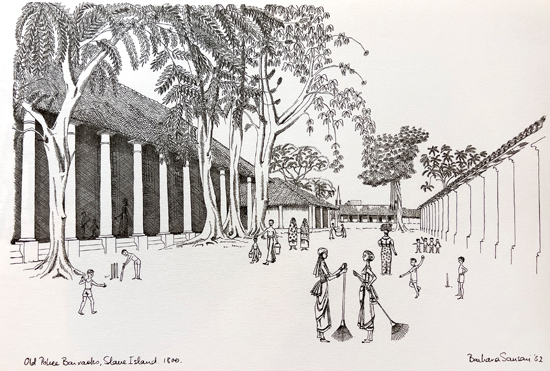
Old Police Barracks, Slave Island: Captured by Barbara in 1962 (courtesy The Architecture of an Island)
Today, and in the following weeks we will show some ordinary old houses which are standing not far from Colombo, and which in their own way are fine architecture. There are thousands like them.
.. The conception and construction of this house, is unlike most modern houses, clear and logical and craftsman like. That is the first condition of good architecture.”
- This was Barbara Sansoni, better known as a legend in the handloom industry writing in 1961.
In over 50 articles published between 1961-1963 in the Times of Ceylon, Barbara addressed vital issues related to the architectural heritage of this country.
Barbara had no formal training in architecture, but her many years of intensive research had given her an understanding of indigenous buildings from different historical periods.
Her main inspiration was the simple domestic architecture of rural Sri Lanka.
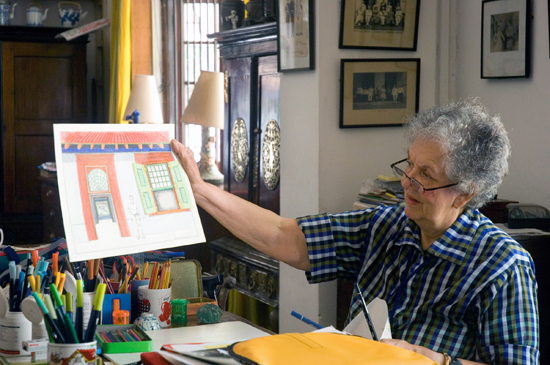
Barbara at work in her home. Pic by Dominic Sansoni
Barbara illustrated each of her articles with wonderfully evocative perspective line drawings using the medium of pen and ink. The majority of these illustrations were the outcome of a documentation project of vernacular and domestic buildings undertaken between 1961-1963 by a team of four comprising Ulrik Plesner, Barbara, Laki Senanayake and myself.
Plesner, the Danish architect who arrived in the island in January 1958, was an associate in the firm of Edwards, Reid and Begg of which Geoffrey Bawa was later to become the senior partner. He was principally responsible in instructing Barbara, Laki and myself to generate attractive illustrations.
Plesner had previous experience in documenting ancient country houses and castles of Denmark following his graduation in 1955 from the Royal Danish Academy in Copenhagen. He explained the basic rules that governed the technique involved in one-point and multi-point perspectives cogently to us. All this was new to us.
Plesner, Laki and I were responsible for the bulk of the architectural drawings, which comprised mainly the plans, sections and elevations. Barbara’s role was to depict the perspective views of the buildings which injected an overall ambience and fitting character to the structures.
Although in the last century a bewildering variety of building materials had been introduced, only a handful of buildings constructed over this period could be considered meaningful and tasteful.
Of these and related issues and of the country’s much neglected architectural legacy, Barbara wrote clearly and succinctly articulating the essential basis of good architecture and design, studiously avoiding the architectural jargon, which has now become so commonplace.
In one of her stimulating articles, she wrote of the complex of buildings in Slave Island now occupied by the Police as residential units. Her insights in architectural spacing between buildings, modulation of columns, and landscape are worth noting:
“These wonderful buildings are in the middle of Colombo, right on Beira Lake off Parsons Road. They form a town of their own, with streets and a square and cool, old trees and they have big fat columns and verandahs the whole way around. In the middle there is a building much bigger, where the columns are twice as high- everything is big. A generous grand building, among others.
There is no other group of buildings, like this in Colombo.
…. As they stand they are architecturally the most complete and finest group of old houses in Colombo” (November 11,1961)
All throughout her contribution both as texts and drawings that continued for several years she lamented that such attractive buildings were substituted by new and ugly structures.
The official view by the responsible government departments such as the Urban Development Authority is that although quaint, these older structures were decayed, and hence a threat to public safety, and need to be demolished, with modern structures constructed in their place.
The importance of her views were probably lost on many of the readers. But not so a small group of architects to whom it made much sense. Among them was probably Geoffrey Bawa whom we now identify with reviving the significance of vernacular architecture
Abandoning a Euro-centric approach Bawa turned to acquiring the craft of building which had been the tradition for hundreds of years. Bawa seemingly echoed Barbara’s view that traditional building practices were vital and the lessons he learned from this architectural strategy, he refined and recycled in his new design vocabulary.
Even as early as 1962 Barbara suggested the establishment of an organization comparable to the National Trust in the UK, which would make the public more aware of valuable old buildings and the need for their conservation.
Barbara’s main line of work was her enduring contribution to textile craft and design, particularly to the handloom industry- which she took to new heights. To bring a wider public recognition of her work, I organized a special exhibition at the Ceylon Tea Centre in Copenhagen in October 1968 where her textiles were exhibited receiving much appreciation.
Though not much talked of, Barbara’s architectural writing too deserves to be remembered and revisited in this age of rapid urban growth.
| Changing lines of pen and ink | |
| Barbara ’s chosen medium to illustrate her text was the traditional pen and ink technique, known in Europe since the time of Durer and Rembrandt. Unfortunately, 1960-1965 was a period of austerity and very few art materials were available due to the stringent economic situation in the country. It was only after 1966 that the draconian economic laws and import restrictions were relaxed, after which artists had access to drawing materials such as water colours, oil paints, good paper and instruments. Until then, artists producing sketches and drawings had to undergo a torturous process while working with mediums such as pen and ink. It was a messy, unforgiving task. It was the introduction in the art market of a pen with a trade name Rapidograph that made drawing in ink much easier. But for all its advantages– these newly introduced pens produced a uniform line and the more attractive flexible curves which gave pen and ink drawing its character and charm were lost. |
Searching for an ideal partner? Find your soul mate on Hitad.lk, Sri Lanka's favourite marriage proposals page. With Hitad.lk matrimonial advertisements you have access to thousands of ads from potential suitors who are looking for someone just like you.