

Columns
Not only Justice remains blindfolded but Lanka’s Cabinet Ministers as well
View(s):Following the brutal killings of Attorney-at-Law Buddhika Mallawaarachchi and his wife Nisansala last Friday the 13th, the President of the Bar Association of Sri Lanka, Rajeev Amarasuriya, issued a statement last Saturday, summoning the membership to a ‘Special General Meeting’ to be held the following day, Sunday the 15th of February.
‘The last time such a special meeting was held,’ he told the media, ‘was 14 years ago when Chief Justice Shirani Bandaranayake’s impeachment crisis was at its height.
After Sunday’s special general meeting had been concluded, a brief note on what had transpired at the special meeting and the conclusions drawn was issued to the media.
The statement said:
Taking into consideration the grave concerns expressed by the membership about the existential threat faced by Attorneys-at-Law, as highlighted by this inhuman assassination of Mr Mallawa Arachchi, AAL, and the similar dangers faced by the Judiciary, as shown by the shocking murder of the late Hon. Sarath Ambepitya, High Court Judge, in November 2004, and with a view to demonstrating the collective desire of the membership to meaningfully express its strong resolve to assist in the process of remedying this grave situation, the membership unanimously decided as follows:
1. To compel the Government to take urgent and robust measures to bring an end to the current culture of brutal killings and to ensure public security;
2. All Attorneys-at-Law to refrain from appearing in all courts throughout the country on Monday, 16th February 2026;
3. To call upon the Law Enforcement Authorities to forthwith apprehend the perpetrators of these brutal killings and to expeditiously take steps according to law;
4. To express the utmost displeasure of the BASL with regard to the public circulation and attempts of narrative creation through unverified information attributed as having been communicated by the Police.
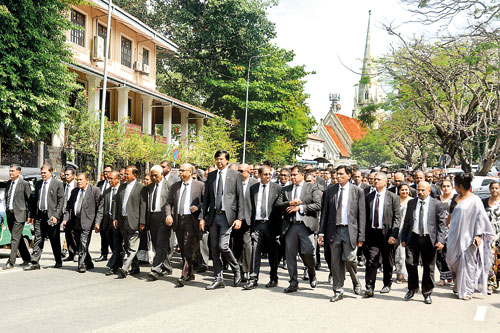
THE LAWYERS LEFT UNDEFENDED BY GOVERNMENT: Boycott succeeds but will the message see a positive result or meet a government garbage bucket?
In other words, lawyers were to boycott courts on Monday to compel the government to take urgent and robust measures to end the wave of killings and ensure public security.
Monday’s total boycott of courts – the earning grounds of their daily bread and butter, occasionally layered with an irresistible rich strawberry spread – was trumpeted by lawyers themselves as an enormous success. But whether the supreme sacrifice they had so gallantly paid in forgoing their daily lucrative fee to compel the Government to end the recurrent torrent of brutal killings would pay off remains to be seen.
So far, the Government has remained unperturbed over the lawyers’ boycott of courts on Monday. In Parliament, Public Security Minister Wijepala dismissed – in the backdrop of a grisly string of such underworld killings – the killing of 44-year-old Buddhika and his 42-year-old wife, Nissansala, who instantly died in a spray of T 56 machine gunfire inside the car park at an Akuragoda supermarket – as an ‘isolated’ one and posed no danger to public security.
JVP MP Chandana Sooriyaarachchi responded to the situation by doling out the hackneyed message clothed in velvet and placed on a silver platter. He said the government is implementing a comprehensive programme to eliminate crime, organised criminal networks and drug trafficking. While acknowledging that such initiatives are progressing, sudden incidents such as the recent shootings create additional challenges and increase pressure on law enforcement authorities.
Brilliant, to say the least, how practice makes perfect the art of storytelling to Grade 6 kids.
At Tuesday’s weekly cabinet briefing, Foreign Minister Vijitha Herath, standing in for Health Minister Jayatissa, said it was an isolated incident and posed no danger to national security. When challenged by a reporter who claimed it did, the minister asked him, “What is national security?” The reporter eloquently defined national security and described how public security is just one aspect falling under its domain. Though flummoxed, Vijitha Herath stubbornly insisted that the killings were isolated incidents which had no bearing on national security.
The Brigade of Lawyers’ boycott of courts for just a day was a total success. It sent a strong message to the government; it could make Justice sheath her sword.
The underworld’s killing of Attorney-at-Law Mallawarachchi and his wife was also a total success. It dispatched a deadly message to both the government and to the entire Legal Brigade that by randomly killing a few notable figures in the Judiciary and at the Bar – whether official or unofficial – they could also make Justice sheathe her sword, not just for a day but for weeks on end.
Perhaps, in the eyes of Cabinet Ministers, such lethal incidents will still remain ‘isolated’ killings, posing no danger to the country’s national security at all.
But the message that rang loudest and appealed the most to the heart was the voice of genuine compassion that flowed from the parents of slain Mallawarachchi. Amidst the grieving tears, falling down from their broken heart for their eldest son, their heart still found a compassionate spot, reserved to pray for the killers’ parents.
From their humble dwelling in some far-off rural hamlet, they wept. ‘May the parents never know the pain we feel as we weep for our dead son. May their mothers never be visited by the anguish we suffer so much.’
| Tragic toll spurred by mob hatred spawned by evil forces of revenge Twelve men charged with the killing of SLPP MP for Polonnaruwa Amarakeerthi Athukorale and a police bodyguard on the streets of Nittambuwe await in the dock of the Gampaha High Court to hear the Tribunal’s judgement. Outside the courthouse, there is mounting tension in the air as families of the accused inside agonisingly wait with bated breath for some news of their loved ones’ fate. It has been a long and agonising wait for the accused and their families, indeed. Apart from the main 12 accused, there were a total of 29 defendants facing lesser charges, and they, and their families, too, endured the same anguish as borne by the others. When judgement hour arrives in court and the fates of those 12 accused hang suspended in the hands of three High Court judges on the bench after judiciously taking into account the surrounding circumstances of the case – unlike Amarakeerthi’s life, which lay in the merciless hands of an infuriated mob braying for blood in a mad frenzy of revenge – the tension mounts, a hush descends, and the eyes of those within court rest fixedly on the raised dais of the judicial bench.  Amarakeerthi Athukorale As the judgement of the court is read and the death penalty is pronounced on all 12 main accused, wails of inconsolable grief break out from families outside. Some of the women, too distraught to cry, seek relief on the shoulders of their family members or friends. One woman, failing to withstand the overwhelming force of enveloping grief, suddenly faints and has to be horizontally borne aloft by people around to a nearby van and swiftly driven away from the scene. Many may feel they have been left widowed at a relatively young age, bereft of their husbands and soulmates by the court’s decision to impose a legal noose round their necks and banish the sun-kissed prospect of building a prosperous future blessed with children and a happy home. Similar feelings of gloomy prospects may have veiled the face of Amarakeerthi’s wife, left widowed at a relatively early age. At a time when the full blush of a rosy-hued dawn stood on the threshold of her marital life, her husband was prematurely robbed of life—not by a legal noose, but by repeated blows from clubs and poles until he was left battered to death on a busy public street: the innocent victim of a violent mob, fed with envy and maliciously driven by demonic hands of revenge. Yet, there was a common invisible bond existing between the women weeping outside the courthouse, aghast at their beloved ones being condemned to death by a judicial bench, and Amarakeerthi’s wife, still bearing the loss of her husband killed in cold blood on a busy highway three years ago. They are tied together by an inseverable cord and find themselves on common ground as the innocent victims of revenge in a climate damned with envious hate. Often, it is the women and children who suffer most as they gather the twigs of their once sturdy oak, felled by a revengeful whirlwind to sate hate-lusts of those fed on unfounded lies after vicious lies without any proof of what is claimed. Simultaneously, the weeping women outside the courthouse can find comfort that they can see their husbands and their children, their fathers, briefly in jail or united with them again in freedom’s pristine air, however wrinkled and old they may be with the passage of time. But there can be no such solace for Amarakeerthi’s wife, whose grievous pain will ever remain deeply etched in her heart. She will never more hear the tread of his feet as he climbs the stairs nor ever behold the smile on his face except in the stillness of photographic images preserved in family albums or found hanging on walls. He will only walk in her nightly dreams and only live for her in memories. A lambent flame of life, extinguished before its ordained span of existence on this earth. All the hope and promise reposed in him, condemned to lie entombed beneath a graveyard stone. Ever since the present constitution was enacted 48 years ago, the death sentence has never been implemented. President Jayawardane – though he let the death sentence remain in the statute books – declined to sign the warrant to make a condemned man swing on the gallows. Instead, it was always commuted to a sentence of life on death row. For the last 48 years, all successive presidents have followed suit. The loved ones of the 12 accused – the families who will financially feel their absence from home and emotionally pine till they return home – will, at least, be spared the nightmare of seeing their condemned men ‘hanged by the neck until they be dead.’ The grieving, weeping, fainting wives who profusely grieved and wept last Wednesday outside a Gampaha courthouse can find immense comfort in knowing with near certainty the hanging will never be carried out, and their 12 condemned men will certainly live to see another sunrise. Furthermore, they can also take heart that the Gampaha High Court had delivered a divided judgement. The presiding judge of the case. Justice Sahana Maapa Bandara delivered a dissenting judgement acquitting all 41 suspects on all 4 counts. The judgement of the two remaining judges on the bench, Justices Rashmi Singappuli and Rasantha Godakawela, sentenced 12 to death, 4 to suspended prison terms, and acquitted all the rest. The divided verdict – so extreme in its division – with the presiding judge taking one extreme and freeing all 41 accused, and two remaining judges on the same bench adopting the other extreme of imposing the penalty of death by being ‘hanged by the necks till they be dead’, will certainly increase the condemned dozen’s chances of an appeal to the Supreme Court being heard. If perchance the appeal to the Supreme Court fails, and the judgement of the Trial Court is affirmed, it will still not be the end of the world for the twelve guilty men. They still have their last trump to play, which can be played only after all appeals have been exhausted: the court of last resort. The court that holds the Conscience of Lanka’s President. Only he has the almighty power to play God at those heavenly heights, where – as Milton described – ‘sole reigning he holds the tyranny of life or death’ – whether the guilty men should be set free, cleansed of their blood-smeared hands and their blood-splattered clubs that battered Amarakeerthi to death on the streets in a frenzy of revenge, or whether the condemned twelve men should be ‘hanged by their necks till dead’ with no mercy shown to their butchery. If this condemned dozen are spared the fate that SLPP MP Amarakeerthi accidentally met on Nittambuwe street three years ago, and the brutal killing is defended on the mitigating ground that Amarakeerthi was clubbed to death not because the attackers bore a personal grudge but because they beheld him as a symbolic target of the people’s collective hate to be battered to death on sight, then the question must be answered: Who spawned the hate and nationally sowed its seeds on every garden plot and fertile field all across the broadacre of this land? Who stored the whirlwind to unleash its fury at the appropriate hour? | |
Buying or selling electronics has never been easier with the help of Hitad.lk! We, at Hitad.lk, hear your needs and endeavour to provide you with the perfect listings of electronics; because we have listings for nearly anything! Search for your favourite electronic items for sale on Hitad.lk today!
Leave a Reply
Post Comment