

Columns
Dance that funky freedom music
View(s): If this year’s Independence Day celebrations pathetically failed to kindle the flame of inspiration in the collective breast of Sri Lankans, fear not; it was not by accident that they lacked lustre; it was by government design.
Minister of Local Government, Professor Chandana Abeyaratne—the one who issued a circular to the ministerial staff shortly after taking ministerial office, warning them he was no mere dime-a-dozen lecturer but an exalted professor who breathed the rarefied air, and that henceforth he should be strictly addressed as ‘Professor Chandana Abeyaratne’ and nothing short of it—threw a wet blanket on the following day’s Independence Day celebrations that, by tradition, symbolically show off the nation’s past glories and the pomp and pride of its defending might.
On 3rd February, Professor Chandana Abeyaratne—to call him by his full name, professorial handle and all, lest he take umbrage—says at a media briefing that Independence Day will be held on a simple note without the usual display of the military hardware the Tri-Forces possess in their respective armouries.
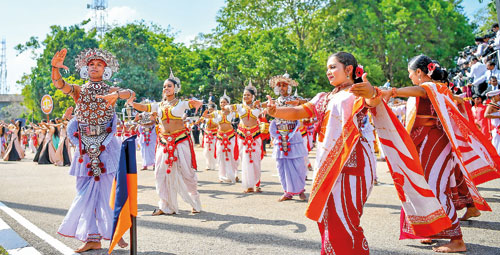
FREEDOM’S MIDNIGHT HOUR 78 YEARS LATER: Gyrating on the Millenium independent catwalk to meet free and footloose Gen Z trends
Professor Chandana Abeyaratne, appointed as the Chief Organiser of this year’s Independence Day ceremonies, declared, ‘Independence Day ceremonies will be kept at a low key. There will be no military parade. We do not believe that national pride can be built by displaying military equipment bought with borrowed money.”
Elaborating further on what national pride must be founded, the professor declared on Serana TV, ‘National pride must be tied to economic development,’ and pointed out that the government is taking rapid steps toward a manufacturing-based economy, with special focus on research and development and contributions from internationally recognised Sri Lankan scientists.
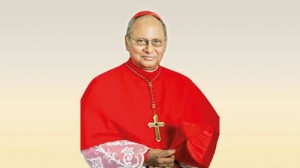
CARDINAL: Dismayed
Although results may not appear immediately, he expressed confidence that by the 79th or 80th Independence Celebrations, Sri Lanka’s inventions and research achievements will be proudly presented to the nation.
With all due respect to his professorial infallibility, a few questions, however, demand to be asked on this superficial statement he made—unworthy of his academic scholarship—at the media briefing on Tuesday that cast an indelible slur on the nationalistic pride of a nation that will dump the proud boasts of heraldry into the surrounding seas when it is fighting for survival as a unitary state and would beg, borrow or obtain the necessary military wherewithal on borrowed money, if need be, to prevent the dismemberment of Sri Lanka.
Furthermore, this nation does not derive false pride from heaps of iron or metal lying idle in its military depots—whether bought on credit or not—but inevitably finds genuine pride swelling in its resilient breast when patriotic men and women of Lanka bravely lay their lives on the line and skilfully employ the iron and metal to courageously safeguard the country’s territorial integrity and its continued status as a unitary state.
Heroes are forged on battlefields, not in air-conditioned offices of government ministers.
However, Abeyaratne, by his insolent observation, set the downgrading tone of the Independence Day ceremonial proceedings to warn the people in advance that this year’s ceremony will be nothing more than a ritualistic affair held before a diplomatic corps to mark the day of the nation’s deliverance from the yoke of a British colonial harness.
But the people did not expect to hear hosannas sung of the glorious struggles waged by their forefathers in the quest to gain independence, as there were, in reality, none to boast about to the high heavens. Ceylon’s independence had a painless delivery and was handed over on a silver platter as a parting gift of goodwill from the departing British fleet.
But if there is a purpose behind the yearly resurrection of Independence Day, it is not to relive that historic day alone; it is to revisit the milestones this nation has passed. Each milestone stands as a monument to challenges met and the feats accomplished; a testament in stone to all this nation has achieved, despite 78 years of economic downfall and 30 years of a terrorist war.
It is to celebrate 78 years of achievements after we became the masters of our fates, when the long-held captive spirit of the people finally found release from colonialism’s cage.
It was to see the parade of a long line of armoured tanks, rocket launchers and heavy vehicles as the Military Forces unveiled their proud array of the weaponry held in their arsenals. They may lie impotent in the armouries without a single shot fired in resistance at the appearance of a hostile regional power in the distant horizon, but they certainly played a significant and decisive role in ending a 30-year destructive war, ending the senseless loss of human lives and beholding the dawn of lasting peace.
It was, no doubt, financed by means of loans obtained from international lending institutions and states. If that provoked Minister Chandana Abeyaratne to raise his hands in horror and say at a media briefing this week: We will be holding the Independence Day ceremonies on a very simple note. There will not be any military parade. The pride of the nation cannot be built on weapons bought on loans’.
In the event of another terrorist war starting, if before the defence of Lanka can begin, it has to wait until the payment for weapons bought is settled in full with cash proudly paid upfront, it will not leave Lanka suffused with pride but will leave it in a surfeit of catastrophic shreds.
This crass and foolishly naive comment, so untenable to maintain or defend, only served to reveal the limitless extent and starting flair of Chandana Abeyaratne’s professorial scholarship. Even Jaffna’s only independent MP, the irrepressible Archchuna, could scarce forbear to retort in Parliament, ‘Haven’t everything you have worn, from your underwear upward and downward, been worn on loan?’
During the dark, bleak days of World War II, when the Nazi shadow was rapidly spreading across Europe, leaving Britain to stand alone against the might of Hitler’s advancing Nazi forces, US President Roosevelt, to raise the morale of Churchill, writes in his own handwriting the following Henry Longfellow’s verse:
‘. . .Sail on, O Ship of State!
Sail on, O Union, strong and great!
Humanity with all its fears,
With all the hopes of future years,
Is hanging breathless on thy fate!
Reading the verse aloud in Parliament, Churchill asks the House, ‘What is the answer that I shall give, in your name, to this great man, the thrice-chosen head of a nation of a hundred and thirty million? Here is the answer which I will give to President Roosevelt: Put your confidence in us. Give us your faith and your blessing, and, under Providence, all will be well.’
‘We shall not fail or falter; we shall not weaken or tire. Neither the sudden shock of battle nor the long-drawn trials of vigilance and exertion will wear us down. Give us the tools, and we will finish the job.’
Taking the cue from Roosevelt’s handwritten letter, the British Prime Minister dumps British pride in the English Channel and appeals for military help through a long-term loan.
Britain’s Prime Minister Churchill sent a formal 15-page letter to President Roosevelt in December 1940, informing him that Britain was nearly broke and could no longer pay cash for supplies bought on loan.
The US President responded to this appeal by proposing instead the Lend-Lease programme in December 1940. Employing the analogy of lending a “garden hose” to a neighbour whose house is on fire, Roosevelt suggested that America should provide military hardware to Great Britain to be returned or paid for after the war had ended. The Lend-Lease Act of March 1941 allowed the U.S. to provide billions in military aid to nations vital to American defence, including Great Britain.
Perhaps, if he’s ever chosen again to play the role of Master of Ceremonies, the Professor can see and learn from the US-UK Accord. There is no loss of pride when the nation hocks the family silver to purchase arms to fight and prevent being torn asunder by the armed spectre of separatism.
If there was any gravitas left towards the end of this highly formal state occasion with foreign diplomats gracing the annual event, it took flight from freedom’s historic square the moment Pandemonia arrived on the catwalk to dance that funky freedom music with her bevy of inmates.
They twisted and turned, they swirled and twirled, nurses with raised hands clutching rolled-up certificates tied with red ribbons, female lawyers dressed in white sarees and draped in black gowns swaying from side to side, male lawyers in black jackets and black ties, graduates with their mortarboards, and Kandyan, low-country and Baratha Natyam dancers, abandoning their traditional styles and dancing to the same tune, while a gang of grease-yakkas covered from head to toe in tight-fitting black wear with faces painted in white ran wild between row and row like three-wheelers changing lanes in traffic, comprised the potpourri that would have danced all night in freedom’s trance, if asked.
But no cannon guns boomed near Independence Square, no 21-gun salute to honour the fallen, the martyrs who sacrificed their lives for Sri Lanka to remain a unitary state.
Perhaps, Minister Abeyaratne saw no pride in that, for they had used guns bought on borrowed money to defend the motherland.
At Independence Square, the President made an appeal: ‘Leader of the Opposition, the public service and religious institutions, call upon all citizens to come together and commit wholeheartedly to the comprehensive reconstruction of our country.’
To drive home the point, he borrowed an African quote that said, ‘One travelling alone can go faster, but if all travel together, they go longer.’
Earlier in the day, the President’s, the Prime Minister’s and the Opposition Leader’s messages had been published in the newspapers. They all expressed the same clichéd messages of no great import.
The significant ones were nailed to the mast; the prevailing uncertainties of the way this country is proceeding—whether it is heading North or South or East or West or simply spinning like the direction hand of a compass gone mad—came from the nation’s religious guardians.
From the Siam Nikaya, the religious custodians of the Sri Dalada, came the succinct message. The Anunayake Thera of the Malwathu Chapter of the Siam Nikaya declared in no uncertain terms, ‘What this country needs now from this government is to talk less and to work more for the people’s welfare.’
The Cardinal stole the Independence Day spotlight by delivering a sermon from the pulpit of his heart that spoke of the dangers involved in ‘trying to build the country in a way that is contrary to the religious and moral values’.
Cardinal Malcolm Ranjith did not mince his words in his pre-Independence Day message but expressed his frank opinion of the reigning mayhem existing in the country today.
He said, ‘The spiritual thinking of our country has been largely shaped by Buddhism and its values, brought by Arahant Mahinda in the third century BC. Our character, discipline, and civility are largely shaped by it.
‘It is the responsibility of the political world to always preserve this religious heritage and to guide and assist other religious groups living in this country towards spiritual awakening.
‘It must be said here that it is absolutely inappropriate for our country to obscure the religious identity of our citizens or to act in a way that contradicts that heritage and weakens that religiousness. Since all the rulers of the country are citizens of our own country, they too should not be of any religion or human rights.
‘It goes without saying that they embrace a libertarian mindset. Everyone is free to follow any religion or philosophy of life they choose.
‘Since our country is a country built on a long religious tradition, particularly the influence of Buddhism, it is clear that the country’s leaders should respect religious traditions. Trying to build the country in a way that is contrary to the religious and moral values that arise from our society because of a certain political ideology is not the way to achieve the desired economic and social progress.
‘It seems that the attitude of those who govern the country towards Buddhist monks and their treatment of them as those who have no right to say or do anything in the public affairs of the country has been intensifying recently. Similarly, we must condemn the statements made by some government ministers that undermine religious leadership.
‘True economic progress in a country can only be achieved if it is built on righteous principles. Anyone who does not accept religion and seeks only human progress will be lost.
‘Today, Sri Lanka is in a very dangerous period economically. In our economy, which collapsed in 2022, we are trying to follow the advice of the International Monetary Fund, but we are in a very uncomfortable period due to poverty, economic abnormality, and having to live in debt to powerful countries of the world. Many families in this country are living in a period filled with very dangerous debts.’
‘No matter how many promises political leaders make, the country’s economy still has such a foundation.
‘Similarly, the selfish rejection of children in the concept of a small family being golden has disrupted the balanced population ratio between different ethnicities and religions in the country, creating dangerous precedents for another clash between ethnicities in the future.
‘The politicised education system is creating a selfish and vulgar cultural foundation, and the country is once again moving towards a state of division.
‘Because of all this, our country’s leaders should not try to take the country forward through a mindset that is incompatible with our culture and civilisation but should strive to take our society forward, its diversity, and the religious and moral values within it. I would like to state that doing so is their primary responsibility.’
The Cardinal’s sermon has transcended all faiths, all races, all creeds and castes and resoundingly given echo to the unspoken fears, griefs, doubts and uncertainties lying within the hearts and minds of all worried and disturbed citizens of this country.
Buying or selling electronics has never been easier with the help of Hitad.lk! We, at Hitad.lk, hear your needs and endeavour to provide you with the perfect listings of electronics; because we have listings for nearly anything! Search for your favourite electronic items for sale on Hitad.lk today!
Leave a Reply
Post Comment