

Sunday Times 2
The purpose of education should be to provide the country with a productive, intelligent workforce
View(s):By Ananda Amarawansa
Free education in Sri Lanka, initiated by Mr C.W.W. Kannangara, has come a long way to date. But how much fruit have the people of our country reaped from it? To what extent have his desired goals been achieved? How well do the educational changes made since independence fit the country’s economy? Many issues need to be discussed.
The primary objective of free education was to open up higher education, which had previously been restricted to a privileged few, to the general public. The 55 Central Colleges-Vidyalaya programme and scholarship programme created in the initial phase were a major avenue to achieve this objective. This opened up the avenue of education that was previously closed to talented students, especially those selected from rural and underdeveloped areas. The scholarship system was not used to select students for popular schools as it is today, but the idea was to provide talented students from low-income families with the opportunity to develop their talents in a central college within the district while receiving hostel facilities.
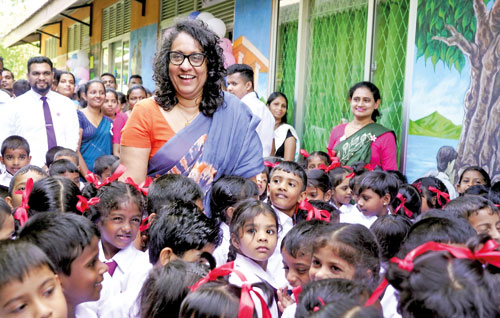
Prime Minister and Education Minister Harini Amarasuriya: The main architect of the education reform, seen with school children in Galle
The central colleges were not limited to just the name. An attempt was made to create an educational innovation by making it a centre of learning in the region for all students, providing it with all the facilities and appointing a competent teaching staff. Even in the central schools, education was initially provided through the medium of English too. It was a necessity of the times. But after 1959, as the medium of instruction in all government schools became the vernacular, the language of secondary schools and tertiary education also changed accordingly. This was seen by many as a progressive move.
Native language education and deficiencies
There is nothing wrong with providing education in the mother tongue. Therefore, the opportunity arose to more easily understand the subject matter, and it also enabled students to obtain a valid educational certificate, regardless of language barrier. But the long-term problem was that this process was not integrated into an overall plan with a forward-looking vision. Because of this, many people who were educated in their native language later found themselves lost.
Most of the unemployed people currently have received adequate education in their native language. Such people have job opportunities in the government sector. They did not have a shortage of jobs in the early stages, as job opportunities arose in the government corporations and departments in public sectors that emerged after 1958. However, it was temporary. The reason for this was that more qualified job candidates in the vernacular emerged later than the job opportunities available in the public sector, and there was no job creation programme for that. Although the above programme extended to providing primary and secondary education as well as tertiary university education in the vernacular, there was no clarity on vocational education. Although this education system was integrated with the public sector, it was not integrated into the planned economy. That is, there was no suitable employment generation programme for the graduates emerging from each educational institution and course, nor any practical way to integrate their labour into the economy, either within or outside the public sector. What often happened was that the worker was persuaded to take any job, regardless of the education he had received.
One of its shortcomings was the lack of a proper relationship between the education received and the labour contribution that could be made to the economy. As a result, the country did not receive the benefits of the investment made in education. Those in rare vocational education had limited opportunities to use their acquired knowledge in the public sector. For example, management graduates did not have opportunities in the public sector. As a result, what was a great achievement in free education was also disappointing, and their service and efficiency were lost to the country where their labour value was zero.
The opportunity to do a job that is not compatible with the education received exists even in the public sector, only if that sector expands. Due to the recent crises, many government institutions and businesses have collapsed, and employment in the public sector has been disrupted due to the financial crisis.
Labour utilisation
Since the public sector was unable to properly pay these workers, the solution proposed was to encourage the private sector and implement a job creation programme for them. But it is uncertain to what extent the private sector will provide jobs to the majority of people educated in their native language. This is why the educated youths are currently stranded, especially in the rural economy, which accounts for 75%. The seriousness of this is their mental state, which is strained by external pressures.
They have acquired advanced knowledge in any language, but they cannot do a job they are not comfortable with. Who can say that they have not fallen into a deep depression when they receive an education with the desire to rise from poverty and are no longer supported by it and poverty grips them more and more?
It is not an easy matter to redirect them to vocational education as a solution to this without a proper plan and facilities. Higher vocational education in the country is currently open through English and computer knowledge. Even if a programme is developed to do it in the vernacular, if there are no job creation programmes after that, it will have no meaning. Also, vocational education at an acceptable level is still available in the capital. Those living in the rural economy cannot afford the costs required to obtain it. Although vocational courses are available at locally established higher technical education institutions, only a handful of students are motivated to complete those courses through the English medium. It is difficult to immediately direct those who have completed primary and secondary education in their native language to vocational education through the English medium. But if such courses with a clear future and recognition are organised, they will complete them with even difficulty. It is a pity that such confidence is now lost.
National wealth
Any form of effective free education by the government is an investment in the future. It should yield a return to the national economy. Otherwise, it is a waste. If the national wealth spent on education becomes a burden on the country, there is a long-term bias in those investment decisions.
On this basis, no one can say that money should not be spent on free education. When doing so, the emphasis should be on designing it in such a way that there is a balanced benefit between education and employment opportunities. Although jobs are scarce in some fields today, they are common in others. But there are no suitable people for the common fields. The unemployed, especially the educated in the rural economy, receive a low value in terms of demand and supply for labour. This discrepancy is caused by the contradiction in the overall plans of the country.
Job creation
For this, an educational reform programme that is consistent with economic policies that generate employment should be proposed. Here, we should not forget the surplus educated labour that has been created in the rural economy too. If a suitable programme is implemented so that at least one educated young man or woman in a family gets a job, it will be a relief for the entire family unit. It will be a starting point for strengthening the family’s security. Since a village is made up of many families, a large number of people in the village will receive jobs under this scheme, and money will flow into the village economy. As that money circulates more within the village, i.e., through transactions, the market for rural products and services will also expand. New education should be a means to take advantage of that.
In addition, by creating a public investment programme in line with education and encouraging production, there will be a renaissance in that economy. This is how the rural economy should be revived, and it is a matter that the rulers should consider first.
The value of the labour that has been left behind due to past educational deficiency can be further increased by providing adequate facilities to school leavers who wish to come to the city and receive higher vocational education. For this purpose, it can be proposed to provide those with special talents selected through a scholarship programme with the educational qualifications and encourage them to do so by providing them with residential facilities in a developed area like Colombo.
Far-reaching plans
Secondly, comprehensive plans related to education should be developed in a far-sighted manner so that such surplus educated labour is not wasted in the future. Here, a system similar to the Central Education System or a Regional Education Center System can be established to expand English, vocational, and computer education facilities in the provinces. Through this, effective education can be provided at the local level. The concept of keeping talent in the village is not to bring the village to the city, but to bring the city to the village.
Further consideration should be given to rural employment and self-employment programmes. Specific educational courses can be developed accordingly. The provision of foreign employment should be coordinated and regulated by the government more than it is today, and that should also be a part of this process. For this reason, by giving priority to those who have received purposeful education when recruiting employees, the investment in that education can be utilised without being wasted. Especially if the public sector is developed with a managerial orientation, it can provide the necessary educated workforce at various levels.
It is not fair to force a group of workers who were born through informal free education to take up jobs in the private sector without considering the bottom line. About 75% of the unemployed currently do not have the qualifications that the private sector expects. Either a system to improve those qualifications is created, or the government should be responsible for providing jobs in the public sector.
There should be a close strategic relationship between education, job creation, and economic development. Not only has the process of creating such integrated plans across the entire governance deteriorated to the point of near-total failure in recent times, but the collective responsibility that should exist between ministries has also been disregarded. To overcome this, we must also make changes in the structure of state institutions. In doing so, we must seize the opportunity to collectively build a national education policy, a national labour utilisation policy, and a national economic policy. These policies should be formulated in such a way that the child studying today will become a useful person for the country in a few years and will be able to contribute to the economy, and it is the responsibility of those responsible to establish it in a far-sighted and continuous manner.
(The writer is a financial and economic analyst and
chartered accountant.)