

Columns
The unfortunate politicisation of education reforms
View(s):The demonstrations for and against the government’s proposed education reforms are a blatant example of the politicisation of education in the country. Regrettably, education has been politicised in many ways for decades.
Persistent issue
Politicisation of education policy and school and university administration has been a persistent problem. Often, education goals are influenced or dictated by partisan agendas, regime changes and patronage networks, rather than long-term professional expertise. Appointments and transfers of teachers are often politically influenced.
Trade unions
The politicisation of teacher and student unions has aggravated the administration of both school and university education.
Reversals in policy
Successive governments have often reversed or overhauled the educational policies of their predecessors. For instance, structural reforms such as changes to schooling age or examination systems have been introduced and then promptly reversed following a change in political regime.
Patronage
Appointments to high-level positions, such as vice-chancellors of universities, university council members and school principals, are often politically motivated. This trend extends to teacher recruitment and transfers. Such favouritism as a means of gaining support has vitiated educational institutions.
University administration
The politicisation of appointments of university support staff has contributed to the inefficiency and corruption in university administration.
Fortunately, such politicisation is minimised in academic recruitment and promotions by the stipulation of academic qualifications, academic criteria for promotions and the interest of the academic staff in maintaining academic excellence.
Independent institutions
Another issue is the marginalisation of independent institutions and statutory advisory bodies like the National Education Commission (NEC) and the University Grants Commission, with their functions becoming more aligned with political and ministerial directives rather than independent expert advice.
Nevertheless, there have been several politically appointed University Grants Commission (UGC) heads who have acted professionally in the maintenance of academic excellence.
Education Reform in 2026
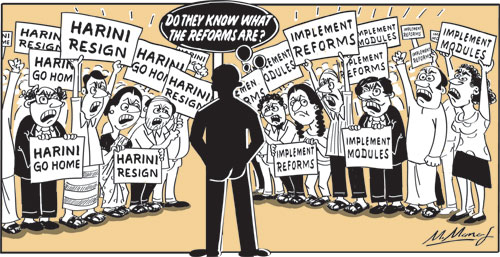
The current opposition to the government’s proposed reforms in school education is a blatant example of the politicisation of education in Sri Lanka.
The irony of the current protest is that those demonstrating for and against the reforms have no idea of the school education reforms. In fact, even others have little or no idea of the proposed changes in the syllabi and school curriculum.
Ivor Jennings
The demonstrations for and against the reforms remind one of Sir Ivor Jennings’ comment that students at the University of Peradeniya would keep awake the whole night discussing Karl Marx’ Das Kapital and The Communist Manifesto without having read either!
Better process
Nevertheless, it would have been better for the government to have had an informed discussion of the reforms and sought ideas from the intelligentsia.
Inappropriate
Be that as it may, the current controversy appears to be about the inclusion of a “link to an inappropriate website”.
On the face of it, this highly inappropriate inclusion appears to be an act of political sabotage. Surely none of those responsible for the formulation of the reforms would have included this inappropriate website link. It smacks of a mischievous schoolboy prank that is in fact an act of political sabotage.
Reform
The plans to implement a new module-based system for Grade 1 to Grade 6 students aim to shift away from an exam-centric model to a more practical, activity-based learning approach with fewer subjects per day. It is this reform that is opposed by some opposition parties. However, the main opposition SJB’s Dr Harsha de Silva has called for the expeditious implementation of the reforms after removing the inappropriate website link.
Plan
The Prime Minister and Minister of Education, Dr Harini Amarasuriya, has proposed a five-pillar plan for education reform and allocated record-level funding in the 2025 budget. As far as we could fathom, the plan is a progressive step in our education system. However, effective implementation of the reforms would be an uphill task, as teachers have tended to leave teaching for examinations to private tuition classes. This is especially so in the cities and reputed schools in big cities.
Summary
Although the country’s free education from pre-independence has achieved much, the politicisation of education has retarded the progress in education. The current effort of the government to introduce reforms in school education is an important step in the right direction. The government has also allocated more funds for school and university education. The higher investment in education is vital for the country’s economic development and social transformation.
Concluding reflection
The real challenge before the government is in the implementation of the new reforms in school education. Will schoolteachers be equal to the task and willing to implement the reforms? Will teachers be willing to change the tuition masters’ dominance in education?
Buying or selling electronics has never been easier with the help of Hitad.lk! We, at Hitad.lk, hear your needs and endeavour to provide you with the perfect listings of electronics; because we have listings for nearly anything! Search for your favourite electronic items for sale on Hitad.lk today!
Leave a Reply
Post Comment