

Columns
How Ceylon won her Freedom Hour thanks to Gandhi’s nonviolent power
View(s):On that fine and sunny February morn 78 years ago, Britain, still morosely sulking over the loss of India that crowned her vast empire on which the sun never set but always rose at dawn, performed one little chore, one small duty that remained to be done before leaving for old England.
It involved the formal ritual of ceremoniously handing over, on a silver platter, the royal gift of independence granted by His Majesty the King of England to the people of Ceylon and the tearing up of the Kandyan. Convention and casting its remains to the consuming flames of the pyre of their past colonial shame.
Whatever relief the British gained in committing this final rite, it set them free to flee from this once invaluable isle they bore with a characteristic stiff upper lip. This had been their gateway to the subcontinent of India. But now with her hold on India gone, the island of Ceylon had suddenly become a luxury they couldn’t any longer afford.
For the recipients of this royal gift of independence, that was waiting to fall, like manna from heaven, onto their laps, there were celebrations in the air and land at the news they will soon be free of the yoke of a foreign harness.
On that auspicious sunlit day, as they watched the Union Jack—which had flown majestically over the entire isle of Ceylon for 133 years—being ceremoniously lowered to the ground, marking the end of Britain’s regal sway, the pride and hope that swelled and soared in the newly independent nation’s collective breast, no doubt, would have leaped by fathomless bounds.
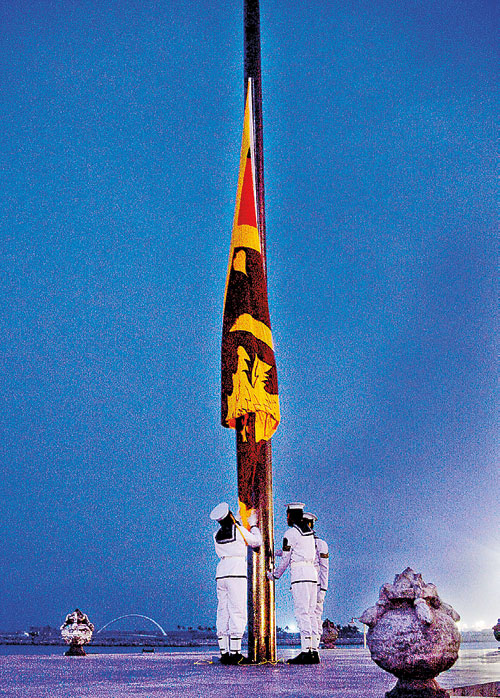
THE DAWN OF AN INDEPENDENT CEYLON: Was the morning bloom to perish in evening’s gloom?
But if there was no single drop of blood, no sweat, no toil, nor any tear to spoil her copybook, it was because Ceylon’s independence had been born in India’s pains.
It was born in the tireless pains of Mohandas Gandhi. In the tireless efforts he waged, in the tumultuous struggles he braved, in the peaceful Satyagrahas he staged, in the long days and even longer nights he spent in British jails. It was born in the blows he received when he willingly turned, like Christ, the other cheek to be repeatedly slapped until at last, the British Raj was brought to heel in the face of Mohandas Gandhi’s staff of the Jain doctrine of nonviolence.
The British were perplexed. Fire could be met with fire. But to render blow after blow to a nonresponsive human being was like flogging a dead horse.
It left the British in a quandary. As the man who would be the last Viceroy of India, Lord Mountbatten sued for peace and invited the small but indomitable Mohandas Gandhi for talks.
It signalled the end of an Indian summer for the British in India.
Churchill once described, in his own eloquent style, a scene so demeaning to his imperialist pride that he found it greatly offensive to the British Empire. He said, ‘That nauseating and humiliating spectacle of a one-time Inner Temple barrister, now a half-naked fakir, striding up the steps of the Viceroy’s Palace, and there to parley with Him on equal terms.’
But the days of such high-handed, uppity pukka sahib talk were gone. Now was the time to board the ships that lay rigged and ready in the harbour to sail for old Blighty the next day and say their last farewells to the beautiful Indian maidens they were leaving behind.
Not that, of course, the Ceylonese elite at the forefront of the struggle for independence had remained idle.
Apart from being rounded up by the jittery British—following a rumour that a coup d’état was afoot—and spending the night in a British jail without protective mosquito nets and fans to beat the sweltering heat, they were actively discussing and debating the inspired means through which they would obtain for Ceylon her freedom, while simultaneously waiting for the manna of independence to fall into their laps from neighbouring Indian skies above. Bravo.
It’s a pity; it’s a shame that not even a passing footnote is made of Mohandas Gandhi, the noble and valiant son of India, who, treading the path of nonviolence, waged a ‘Dhamma Yuddhaya’ against the temporal might of the British Empire and triumphed over its earthy power and gained for India independence ‘at the stroke of the midnight hour’ on August 15th, 1948.’
Why does Sri Lanka still deny Gandhi his legitimate and foremost place in her recent history as the bringer of the nation’s independence that freed the nation from its slavish, feudal state? Do political parties of all hues deny Gandhi his rightful place lest he justly steal the glory and the credit exclusively reserved for the founding fathers of their political parties who were alive at freedom’s hour?
He made the winds of freedom blow across the Palk Strait and release Ceylon from the captive cage of the British.
But beneath the euphoric joys freedom’s long-awaited advent naturally evokes, when beneath the patriotic, ecstatic cheers freedom’s hour invokes, and when a long-suppressed spirit of a nation finds itself free of its colonial fetters, did there dwell in the sober recesses of Ceylonese leaders’ westernised minds a historic sense of gravitas of what they had just received?
With an independence gained without sacrifice, without struggle, without blood, tears, toil and sweat, did the magnitude of the burden placed on this nanny-fed nation grace the leaders’ jacketed shoulders when a free and sovereign Ceylon was handed over to them on a platter?
This was the real and radical system change. The transfer of power—not by violent revolution but through peaceful means—from the monarch to the masses, from the foreign jackboot of an invader to a free and sovereign state where the people became the masters of their fate and the power of the ballot ruled supreme and rendered impotent the power of the bullet.
Beneath the trance, as they stood in that sunlit hour bathed in the lambent light of the nation’s sunrise and embraced destiny wholeheartedly to their bosoms, did they realise that, henceforth, in their hands lay the labour to forge the future? That they would have none but themselves to blame if they failed to flower the blooming buds of a nation’s aspirations, that the British Raj’s magic wand would no longer be there to fill the larder of their wants nor provide the armed protection of a mighty empire nor to seek refuge nor shelter from the tempests that may soon howl and blow.
Were these inheritors of Lanka’s ancient glories, the Gullivers their forefathers once were or Lilliputians made weak by time and fate, the deformed descendants of the Sinhala genius that had succumbed to the repeated battering of foreign invasions and were now weak in will, reduced to pulp? The harsh price of monotonous defeat had taken its inexorable toll and sealed the nation’s resurgence.
Through the mist of the hazy past, behold the grandeur that was Anuradhapura, the acclaimed city which was the capital of Lanka for a record 1400 years. At its glorious zenith, its stupas matched the wonders of Egypt’s Giza pyramids, and the nation’s ports had become the trading hub of the then-known world.
In that golden era which saw the arrival of Buddhism to the land in the first hundred years of the city’s establishment, the manifold facets of civilisation thrived beyond measure. After 1400 years of existence, the city showed no sign of slowing down.
But the cycle had turned, the decline had begun and the rot had set in. Though there had been many Chola attacks during the first millennium, they had all been successfully repulsed. But the die had been cast. The city’s death knell had been rung. The fall was inevitable. And when it came, it was devastating.
But the summer of the Sinhala renaissance, flowering so soon after the loss of the ancient city, was not destined to last, nor was its sweet fragrance to linger long and perfume the annals. The resurgence was short-lived; the reborn hopes which the conquest of Polonnaruwa had kindled of a Sinhala comeback lay cruelly crushed, like beautiful butterfly wings under chariot wheels.
The loss of Polonnaruwa, lasting only 142 years, was the turning point. Thenceforth the Sinhala Kingdom, or rather what was left of it, went mobile to survive the exigencies of that deciding hour. Like nomads living desert life on shifting sands, like gypsies with no fixed abode, Sinhala kings, with their kingdoms packed into caravans, took flight, wandering from safe house to safe house, from safe refuge to safe refuge, fleeing the Indian scourge shadowing them. The descent had begun. The kings were on the run.
From the descending southbound step to the Kingdom of Kotte, the Sinhala Kingdom took flight from the siege laid on Kotte and sought refuge in the hills: in the Sinhala stronghold of Senkadagala.
The Kingdom of Kandy thus became the sole repository of Sinhalese aspirations, where the hills were alive with an equal temper of free souls, breathing freedom’s sweet air. But, apart from defending this highland patch where the last trace of the island’s independence still precariously survived, the kingdom was also embroiled in power politics within its royal court, in clan intrigues and in betrayals that hastened its end.
After over 200 years as the last capital of the Sinhala Kingdom, as the last bastion of Sinhala rule, its ultimate downfall in 1815 AD marked the beginning of Lanka’s long night of oblivion.
Dusk had set in much earlier over the Sinhala Kingdom. It had fallen in the early part of the 13th century with the abandonment of Polonnaruwa’s splendour, which, during the renaissance, had briefly shone on the Sinhala firmament, like the last bold burst of a dying star. The Sinhala retreat had been sounded. Fortune that had favoured the brave had fled once stout Sinhala hearts; and debilitating fear had taken its place.
The fire that had spurred King Dutugemunu and Vijayabahu to emerge from the southern wilderness and drive out Chola usurpers from the Rajarata and unify the land under the Sinhala banner – and moved other great kings to defend and never to yield – had long died out; and, in its stead, an all-pervasive sense of defeatism had taken hold of the collective Sinhala spirit.
With the kingdom in reverse mode, the Sinhala exodus to the south began. Deserting the grandiose works, which the Sinhala genius of their forefathers had created, to the vagaries of the elements or as departing gifts to Indian beneficiaries, they hitched their wagons to the kingdom’s slinking star and drifted further south, seeking southern safety and southern comfort.
The Sinhala Kingdom had entered the twilight zone; and the Sinhala Kings ruled from their fast-dwindling twilight realms. Every descending step, driven by fear, prodded by Fate’s spur to survive, brought them, unwittingly, closer to dreaded night. Every step down, from Polonnaruwa to Dambadeniya, to Yapahuwa, to Kurunegala, to Gampola, to Kotte and Sithawaka, was attended with a rain of blows battering the Sinhala psyche.
The scramble to the hills when all seemed lost was the abject admission of final defeat; and the ultimate fate that awaited the Sinhala Kingdom during its mountainous refuge was the final killer blow—the knockout punch—that crushed the once proud Sinhala spirit and made it genuflect to the infidel’s sword.
The long night of darkness had enveloped the Sinhala people; and when morning broke on February 4, 1948, a dazed Sinhala race awoke from their long enslavement to find independence thrust upon them and made the masters of their fate.
But in that shining hour, were they, leaders and the citizenry alike, up to the task? Had the repeatedly bruised and battered collective psyche of their forefathers, which, according to Jungian psychology, contains the full gamut of ancestral experience, rendered the inheritors impotent of vision beyond their petty prejudices, incapable of placing the nation’s interest before their own? But thoroughly able to make a pig’s breakfast out of a bright future given on a salver.
Though the primordial fire of chauvinism still burns in their bellies and vainglorious boasts of their forebears’ marvels still spout from their mouths, does it all spring from an inferiority complex? Is it a wounded psyche—scared and insecure—that, even 73 years after independence, still remains in search of a new constitution and a new education system and still struggles to correctly draw the ‘Dhamma Chakra’ on Grade 6 textbooks for 10-year-old school kids?
Buying or selling electronics has never been easier with the help of Hitad.lk! We, at Hitad.lk, hear your needs and endeavour to provide you with the perfect listings of electronics; because we have listings for nearly anything! Search for your favourite electronic items for sale on Hitad.lk today!
Leave a Reply
Post Comment