


The best of Sinhala fiction in 2025
Here we speak to the laureates of the year we are bidding adieu to: the five authors of the novels shortlisted for the Swarna Pusthaka 2025, the much-anticipated local Booker.
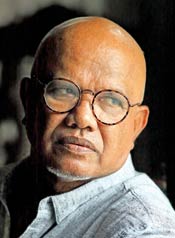 Winner- Piyasara Samaya by
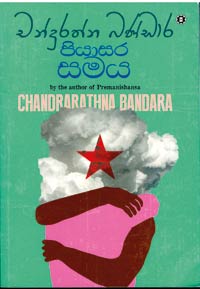 Chandrarathna Bandara
The winner, also of the State Literary Award, Chandrarathna Bandara is testimony to the richness of our local literary traditions, nurtured by folk poetry, village rituals and also exposed to a host of writers ranging from Martin Wickremesinghe to Gunadasa Amarasekere.
Piyasara Samaya homes in on the 2022 Aragalaya, and brings under the microscope the period after Independence, through the eyes of a young student activist and the young wife of a Minister, an upper class woman who is also a university lecturer. They meet in Canada, the country of domicile for Chandrarathna as well.
The novel is also about the figures who lurk behind politics unseen by the public, and how personal connections influence politics.
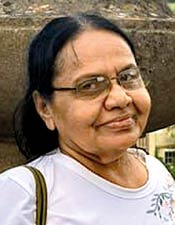 Parikarma by Sunethra Rajakarunanayake
Parikarma, curiously enough, was born out of a visit to England. “All I do when I go there is read,” laughs Ms. Rajakarunanayake, but during this sojourn she visited Canterbury Cathedral and spent “a long time” in front of Beckett’s shrine.
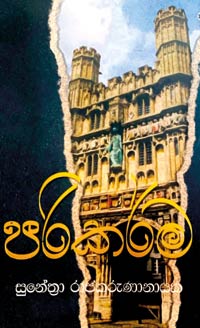 She also visited the medieval pile that is St. Augustine’s Abbey and the story just “walked in” to this anglophile’s head.
Set, however, in Victorian England and Ceylon, the protagonists are a British civil servant Valentino and his young wife Portia Knox- a descendant of that colourful Kandyan prisoner, a girl who has always dreamt of seeing the isle where her ancestor (according to this novel) died and is buried.
Shifting from Canterbury and London to British Kandy, the tale documents the beginnings of such upcountry institutions like Trinity College and St. Paul’s Church. There are the de Zoysas of Moratuwa and radala nobles galore, and the imperial monarch who gave her name to that era herself is featured but not, surprisingly, as an anachronism.
Sunethra portrays Queen Victoria positively, pointing out how she tacitly supported the first women’s college established in Cambridge. She also brings in characters like the maligned Scot John Brown and Shivapuri Baba, who was a yogi in Windsor.
Of course Sunethra could have gone onto a 500 pages and more with such fascinating material but practicality called! “I won’t mind writing another book against the same background,” laughs Sunethra.
She adds that the book would have been better off written in English, but the lack of readers deterred her and “a translation would not be possible because I would want to add more and more detail!”
Sunethra says she blesses the free library system of the UK that made all the rich historical “stuffing” in her novel possible. Sunethra is one of the most-read Sinhala authors of our time and has written nearly 40 books.
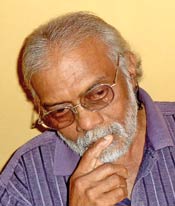 Sithe Ketunu Devanagara by
 P.B. Jayasekara
Erstwhile journalist Jayasekara wrote for The Island and The Sunday Observer, apart from being a sub-editor for magazines Sandesaya and Vivarana.
The novel is about Sumith, a boy whose “mind-blackboard” appears blank, because of which society dismisses him as mentally disabled. Only his grandmother sees that his mind is not empty; rather it is written in a script others can’t decode. It’s the language of the gods – Devanagari.
While his grandmother and mother are devoted to the child, pandering to his love for the colour yellow, dressing in canary or lemon hues and even preparing yellow meals, Sumith’s father, an army officer in the Vanni, thinks the boy’s birth chart is a curse upon his life and tries to end his son’s life.
Woven into the novel is a murder mystery in a palatial house as well, giving that extra something to the reader.
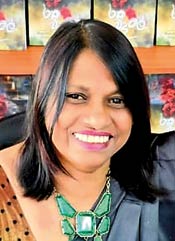
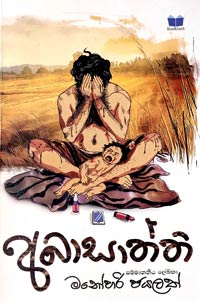 Abaasaaththi by Manoharee Jayalath
This moving novel recounts how a 16-year old girl who has been raped and is pregnant, attempts to end her life by jumping off a bridge and is saved by a cannabis cultivator. After the baby is born, it is the man who brings up the child tenderly, as the girl wanders off.
Manoharee brings out the paternal nature in a man; “there is the rapist in him; but also the father- a man has great reserves of love and humanity.” The novel also addresses how women are raped again and again in court where they have to divulge in detail their ordeals.
Herself a lawyer, Manoharee says the story was inspired by the daily sight of innocent people who suffer because they don’t have an understanding of the law.
-
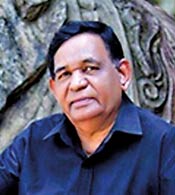 Vaapi by Mahinda Chandrasekera
This debut novel, also winner of the Vidyodaya Award, deals with the deified ancient king Mahasen – 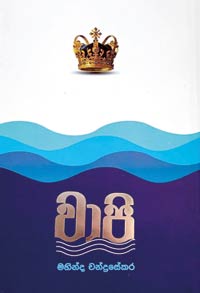 the Anuradhapura monarch who, though adulated by the people, was also maligned for being the destroyer of the Mahavihara, the main centre of orthodox Buddhism.
The novel, relatively slim but absorbing, is a totally new telling of this king’s life and his journey to godhood.
Mahinda Chandrasekara is a songwriter and poet, and lives in Anuradhapura, which ancient land inspires his writing.
The shortlist gives a soupcon of a tradition that has evolved over millennia; dip in, and you will definitely ask for more…
Searching for an ideal partner? Find your soul mate on Hitad.lk, Sri Lanka's favourite marriage proposals page. With Hitad.lk matrimonial advertisements you have access to thousands of ads from potential suitors who are looking for someone just like you.