


Moved by the global power of music
View(s):- Currently in Colombo, London composer, music educator and conductor, Professor John Howard talks to Yomal Senerath-Yapa
For Professor John Howard, music is as integral as daily bread, as he was brought up in a Glasgow manse where the Sundays were bright with hymns, and often the family sang together at home, around the piano with little John at the trumpet. So it was that he banished the idea of becoming a cricketer (his other passion) in favour of this almost sacred legacy.
Now a renowned London composer, music educator and conductor, John can look back on a long career which has been enriched by his love for world musics, from Chinese to Aboriginal, passing through African, Malaysian, Indonesian… All this, while composing in what is a highly prolific career and being a professor at the London College of Music, University of West London, and Director of the London College of Music Examinations.
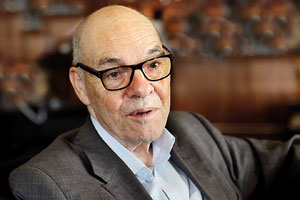
Prof John Howard
We met the gentle don visiting Sri Lanka as winter examiner for the International Institute of the London College of Music, together with Shyama Perera, LTCL, LGSM, FTCL, managing director of the International Institute of Music, Speech and Drama, and Sri Lanka III representative of LCME.
He will be the chief guest for the prize giving of the London College of Music Examinations (LCME) this evening,
The professor is fascinated by the history of the mosaic of world music, how melody and tune across the world is interrelated; how from ancient Arabia, for example, on camelback swayed away traditional Middle Eastern music along with the lute to the further East, but also to other parts like North Africa, Spain and Australia…
While on the theme of world music, asked how different countries develop different music, Prof. Howard says a myriad things can influence: for example technology (that’s how the piano in the 18th and 19th centuries was born); culture (take the potpourri of musical styles that is
modern America) and religion (how the seismic birth of the Anglican Church affected music
in England).
As an educator, Prof. Howard believes a love and even a knack for music can be inculcated in anyone, recalling how a friend of his was conducting a workshop for kindergarteners while their mothers were waiting. After the singing was over they could still hear some noise: the small babies whom the mothers had brought along in prams outside were responding to the music!
The professor regrets that mothers no longer sing lullabies to their infants, and points out that music can even positively affect children still in the womb. However he points out the teaching should be done the proper way as “bad teachers can put children off music”, adding that the teacher should have a method to get students involved.
Music, he goes on to say “can almost do anything”. He cites the curious case of an autistic child featured in a documentary series done by a friend of his, a boy whose only response to the world was incoherent screaming; his mother could not get him interested in anything.
Coming across a small electric keyboard at a shop once, the mother on a whim took it home, but the boy did not even look at it. One day while in the kitchen however, a series of notes wafted to her and she was amazed to go and find her son playing the keyboard.
By the time the documentary was being turned out the boy had graduated to a big keyboard with all the facilities, and could speak.
It is a proven fact that a brain that has made a study of music can be remarkably sharp in many a sphere, says Prof. Howard.
“Music is probably the most powerful thing in the world and has the least recognition” Prof. Howard’s final words ring across as we bid him adieu.
Searching for an ideal partner? Find your soul mate on Hitad.lk, Sri Lanka's favourite marriage proposals page. With Hitad.lk matrimonial advertisements you have access to thousands of ads from potential suitors who are looking for someone just like you.