

Columns
- Main opposition SJB stays out, so do Wimal and Champika; Sajith says he won’t share stage with corrupt politicians
- Undercurrents loom for Harsha amid damage-control moves in the party over Sajith’s India visit controversy
- JVP commemorates founder Wijeweera; NPP leaders conspicuous by their absence
- As ruling party faces budget defeats in local councils, President showcases economic achievements in post-budget speeches
- Govt. reports progress in drug war, but goes silent after its bid to link SLPP with ice chemicals backfires
By our Political Desk
As the government grapples with the challenges that beset the ruling party, several opposition parties are readying for a showdown with a planned public rally at Nugegoda on Friday. While the main opposition, Samagi Jana Balawegaya (SJB), has decided, amidst severe internal discussions, to opt out of the joint rally, the anti-government effort has brought together an interesting mix of political forces, giving credence to the saying ‘There are no permanent enemies and no permanent friends in politics – only permanent interests,’ but in this case at least, temporary interests.
The United National Party (UNP) and the Sri Lanka Podujana Peramuna (SLPP) are the main parties spearheading the rally, with SLPP National Organiser and parliamentarian Namal Rajapaksa, heir-apparent of the Rajapaksa dynasty, playing the lead role in organising it and canvassing with different parties to join the Nugegoda meeting. While the Sri Lanka Freedom Party (SLFP) and the Pivithuru Hela Urumaya (PHU) of Udaya Gammanpila have thrown their weight behind the Nugegoda rally, several well-known opposition figures, including former MPs Wimal Weerawansa and Champika Ranawaka, have said they would not be attending it.
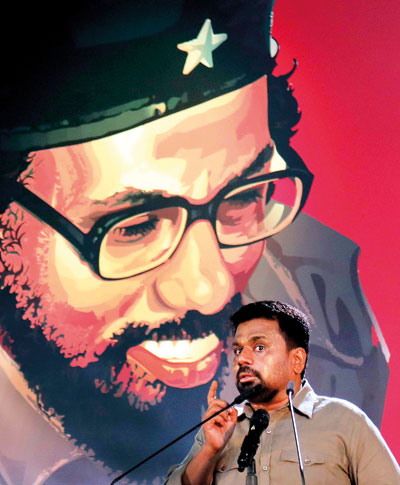
President Anura Kumara Dissanayake addressing JVP members at the Il Maha Viru Samaruma event at the Vihara Mahadevi Park in Colombo. Pic by M. A. Pushpa Kumara
The anti-government rally has given the opportunity for the SLPP and the SLFP to mend fences. A first step in this direction was taken this week when the young Namal Rajapaksa visited the SLFP headquarters at Darley Road, Colombo-10, for the first time in nearly 10 years. The SLPP was formed in 2016 when former president Maithripala Sirisena took control of the SLFP after winning the 2015 presidential election and parting ways with the Rajapaksas.
Mr Rajapaksa was received at the SLFP headquarters by party chairperson and former minister Nimal Siripala de Silva and general secretary and former minister Duminda Dissanayake. Mr Also this week, Mr Rajapaksa met former President Ranil Wickremesinghe at the UNP office on Flower Road, Colombo, to discuss preparations for the upcoming rally. He briefed UNP members on the preparations for the rally. He ended his address by saying he would like to meet them at the UNP head office at ‘Sirikotha’ next time, which drew cheers and loud applause from those present. Some UNPers posed for selfies with him after the meeting.
Multiple crises within SJB
While the SLPP and UNP are busy spearheading preparations for the rally, the reverberations of SJB leader Sajith Premadasa’s visit to India continued to be felt inside the party, which has put Mr Premadasa in damage-control mode.
SJB Colombo District MP Harsha de Silva seems to be caught in the middle of the unfolding events after he told a television talk show this week—in answer to a direct question if he knew of the Premadasa visit—that he was not aware of it prior to the visit and did not know anything more about the visit other than what was reported in the media.
That Premedasa chose to include in his delegation an SJB Kotte UC member—instead of an MP who is very pro-India, no doubt—has left a lot for political speculation. Several SJB seniors too have expressed similar thoughts but are hesitant to come out in the open, fearing a leadership backlash.
Backroom conversations in Premadasa’s own inner circles these days have seen allegations that Harsha de Silva is playing Jekyll and Hyde, praising the government and attacking it in the same budget speech. More pointedly, it is alleged that he was among those who discouraged the SJB leader from accepting the post of Prime Minister when it was offered to him by then President Gotabaya Rajapaksa in May of 2022, thus denying Premadasa the opportunity to become PM and then President, which opened the door for Ranil Wickremesinghe to become President.
On the contrary, though, Mr De Silva was one of the lead negotiators advocating the PM post for Premadasa at the time of turmoil in the country, but conditions put forward by the SJB leader frustrated President Rajapaksa, and this hastened the appointment of Wickremesinghe, who took up the post unconditionally.
There is also the issue of the November 21 rally, which Premadasa has been adamant not to attend, while many in the SJB felt it was an opportunity for the party to speak out against the manner in which the government is taking numerous anti-democratic measures to stifle opposition. When the issue came up at the SJB’s Management Committee meeting on Wednesday, Mr Premadasa reiterated his position that the SJB would not attend. When asked for the reason for this decision, he said that the SJB would not share the same stage with ‘corrupt politicians’.
On top of that, the SJB parliamentary group has failed to take a uniform stance on the government’s budget proposal to increase the salary of estate workers. While some in the party have ridiculed the decision and called it illegal, those representing the estate sector have praised the government decision. Mano Ganesh, P. Digambaram and V. Radhakrishnan—who contested the general election on the SJB ticket—voted in favour of the budget when the second reading vote was taken on Friday evening, while the rest of the SJB MPs voted against it.
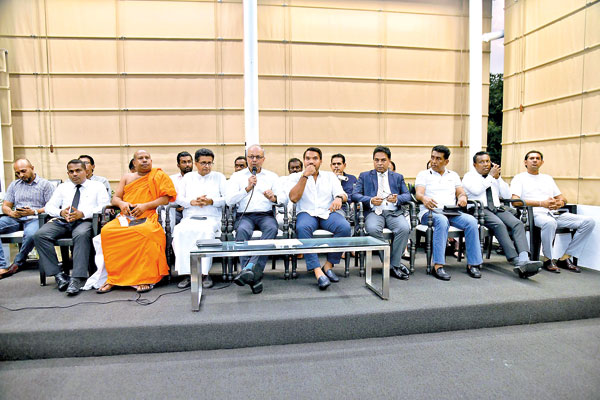
SLPP National Organiser Namal Rajapaksa, Pivithiru Hela Urumaya leader Udaya Gammanpila and other opposition figures addressing UNP members at a meeting held at UNP leader Ranil Wickremesinghe's Flower Road office
The lack of direction and a cohesive stance during the debate on the Second Reading of the Appropriation Bill has led to some in the SJB pointing fingers at the Chief Opposition Whip Gayantha Karunatillake, stating that he has failed to brief the parliamentary group ahead of the debate and allowed a free-for-all.
The rumbling within the SJB comes as the UNP decided to appoint former Minister Harin Fernando as the party’s Deputy Secretary General of Political Mobilisation. His responsibilities in this new role include uniting all political parties in the country and engaging them in a common programme, the UNP said in a statement.
Mr Fernando, who spoke to reporters after his appointment, said his first task was to organise 1000 public meetings island-wide and called for the UNP and the SJB to unite. The 1,000 meetings call had come earlier from party leader Wickremesinghe soon after his remand prison experience, recalling the days when J.R. Jayewardene led the opposition to electoral triumph in 1977.
The UNP functionary warned that if the SJB leadership fails to heed the call of its supporters at the grassroots and join with the UNP, the same way that the bulk of members of the UNP left it to form the SJB, it could be a reversal of what happened then with SJB members re-joining the UNP.
Setback for NPP in local councils
For the government, getting the budget approved in Parliament was a breeze given its overwhelming majority, but at the local government level, it faced a number of challenges this week.
The JVP/NPP holds a slim majority in a large number of local government bodies, and while the party managed to form the councils with the support of opposition parties, that grassroots support seems to be slipping away.
This week, in six local authorities, the JVP/NPP budgets were defeated. These were the local authorities in Padiyathalawa, Dodangaslanda, Nalua, Uva-Paranagama, Panduwas Nuwara and Soronathota.
There is provision for these budgets to be put to a vote a second time, but all budgets to the local bodies will have to be approved before the end of the year. Given the razor-thin majority the JVP/NPP holds in many of these councils, the weeks ahead will pose a challenge to the government in its attempt to keep control of these councils.
Plans are now being drawn up by JVP/NPP members to resubmit the defeated budgets before the councils next Friday (21). The Sunday Times understands that this move is being mooted to take advantage of the expected absence of opposition local councillors, who are likely to be at the joint opposition rally in Nugegoda on that date.
The government, meanwhile, has chosen to adopt a dismissive attitude towards the opposition’s joint rally. Public Security Minister Ananda Wijepala said that the Opposition is trying to claim that the government’s first full budget had nothing to offer the people and predicted this will be one of the lines of attack at the rally to be held on Friday. In reality, however, this will be the budget that aims to restart mega development projects, including expressway projects that were stalled due to the economic crisis, the minister said.
“The Opposition first said this rally will be their first salvo against the government. Now, they are saying the rally will be held to remind the government of its broken promises. There is no need to remind us of promises we made, as we still have four years to complete our term. But they will have nothing left to say in another year’s time,” he said, adding that the government will be able to show substantial results by then.
Minister Wijepala also claimed incidents of racism have diminished under the JVP/NPP government. There have been no violent crackdowns on protests like it was before they came to power. “There have only been one or two occasions this year where the police have been forced to fire tear gas during protests,” he said.
JVP commemorates Wijeweera
On Thursday, President Anura Kumara Dissanayake was joined by the JVP Old Guard, or those who are still alive of it, to commemorate the death anniversary of the movement’s founder, Rohana Wijeweera, at the annual ‘Il Maha Samaruma’ (November Commemorations) event that had been held for the past 36 years. The late JVP leader was killed on November 13, 1989. General Secretary of the JVP Tilvin Silva took centre stage with President Dissanayake at the event held at Colombo’s Vihara Maha Devi Park, where die-hard supporters of the party gathered to lay wreaths and listen to the ‘remarkable achievements’ of the JVP of today.
In his speech, the President reflected on the sacrifices made by JVP cadres and how the party had evolved into one that had been embraced by the people of the county. “Our victories are not achieved individually but through collective effort. Our governance is sustained by this very unity through cooperation between the government and the citizens and between the government and our allies, and we must continue to uphold this unity,” the President said to the cheering supporters all dressed in red shirts, though the berets were missing this time.
While it’s true that the present generation of the JVP are far removed from the one spearheaded by Rohana Wijeweera, the movement’s problematic past is not easy to whitewash. That there was little acknowledgement of the JVP’s past crimes, no apologies, and instead, more focus is laid on atrocities of past governments. The event helped to give a one-sided version of history that glosses over the troubled times in the country starting in 1971 and then the 1987-89 period. But the ghosts of the past always have a way of emerging from time to time.
It was noteworthy that the NPP leadership was absent from the rally. Its symbolic leader, Prime Minister Harini Amarasuriya, was absent from what the ruling JVP/NPP would have considered a very politically significant occasion. Is it a strategy on the part of the governing party/parties to say there is a distinction between the old JVP and the new NPP? Is the NPP wilfully asked to distance itself from the old JVP so as to make it the ‘human face’ of a party (JVP) that still leaves a ‘kahata’ taste in the mouth of an older generation of citizens? Only recently did we refer in this column to the JVP (and not the NPP) sending a delegation to China.
Last month, Transport Minister Bimal Rathnayake led a JVP delegation to China. This followed another delegation led by JVP General Secretary Tilvin Silva visiting the country in June. Both visits were undertaken on the invitation of the Communist Party of China (CPC) as part of efforts to deepen relations between the JVP and the CPC. The CPC-organised tours are for JVP party cadres so they can learn more of the workings of the CCP and how it operates. Those going on such tours are members of the JVP and not the NPP, government sources said.
A notable absentee at the rally was Wijeweera’s son, who has cut his own political teeth and is a critic of the JVP.
The Peratugaami party, which claims to have led the Aragalaya public uprising in 2022 and accuses the JVP of hijacking it, held its own meeting to commemorate the death of Wijeweera, bitterly criticising the JVP for abandoning its socialist path that Wijeweera was wedded to.
Drug war
Two weeks have now gone by since the government officially launched its much-publicised and highly ambitious “A Nation United National Operation” aimed at eradicating the drug menace. There have been plenty of arrests and some significant drug busts both on land and at sea over these two weeks. The latest was the arrest of seven suspects with 329 kilogrammes of “Ice” (crystal methamphetamine) during a raid conducted on the southern beach of Kirinda on Wednesday. The raid exposed just how sophisticated organised criminal groups are in their trafficking activities. The drugs had been offloaded in the deep seas from a multi-day fishing trawler to a smaller vessel, which then brought the drugs ashore in sacks, at which point they were seized by police. Six vehicles, all with fake number plates, which had been waiting to transport the drugs to Colombo, were also seized. Police investigations have unearthed that the drugs had been sent by a drug trafficker based overseas. The suspects are being held and interrogated under detention orders.
On November 7, Maldives Police confirmed the seizure of a Sri Lankan fishing vessel, Avishka Putha, along with 355.9 kg of suspected narcotics. Its five-member crew was taken into custody. The seizure was made following a tip-off by Sri Lankan authorities.
Following a court-authorised search conducted on November 10, a total of 24 sacks containing suspected narcotics were discovered. The provisional weight of the seized substances is 355.9 kilograms, comprising 58.6 kilograms of suspected heroin and 297.3 kilograms of suspected methamphetamine, the Maldives Police revealed.
This investigation is ongoing and is being carried out jointly by the Maldives Police Service, Maldives National Defence Force, Sri Lankan Navy and the Sri Lankan Police.
Nevertheless, both the government and its law enforcement agencies are now under scrutiny over their handling of the haul of alleged chemicals seized from Kandana and Middeniya. It was alleged that the chemicals, discovered in September, are used for the production of methamphetamine. We reported last week how tests carried out by the Government Analyst’s Department (GA) and the National Dangerous Drugs Control Board (NDDCB) on samples taken from the two sites had found little or no trace of illicit substances.
Samples taken from Kandana did not contain any precursor chemicals used in the production of methamphetamine or any other drug-related substances. Samples taken from Middeniya showed traces of the final product, methamphetamine, mixed with the talc stones in very small quantities. This throws doubt over widely publicised claims that there were “chemicals” used to produce methamphetamine hidden inside.
The discovery of two containers in Middeniya filled with semi-processed talc stones, but which were alleged to be laced with chemicals used in the production of “Ice”, had earlier drawn widespread media attention. The containers, originating from Iran, had been flagged as being suspicious by US authorities. Nevertheless, they had been released upon inspection by the Customs Narcotics Division (CND) and the Police Narcotics Bureau (PNB), following confirmation that they contained no harmful drugs or illegal substances. A subsequent probe, however, was launched following revelations made by underworld figures Backhoe Saman and ‘Kehelbaddara Padme, who had been arrested in Indonesia and brought back to the country. This led to the discovery of the containers which had allegedly been concealed in Middeniya. This also prompted the launch of a comprehensive investigation by the Criminal Investigation Department (CID) into the procedural lapses that allowed the containers to be cleared, with top officials from the police and customs being questioned as part of the inquiry.
The discovery of the containers led police to go after Sampath Manamperi, a former police officer and former local government candidate of the Sri Lanka Podujana Peramuna (SLPP). Police believed he had been involved in the alleged concealment of the containers. Mr Manamperi later surrendered to the court and is currently in remand custody.
The arrest of Mr Manamperi and his SLPP links were repeatedly brought up by the government to attack the SLPP and in particular the party’s National Organiser, Namal Rajapaksa. Public Security Minister Ananda Wijepala and his deputy, Sunil Watagala, were among the loudest of these voices, often pointing to the Middeniya containers and claiming further links between SLPP politicians and the narcotics trade. “There are plenty of SLPPers who are connected to the narcotics trade. Some have already been arrested, while investigations into others are ongoing,” Minister Wijepala told Parliament in September.
Now, with tests conducted by the GA and NDDCB casting fresh doubts into the probe surrounding the Middeniya containers, questions will inevitably arise regarding the police’s handling of the matter, as well as the at times almost gleeful attitude adopted by the government when using it to attack the SLPP.
It is true that Sampath Manamperi is facing a host of other charges, but that will serve as little excuse for a government which went on what amounted to a premature media blitz to attack the SLPP over the container issue. Moreover, the intense media scrutiny over the arrest of the husband and son of a National People’s Power (NPP) Peliyagoda Urban Council member (who has since resigned) on narcotics charges will no doubt be doubly embarrassing for the government in light of the findings from Middeniya. It was hoist with its own petard.
President on economic performance
Back in Parliament, President Anura Kumara Dissanayake addressed this week the many significant achievements of macroeconomic and financial system stability, political stability, a remarkable turnaround in fiscal health, a predictable policy environment, governance improvements, and efforts to end systemic corruption. It was his first speech after presenting his maiden complete budget.
Importantly, President Dissanayake, who is also Finance Minister, referenced the critical role of the Central Bank of Sri Lanka in the domestic money market in influencing interest rates as well as the Treasury’s financial resources buildup and managing it extremely efficiently.
“This has given us the ability to manage the (domestic) money market,’’ Mr Dissanayake said, while recalling past turbulent periods when Treasury bill rates were beyond control. “Treasury bill rates went to 33%, 34%. And lending rates went to 35%, 36%. Businesses could not borrow. The economy was stuck.’’
Investors in Treasury bills are now mindful of the National People’s Power Government’s cash resources, Mr Dissanayake said.
Overall cash position has improved. Data as of August show the Treasury cash balance at Rs 1.205 trillion. The net cash deficit fell sharply to Rs. 432.7b from Rs. 1.167.8tn.
“At the (Treasury bill) auctions, if rates move higher, the government makes purchases. We have been able to maintain the rates at 8.3% for a long time. This has helped to keep bank lending rates low,’’ he said.
In managing banking system liquidity, that is, the reserve balances of financial institutions, CBSL transmits its policy rate to other short-term interest rates aligning with monetary policy.
Through monetary operations, CBSL strives to maintain short-term interest rates closer to its monetary policy tool, the overnight policy rate.
The President said that if the Treasury were to be empty, “the government loses control of its financial management. Then, the power goes to the hands of the bank, insurance, and funds monopoly. The government is the strongest player in the money market now.’’
Budget records show that in 2017, when Mangala Samaraweera was finance minister, the Treasury net cash deficit blew out past Rs 734 billion and was financed through borrowings. By the end of 2018, lending rates had rocketed to 12%. Sri Lanka was under a three-year IMF ‘Extended Fund Facility’ arrangement then.
Speaking at the 36th Commemoration of the November Heroes at Vihara Maha Devi Park, Colombo, on Friday, President Dissanayake cast Sri Lanka scaling myriad macroeconomic hurdles as commitments and not merely aspirational and achieved through sheer diligence and a collective effort.
He also noted a positive surprise outcome in the fiscal deficit number, having strategically erred on the side of caution in the government’s prediction. He underlined the importance of macroeconomic forecasting in real time.
“In some instances, we are cautious about making predictions, so we make slightly unfavourable predictions,’’ the President said. “We predicted a 6.7% budget deficit. Why? We know we can go below that, but we believed that saying this could be unfavourable. And we achieved a 5.2% deficit. This is a first in Sri Lanka.’’
CBSL has reported that from April 2024 to the end of June 2025, liquidity in the domestic money market has been in surplus at Rs. 138.1b versus Rs. 168.1b by the end of 2024. At the end of the first half of 2025, the liquidity surplus was Rs.154.6b.
T-Bill and T-Bond yield rates have remained broadly stable, CBSL data show. The 91-day T-bill yield in the primary market in the week to November 7 was 7.52%, unchanged from the week before. A year ago in the first week of November, it was 9.37%. A year ago in late September it was 10.49%, the highest in 2024.
From January 2025 to August, the 91-day T-bill yield rates ranged from 7.93% to 7.58%.
The CBSL, the government’s banker, issues through the public debt department rupee-denominated Treasury bills (often offered at a discount) and Treasury bonds—known widely as government securities. T-bills are issued in 91-day, 182-day and 364-day maturities. T-bonds are medium- to long-term debt instruments.
President Dissanayake also dismissed the unfounded narrative the opposition is peddling about the government’s inability to pay external debt. Sri Lanka has resumed interest payments on borrowings from Japan, the China Development Bank, the Export-Import Bank of India, and International Sovereign Bonds following debt restructuring.
“Many say external debt has to be paid in 2028. Yes. We have predicted whether we can or not. We are certain we can pay the debt. We will build an economy to be able to pay our debt,’’ Mr Dissanayake said.
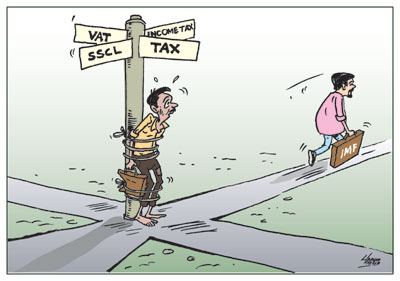
One fiscal goal is to achieve a budget deficit below 5% of GDP from 2026 and beyond to reduce gross financing needs. The debt overhaul means debt service payments — principal and interest — will drop by US$9.5b through the IMF programme period.
| From detection to destruction: Police Narcotics Bureau explains the process The Police Narcotics Bureau (PNB) plays a major role in the country’s operations against narcotics trafficking. The following comments are from the PNB’s Director Senior Superintendent of Police (SSP) H.M.C.P. Herath. He explains the history of narcotics trafficking in the country, the origins and final destinations of the drugs, and how seized drug stocks are destroyed: Historically, around the 1980s, Sri Lanka was utilised as a transit point for drugs. Initially, the drugs came from the Golden Triangle. The countries identified as being part of the Golden Triangle are Myanmar, Thailand, and Laos. The introduction of heroin to Sri Lanka occurred after it became a transit point for these regions. Countries for specific drugs include: Heroin: currently originates from Afghanistan, Iran, and Pakistan. Cocaine: sourced from Brazil. Hash (made from cannabis or Cannabis varieties): primarily comes via Thailand, which acts as a transit point. Cannabis is noted as being legal (legalised) in Thailand. Methods of transit have included concealment within the human body and subsequent transport using bags and even containers. Currently, a significant portion of drug movement occurs via sea, often involving Iranian boats. Destinations and current status While Sri Lanka was initially a transit point, it has increasingly become the final destination for drugs like heroin and cocaine. The current intake suggests that if 100 units arrive, approximately 90 units are destined for Sri Lanka’s internal consumption. When drugs are still being transited through Sri Lanka, typical destinations include various states in India, as well as Pakistan and Bangladesh. Maldives is also a specific destination mentioned for transit via Sri Lanka. (Currently, the majority of drugs are transported to India and the Maldives.) Process of destroying seized drugs When large stocks (production) of seized drugs lack an owner, a magistrate’s court order is required to dispose of them. The procedure for handling seized drugs involves: Initial Submission: Seized goods must be immediately sent to the Government Analyst’s Department within 24 hours for analysis. Analysis and return: The Government Analyst’s Department analyses the large stocks but returns them because they do not have the space to keep the entire quantity. Destruction site: Destruction is carried out in an incinerator located in the Lakwatta area in Puttalam. Oversight and verification: The disposal must be supervised by multiple bodies under the judicial decree, including the Narcotics Department, the Government Analyst’s Department, the Judicial Registrar, the Puttalam Magistrate, and the National Dangerous Drugs Control Board. Following destruction, all reports must be attested. | |
Buying or selling electronics has never been easier with the help of Hitad.lk! We, at Hitad.lk, hear your needs and endeavour to provide you with the perfect listings of electronics; because we have listings for nearly anything! Search for your favourite electronic items for sale on Hitad.lk today!
All roads lead to joint opposition rally — or do they?
View(s):