

By Wikum H Jayasinghe
We often assume that intelligence comes from having a large brain. Yet in nature, some of the smartest decisions are made by creatures no bigger than a grain of rice. While humans can struggle to agree on simple things like where to eat or how to move a heavy piece of furniture, honey bees and ants have spent millions of years perfecting teamwork.
Research suggests that these tiny insects can outperform humans when working in large groups. Their success lies not in individual brilliance, but in simple rules and strong cooperation; something scientists often describe as “swarm intelligence.”
The Bee Debate: Real Estate without a Boss
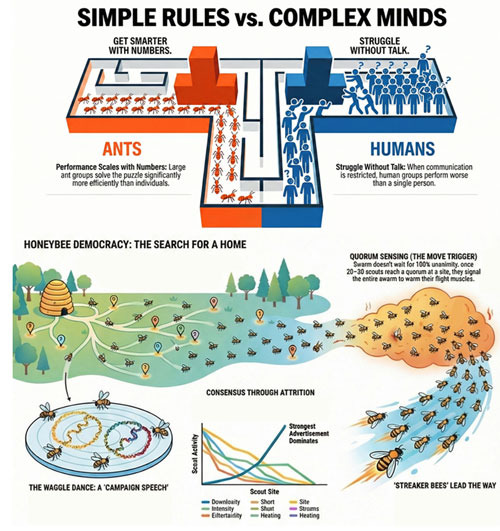
When a honey bee colony becomes too crowded, thousands of bees leave in search of a new home. Surprisingly, the queen does not make this decision. Instead, the colony operates like a well-organized democracy. A group of scout bees searches for suitable locations, such as hollow trees. When a scout finds a promising site, she returns to the swarm and performs a “waggle dance.” This dance acts like a campaign; stronger, more energetic dances signal better locations.
Other scouts inspect these sites and, if they agree, promote them with their own dances. Gradually, the best option gains more support. Once enough bees gather at one site, a threshold known as a quorum, the decision is made, and the entire swarm moves to its new home. No leader, no arguments, just a clear and efficient process.
The Ant Piano-Movers: Success through Simplicity
Ants, on the other hand, excel at solving physical challenges as a team. In one study, scientists gave longhorn crazy ants a complex task: moving a T-shaped object through a maze. Individual ants failed, but larger groups succeeded, and became more efficient as their numbers increased. Human groups, however, often performed worse as they grew larger.
The reason is simple: humans tend to overthink and disagree. In the study, people frequently argued over strategies or chose obvious paths that led to dead ends. Ants avoid this problem by following basic rules. Some act as temporary leaders, while others simply respond to the push and pull of the group. This creates a kind of shared “collective memory” that helps them navigate obstacles without confusion.
Why "Simple" is Sometimes Better
The strength of bees and ants lies in simplicity. Each individual follows straightforward rules, allowing the group to scale up without becoming disorganized. Human groups, by contrast, often struggle with too many opinions and not enough coordination.
How to Use "Swarm Smarts" at Work
Scientists suggest that we can learn from these natural systems. Encouraging diverse ideas, avoiding dominance by a single leader, and accepting strong majority decisions, rather than waiting for complete agreement, can help teams work more effectively.
The next time you notice a swarm of bees or a trail of ants, it may be worth a second look. These tiny creatures are not just surviving; they are demonstrating powerful lessons in cooperation, efficiency, and decision-making that humans are still trying to master.
(The writer is a Senior Lecturer at the Faculty of Agriculture, University of Peradeniya)



Read this week’s Sunday Times for your interesting articles










Leave Comments