

Columns
Time to tell India exactly where to get off the Ram Sethu bridge
View(s):- How Jha’s Indian dream can turn into the island’s worst nightmare
Even as India’s High Commissioner Santosh Jha renewed India’s call to build the mythological Ram Setu bridge to physically join Lanka with India and had the effrontery to declare that the time for wavering was over, it’s time to tell India exactly where to get off the bridge she plans to build.
High Commissioner Jha, delivering the keynote speech at the Global Innovation and Leadership Summit in Colombo last Saturday, emphasised that such a physical link would ‘transform the economic geography’ of the region. No doubt, it would.
But wouldn’t it also irrevocably transform the unique island status Lanka’s inhabitants have enjoyed for centuries? What made Santhos Jha think that present-day Lankans would be in an awful hurry to give up their distinct identity as descendants of a proud race of islanders for a few paisas more in aid from India with love?
High Commissioner Jha’s wanton foray into a sensitive area of the country’s indigenous heart was not merely an unbecoming act of diplomatic trespass but amounted to an impudent assault on its sovereignty as well when, asserting India’s assumed right to dictate terms to its neighbours as the region’s superpower, he had the brazenness to publicly deliver the message – or was it an ultimatum – to Lanka that the ‘time for wavering’ about getting physically joined with India was over.
The Indian envoy said: ‘The distance between Colombo and Chennai by sea is roughly 300 kilometres, but the distance between Rameswaram and Talaimannar, the closest points of our two countries, is about 30 kilometres. Yet, there is no direct road. No railway. No ferry service that runs at scale. No energy grid connection. No pipeline. It is, frankly, an anomaly.’
If it is, indeed, an anomaly, perhaps, Lanka prefers to keep it that way and regards it as a blessing in disguise. During this last decade alone, India has harped on it twice. The first time was during Modi’s second visit to the island in 2017.
The Indian Prime Minister had proposed to build a bridge over the Palk Strait to physically link the island to the Indian mainland along the same shortest sea route that Hanuman and his monkey brigade had chosen to erect the limestone Ram Sethu bridge for Rama and his invading army to march on foot to Lanka.
Narendra Modi had expressed the poetic aspirations of a Tamil nationalist poet to convey India’s emotional longing for a reunion with her breakaway child.
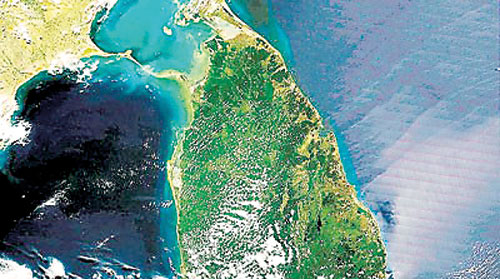
A bridge too far for India to gain: a bridge far too close for Lanka’s comfort
He had said, ‘I recall the lines of a famous song, “Sindu Nadiyin Isai”, composed by the great nationalist poet Subramanian Bharati in the early 20th century: ‘Singalatheevukkinor paalam ameippom” – we shall construct a bridge to Sri Lanka,’ and I have come with the intention of building this bridge – as if such grandiose dreams gave him poetic licence to violate Lanka’s sovereignty at whim and to intrude upon the island’s insularity with insolence.
Modi’s nagging demand for Lanka to be physically joined with India continued to remain on India’s agenda even when Ranil Wickremesinghe visited New Delhi as Sri Lanka’s president in July 2023. Among the many Indian aid packages he found in his bags on returning home was – what else? – a special project proposal to erect a bridge between Lanka and India. This was the second time it had popped out like an irrepressible Jack-in-the-box during Narendra Modi’s span of office.
Whereas nine years ago, Modi’s aspirations had been couched in literary terms, by 2023, a seer’s dream to see Ram Sethu rising anew from its watery grave had turned into a national fixation and had been adopted as a Vision Document by the heads of both states.

NARENDRA MODI: Bridge dreams
But lest it remain a bridge too far to physically construct, it called for a new breed of ‘Vanara Sena’—found in Valmiki’s poetic epic, Ramayana—to hail the bridge as one that would transcend the watery divide and physically join Lanka and India, thus ending the island’s long and pathetic centuries of isolation due to continental drift.
Thanks to Ranil having more than enough economic problems on his plate to chew on, the ‘Vision Document’ appears to have been shelved. But, alas, it has not been shelved in the nightly visitations that Lanka seems to make in the Indian Prime Minister’s dreams.
Santosh Jha continued, last Saturday, in his keynote address, to descend to the gallery by describing, in an unbecoming vein, the absence of a direct road, or railway, or ferry connection as a ludicrous anomaly. “It is as if two neighbouring rooms are connected only through a corridor outside, even when there is a door that can be built between the two rooms, right in the shared wall of the two rooms,” he said.
What on earth was he suggesting? Where, Mr Jha, is the corridor, and where is the door in the bridge India proposes to build across Lanka’s natural maritime moat as a convenient drawbridge for Indian troops to set foot on Lanka’s sovereign soil without even getting their jackboots wet?
At the Indian-sponsored media event, hyped as a ‘global innovation and leadership summit’, the Indian envoy led his target audience down a tortuous labyrinth of swamps and channels, of tunnels and bridges which – no matter what swamp or tunnel he chose – invariably returned to the central theme and purpose of his tireless mission: to convince the emerging generation of the new millennium how the resurrection of the Ram Sethu bridge as a modern-day avatar would put the ‘resplendent’ back to Lanka again.
Undoubtedly, Jha did a splendid job for India. The painful way he laboured to drive home to Lanka the immense debt of gratitude she owed to his country, India, was, indeed, most commendable. He left no stone unturned in his determined endeavour to bring to Lanka’s attention, left no wick unlit to cast unflickering light on how India extended billion-dollar credit lines to Lanka to help her – at that perilous hour – arise from economic bankruptcy.
His words would have moved millions of Indians to feel infinitely superior in moral and economic stature to their island neighbours. Simultaneously, whilst trumpeting from the Taj Mahal’s marbled turrets that India was Lanka’s saviour, Santosh Jha lost no time to crassly rub in the credit lines that Lanka was much obliged to acquiesce to India’s request to build the bridge New Delhi so desperately wanted in spite of Colombo’s reservations.

SANTOSH JHA: No more bridge waverings
Here’s a sample of the pant and urgency in India’s voice, which her envoy echoed last week: “Land connectivity via a bridge or tunnel across the Palk Strait has been discussed for decades. There are enough examples of such corridors across the world. The engineering is well understood. The economics are compelling. The benefits, wherever such bridges have been built, are unmistakable.’
If that was the carrot, what followed was the stick.
India let fall the garb of diplomatic pretences and revealed the vainglorious ambitions she had always held toward Lanka in its stark nakedness.
India’s envoy Jha’s voice adopted the threatening tone of his inquisitorial master and said, in no uncertain terms, ‘But we continue to waver. But let me say clearly: the time for wavering is over. A fixed link between India and Sri Lanka would transform the economic geography of this entire region. It would make Sri Lanka a hub it aspires to become, in a way that no port expansion or airport upgrade can achieve on its own.”
Really?
It seems as though the spiritual voice of India has now descended to a morally decadent tone.
It became evident that India’s constant refrain, ‘Let’s get physical, bro’, sung so oft to woo Lanka’s stubborn heart, had undergone a new arrangement: its tempo more upbeat and faster-paced, its tenor more intense, its tone sharper and shriller, vocalised at an increasingly feverish pitch of pure desperation.
We cannot help but wonder if Jha’s speech was delivered to guilt-trap Lanka’s collective conscience out of India’s chronic insecurity complex. If so, we can only assure India she has no cause for alarm in that respect and her fears remain ungrounded. No need to send in the cavalry, not even a lone foot soldier with a cannonball to fire a single shot of warning.
With all due respect to India’s envoy Santosh Jha, we beg to disagree or as any self-respecting Lankan government would say, ‘put on hold’ India’s proposal.
The historical bond that exists between India and Sri Lanka does not need a permanent bridge to cement it. Talk of an iron bridge to replace a long-vanished limestone one only serves to raise primordial fears still lurking deep within the hearts and minds of islanders.
The historic cultural bonds join the two countries closer together than one built on steel and mortar can ever do. We must confess we have taken the best out of spiritual India and, we hope, made it incredibly better. We have taken the profound teachings of India’s greatest son to heart and aspire to follow the path shown by Gautama, the Buddha.
In fact, it is our proudest boast that we have preserved the philosophy the Buddha preached. We have held ourselves as the guardians of Theravada Buddhism in its pristine form for over 2300 years and sacredly hold this invaluable treasure as our greatest gift to mankind.
We hold a deep sense of gratitude – one that is considered by us as irrepayable – to Emperor Asoka for dispatching his missionary son Arahant Mahinda to gift us the Buddha’s Dhamma that still remains the beacon light that shines upon our path and guides every action we take.
In the same manner and spirit, we owe a deep debt of gratitude to India’s Emperor Asoka – irrepayable again – for sending his daughter Sanghamitta with a sacred sapling of the bo tree under which Prince Siddartha gained enlightenment. It’s the living Jaya Sri Maha Bodhi that best manifests the deep inseverable spiritual bond that exists between the two countries that none can put asunder.
And what’s more, we owe India another debt of gratitude, again irrepayable in money. It’s the debt incurred when we embraced the entire pantheon of Hindu gods and made them our own household deities to worship and to pray to after paying homage to the Buddha.
We also owe a debt of gratitude to her aesthetic arts. We have delved deep to drink from India’s Pierian Spring and striven to enrich its intrinsic value.
If the Egyptians had built their towering pyramids to entomb their pharaoh kings, and if India’s Shah Jahan had built his Taj Mahal for his fondest wife, Mumtaz, to lie in eternal peace within a marbled crypt, then the Sinhala genius had built the soaring stupas to create the grandeur that was Anuradhapura to enshrine the relics of India’s greatest son, the Buddha, for all of mankind to worship and pay homage generation beyond generation, life beyond life.
These are the cultural and religious debts of gratitude that Lanka owes India in perpetuity. Compared to these irrepayable debts, the debt of gratitude that the Indian envoy publicly implied as owed by Lanka to India for giving a 4 or 5 billion dollar credit line at a low rate of interest when she suffered a vicissitude of fortune pales into tawdry insignificance.
And as for trust, which Jha claimed ‘is built over centuries, not decades’, doesn’t trust depend on the integrity of the country’s current ruler? Does Starmer trust Trump in the same manner that Churchill trusted Roosevelt? Perhaps, Lanka prefers to go by the British maxim that a state has only permanent interests, and not permanent friends.
It will be wiser for Lanka to keep giant India at arm’s length, and the 30-kilometre distance between Thalaimannar and Rameshwaram should be the standard yardstick. God forbid, but let Lanka be on her guard that the bridge India is so persistently braying to build does not become the Trojan Horse that the ancient Greeks erected to destroy Troy.
No doubt, the optimists will pooh-pooh the worst fears, while top economists may hail it as a bridge of opportunity for the local economy to grow faster. Lankan importers and exporters will also praise the reduction in transport costs with a 1.5 billion Indian market just a hop, step and jump away. The tourism sector will rub their hands in glee and drool with delight at the prospect of a tourist invasion of Lanka.
But will India’s gateway to Lanka hold hidden dangers to the island’s wellbeing? To her environment? To her culture which, though it owes its roots to India, has evolved on its own, untouched and unspoilt by a diverse host of land-hopping cultures that freely swamped the Indian landmass?
With more than a billion people crouched on our doorstep and poised to become bedfellows, will the Sinhala race run the risk of being bedded out of existence?
Far better for Lanka to remain the fallen teardrop of India than be the coveted pearl that falls for the enchanting wiles of the Indian Ocean’s Titan.
Buying or selling electronics has never been easier with the help of Hitad.lk! We, at Hitad.lk, hear your needs and endeavour to provide you with the perfect listings of electronics; because we have listings for nearly anything! Search for your favourite electronic items for sale on Hitad.lk today!
Leave a Reply
Post Comment