

Columns
- Lack of transparency and accountability in major cases raises questions about NPP’s manifesto promises
- CBSL’s silence raises questions, says ex-Treasury official, adding culprits knew Treasury’s cyber-security weaknesses
- President at May Day rallies reiterates commitment to crack down on corruption; says the corrupt will be jailed this year
- Signs of SJB-UNP reunion emerge; Sajith says it’s already happened but warns of saboteurs
By our Political Desk
The words ‘transparency’ and ‘accountability’ appear dozens of times in the National People’s Power’s (NPP) election manifesto – ‘A Thriving Nation, A Beautiful Life’. The number of times the words appear in the manifesto underscores the importance the party had attached to these lofty ideals back then. Events that have overtaken the country since the NPP assumed power have raised questions as to whether these words hold the same level of importance to the party anymore.
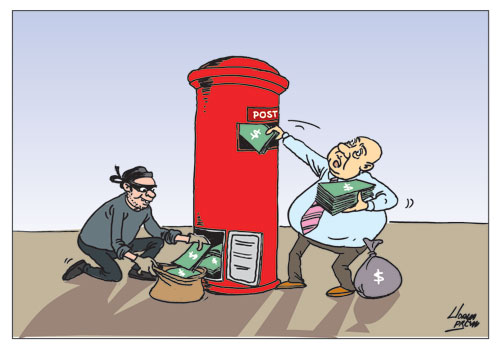
Developments that led to such concerns include the release of more than 300 red-labelled high-risk containers from the Colombo Port without subjecting them to a mandatory physical inspection, the controversy surrounding the procurement of low-grade coal for the Lakvijaya power plant and the cyber-theft of USD 2.5 million meant as a bilateral debt repayment to Australia from the Treasury. In all three cases, there has been a troubling lack of transparency and accountability. While it is true that various investigations into these incidents are underway, they have only come after the government’s hand was forced following embarrassing revelations and days and weeks of negative headlines.
Concerns surrounding a lack of transparency within the administration of President Anura Kumara Dissanayake have grown since the revelation that USD2.5 million has gone missing from the Treasury. The Finance Ministry was forced into admitting that the funds were missing after the opposition-aligned Free Lawyers’ Association sent a letter on April 22 to Speaker Jagath Wickramaratne calling on Parliament to initiate an investigation into reports that such an incident had occurred. The letter came after information leaked out that the Finance Ministry had appointed a ‘Technical Investigation Committee’ headed by two deputy secretaries of the Treasury to probe the case of the missing USD2.5 million payment due to Australia.
There has been a lot of activity since the Finance Ministry’s admission. The Criminal Investigation Department (CID) this week reported to court about the incident for the first time. The CID’s report submitted to the Colombo Fort Magistrate’s Court disclosed that investigations had begun following a complaint to the Computer Crime Investigation Division (CCID) on March 24. The CID also stated that the payments had been made in line with fraudulent payment instructions despite the Treasury being warned that there was a danger of a cyber-theft and that it was investigating whether funds had gone missing during other payments (See story on Page 2).
The incident involves officials from both the Finance Ministry’s External Resources Department (ERD) and the Public Debt Management Office (PDMO). The cyber-heist seems to have occurred during a period of transition, when the PDMO under the Treasury was in the process of taking over debt management functions previously carried out by the CBSL’s Public Debt Department. The PDMO was established under the Public Debt Management Act No. 33 of 2024 in December 2024 and became fully operational only in December 2025.
Responsibility for public finances lies with the country’s Parliament, and the fact that the Treasury had chosen to keep the legislature in the dark about the matter until it leaked to outside parties has infuriated lawmakers from the opposition. Parliament’s Committee on Public Finance (COPF), headed by Samagi Jana Balawegaya (SJB) MP Dr Harsha De Silva, had earlier summoned Treasury Secretary Dr Harshana Suriyapperuma and Central Bank of Sri Lanka (CBSL) Governor Dr Nandalal Weerasinghe before the Committee on Thursday (April 30) to answer questions related to the USD2.5 million payment scandal.
Dr Suriyapperuma, though, wrote to the COPF Chair, informing him that he would not be able to present himself to the committee on that date, revealing that President Dissanayake intended to address Parliament next week to brief the House about the incident. As such, the Treasury Secretary had informed the committee that he could appear before it after the President’s statement. Dr De Silva reacted angrily to the move, writing on X that the Treasury Secretary’s decision is “unacceptable” and “unrelated” as the Constitution places full control of public finance with Parliament. Moreover, under Standing Orders of Parliament, COPF is directly responsible for oversight on debt repayments, he pointed out. “He has to answer questions by the committee. And he had the opportunity to put the ‘record straight’ if by any chance he was being wrongly accused. But why is he running away? What is there to hide? As the incumbent ST, he has a responsibility. He must fulfil that responsibility, or if he cannot, he must give it to someone who can,” the COPF chairman insisted.
Dr De Silva also pointed to another aspect regarding the Treasury Secretary’s position that had been much talked about in the days following the exposure that millions had gone missing from the Treasury. This was the fact that Dr Suriyapperuma was a former NPP MP. In fact, he was a deputy finance minister and even served as a member of COPF prior to his appointment as Treasury Secretary. As such, he became the first ever politician to occupy one of the most important civil service positions in the country. In the wake of the cyber-theft, questions are being raised as to whether the Treasury Secretary’s loyalties lie with the state he is duty-bound to serve or more with the political party of which he was a member.
News that the Treasury Secretary intended to skip Thursday’s COPF meeting until President Dissanayake spoke on the matter also elicited strong reactions from several other current and former MPs. Former head of Parliament’s Committee on Public Enterprises (COPE), Prof. Charitha Herath, slammed the Treasury Secretary’s decision as “utterly unparliamentary and unconstitutional”. Writing on X, he said that no Ministry Secretary should take such a position, pointing out that public finance is a subject of Parliament, and the Secretary to the Ministry of Finance is constitutionally bound to respond to summons issued by parliamentary oversight committees. “He may, of course, request a different date for valid reasons such as health concerns. However, stating that he cannot appear before Parliament until the Executive President makes an address is a serious mistake and sets a troubling precedent. Such actions undermine parliamentary accountability and democratic governance. Only in a banana republic should this be considered acceptable,” Prof. Herath asserted.
Former Ilankai Tamil Arasu Kachchi (ITAK) Parliamentarian M.A. Sumanthiran also weighed in, emphasising on his X account that the Treasury Secretary cannot refuse to attend the COPF meeting when summoned. In the past even ministers of finance have attended COPF meetings and answered questions, he noted.
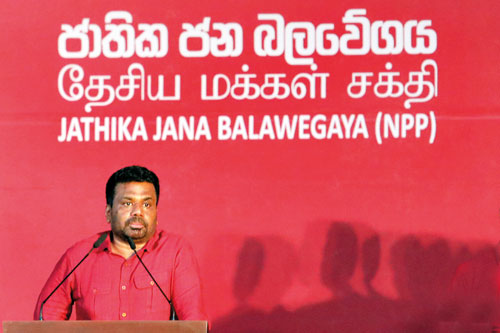
President Anura Kumara Dissanayake addressing the NPP May Day rally in Maharagama on Friday. Pic by M. A. Pushpa Kumara
It may well be that the criticism hit home, for on Thursday morning, reports emerged that Dr Suriyapperuma had abruptly reversed course and would indeed appear with other Finance Ministry and CBSL officials at the COPF meeting scheduled for later that afternoon. Giving an update after the conclusion of the meeting, Dr De Silva told journalists that 10 payments totalling USD2.5 million had been “robbed” from the Treasury from October 2025 through January 2026.
“Notwithstanding red flags being raised, the process had continued, and officials had made payments upon approvals being obtained from multiple reporting layers. We were astonished to find the massive gaps in procedure which had been manipulated to commit this crime over four months. Serious questions remain as to why audits did not pick up the tell-tale discrepancies,” he later wrote in an X post.
As COPF Chair, Dr De Silva said he took the position that it was the duty of the Treasury to inform COPF about such an incident and it should not be told of it by outsiders. “Their excuse of the sensitive nature of the matter, etc. was not accepted.”
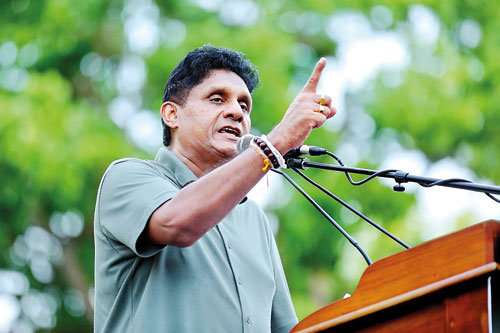
SJB leader Sajith Premadasa addressing the party's May Day rally at P.D. Sirisena Grounds in Colombo
The COPF Chairman further observed that the Treasury Secretary had obligations under several Acts and financial regulations to inform the Financial Intelligence Unit (FIU) of the CBSL within 48 hours of the incident, to get an initial report within seven days and to have the complete report submitted to the Auditor General and Parliament within three months. “While there is a discrepancy on when exactly the Treasury found out about the crime, they informed us that they had initiated all such action, evidence for which we directed the officials to submit to us along with all relevant details,” he added. The committee has directed Treasury officials to report back on the matter in four weeks.
The fiasco surrounding the missing millions has become excellent fodder for those who the NPP has repeatedly accused of stealing public funds. “For years, this administration played Sherlock Holmes, chasing the ‘stolen money’ of Rajapaksa’s with zero proof. Yet, while they were busy playing detective, they became the actual thieves of the people’s money,” Sri Lanka Podujana Peramuna (SLPP) National Organiser Namal Rajapaksa said on social media.
Later, Mr Rajapaksa further mocked the way that Treasury funds had allegedly found their way to hackers. “We paid our debts on time, but we never paid to fake accounts like them. If the government’s version is to be believed, hackers around the world must think that they can call officials, send emails, get senior officials to sign off approval and steal funds without any obstruction. This must be the first hack in history that had been undertaken with approval from the senior-most officials of a Treasury.”
The SLPP MP said he had also held a Zoom meeting this week with IT experts and those responsible for building firewalls to discuss the cyber-theft at the Treasury. He claimed the participants were of the view that this was not an IT crime but an ‘inside job’. “If a hack of this extent occurred, what was the Treasury’s IT Department doing? No one in that department has faced disciplinary action, according to reports. What happened to the software providers whose software is supposed to guard against such attempts? It is all very questionable,” he opined.
Amid multiple external and internal investigations into the incident, a retired senior official with years of experience serving at the Treasury questioned the Finance Ministry’s lack of transparency regarding the incident. “Why did they wait four months to disclose this theft to the public?” he asked, noting that the Finance Ministry had said that an attempt made at diverting a foreign currency payment had been detected as far back as January. Speaking on grounds of anonymity, he also opined that whoever was responsible for the cyber theft had thorough knowledge of the weaknesses in the Treasury’s cyber-security defences. “This was a well-planned heist and not some random attempt where they got lucky. It might well be that some person or persons within the Treasury and the CBSL are complicit in this.”
Speaking from experience, the source explained that when a request comes in for a bank account number change (which had occurred during the theft of the USD2.5 million), it must be approved by a senior Treasury official, which is the standard practice. That official must review the request and examine why a change has been requested and examine the matter thoroughly before deciding whether to give approval or not. “This doesn’t seem to have happened here based on the information that has come out. This is just one safeguard among many. If these safeguards had been practised as they are supposed to, it is highly likely this would not have happened,” the former official claimed.
The source also questioned the ‘curious silence’ of the CBSL in the aftermath of the incident. “We have not heard publicly from the CBSL Governor about this matter. It might be that the CBSL, which relinquished responsibility for debt management operations to the PDMO under the Treasury, would prefer not to get involved in this fiasco. That seems to be its mentality.”
If this is indeed the CBSL’s attitude, it is misguided, the former official insisted. “These are public funds. The CBSL cannot wash its hands of the entire thing on the grounds that it is the Treasury’s debacle. They should at least have the courtesy to reach out and offer whatever assistance they can give.”
At the end of the day, though, the responsibility lies with the government as a whole, especially over the decision to keep the country in the dark for so long after such a monumental incident, he stressed. “Mistakes can happen, but the government should have come clean immediately, admitted such a thing occurred and provided assurances that the matter is being fully investigated. If they had been transparent in the immediate aftermath of finding out that the funds were missing, the matter may not have escalated this far.”
He questioned who had advised those in authority to keep the theft hidden from the Cabinet; from Parliament, which is responsible for public funds; and the public. If such advice had been received from somewhere, it is incumbent on the government to disclose who gave such advice and what international best practices they followed by withholding such an incident from the country, he emphasised. “The fact of the matter is that we would still be in the dark about this if Maithri Gunaratne and his Free Lawyers’ Association had not written to the Speaker exposing this incident,” he pointed out.
He reiterated that the government deserves criticism of the way it has handled the situation because these are public funds. It is Parliament that’s responsible for matters of public finance. “What the Treasury should have done immediately was to inform the President, as he is also Finance Minister, the Cabinet and also Parliament. The Speaker should have been informed that such an incident had occurred. He should not have had to learn of it by a letter from an outside party.”
The consequences of mismanaging the crisis to such an extent are that the country’s financial security reputation has taken a considerable hit, the former official lamented. “These are highly sensitive matters related to public debt servicing. It is not a problem that solely affects the Treasury, Treasury Secretary or CBSL. It is clear from the unfolding saga that the Treasury, CBSL and other state institutions have not learnt lessons from what had occurred,” he added.
Meanwhile, the investigations into the missing funds suffered a potentially serious blow on Thursday when one of the five ERD officials who had been interdicted over the incident was found dead in suspicious circumstances at his residence in Kuliyapitiya. The deceased, identified as Ranga Rajapaksa, was an assistant director at the ERD. Police said there were several cut injuries to one of his legs and hands. A four-member panel of judicial medical officers appointed by the Health Ministry to conduct a post-mortem examination into his death concluded on Friday that his injuries were self-inflicted and he had taken his own life.
President’s May Day message
Burdened with the weight of incumbency as well as the growing lists of scandals linked to government members, the exhilaration with which the NPP celebrated May Day last year has diminished to some extent within the past 12 months. From the release of over 300 containers from the Colombo port, the import of substandard coal, and the questionable asset declarations by some cabinet ministers to the most recent case of USD2.5 million going missing from the Treasury, the government has been out on the dock.
Instead of holding one main rally, the NPP decided to hold 21 separate rallies this year, with President Anura Kumara Dissanayake attending a rally in Nuwara Eliya in the morning and then another rally in Maharagama in the evening. Other cabinet ministers addressed rallies in different districts, with the Prime Minister addressing a rally in Ratnapura, Bimal Rathnayake in the north and Minister Lal Kantha in Kandy.
Ironically, the main thrust of the President’s speeches was the government’s anti-corruption drive. Most of his remarks were directed at those in previous administrations. “This year, 2026, will be the year in Sri Lanka’s history when the corrupt, the crooks, and the thieves will be sent to prison. Criminals, crooks, the corrupt, drug dealers, and underworld figures are being imprisoned at a rapid pace,” the President said. It is the familiar theme on which the NPP rode to power, but the message no longer carries the same weight given his decision to turn a blind eye against those within his own ranks who are facing allegations of wrongdoing and corruption.
In both his speeches, the President underscored the relationship between the NPP and the working class of the country, calling his administration a ‘people’s government’. This Workers’ Day is being commemorated under a government brought to power by the workers. All the decisions that have been taken in the past year and a half have been for the benefit of the working class in the country,” he said.
SJB-UNP ties
For SJB leader Sajith Premadasa, May Day began on a poignant note when he, along with his family members and party supporters, paid tribute to the late President Ranasinghe Premadasa, who was assassinated by an LTTE suicide bomber on May Day in 1993.
Later, he attended the SJB’s May Day rally at Colombo’s P.D. Sirisena Grounds, where he said that the only alternative to the NPP was the SJB. “The list of corrupt deals has exposed the government. The lies being spun by the circle of liars at Pelawatta can no longer hoodwink the people,” he said, referring to the ruling party’s headquarters.
While the United National Party (UNP) had turned down an invitation from the SJB to attend its May day rally, UNP leader Ranil Wickremesinghe had sent a congratulatory message to the SJB in which he said that the recent period has clearly revealed the true nature of the current government, which he characterised as being associated with theft, fraud, corruption, and intimidation.
In the message, the former President reminded party (SJB) members to continue the work of the committee appointed to explore a joint political path between the UNP and the SJB.
Mr Premadasa thanked Mr Wickremesinghe for the congratulatory message and said that there was no need for any more committees for the two parties to come together. “We are already one, and we are working together. Some in the committees are sabotaging the attempts for the two parties to come together. We can and will work together in the future,” he said.
While expressing his optimism over the UNP–SJB linkup, the SJB is also feeling the ripples of dissent within its own ranks.
This week the SJB’s electoral organisers for the Galagedara and Teldeniya electorates stepped down. They were retired Major General Nissanka Ranawana and Channa Galappaththi, who had informed Party General Secretary Ranjith Madduma Banadra that they were resigning from their position.
Prior to this, Dr Chamal Sanjeewa resigned from his post as Ratmalana electoral organiser of the SJB, citing personal reasons. These resignations have led to speculation of internal strife.
Amidst this was the high-profile resignation this week of Eran Wickramaratne, who resigned from the SJB after assuming duties as Chairman of the Restructuring Committee of Sri Lanka Cricket (SLC).
His resignation came after the SJB formally requested that he relinquish his party membership, in line with party policy.
In a letter dated yesterday (April 29), SJB General Secretary Ranjith Madduma Bandara informed Mr Wickramaratne of the decision, following his resignation from the party’s Working Committee and Management Committee.
The letter notes that SJB policy has consistently required sports governing bodies to remain free from political interference and that individuals affiliated with political parties should not hold positions within such institutions. It further notes that continuing party membership under the current circumstances would be inconsistent with this policy and states that, on ethical grounds, Mr Wickramaratne should also step down from the party.
Eran Wickramaratne was appointed to head the interim committee to run Sri Lanka Cricket (SLC) following the resignation of SLC president Shammi Silva and his executive committee. He was appointed as the chairman of the new Sri Lanka Cricket Restructuring Committee (Interim Committee) by Sports Minister Sunil Kumara Gamage on Wednesday.
In 2023 it was the SJB that was in the forefront of efforts to remove Shammi Silva from SLC, with SJB leader Sajith Premadasa spearheading a parliament motion for the removal of the office-bearers of Sri Lanka Cricket (SLC). The proposal was submitted to Parliament by Mr Premadasa in his capacity as Opposition Leader in November 2023 and was passed unanimously by the House.
The motion called for new legislation for cricket administration that needed to be passed through a new act in order to maintain corruption-free, transparent cricket governance.
Meanwhile, a senior government source said that President Dissanayake had asked Shammi Silva and the board members to step down over the long-drawn-out allegations against them. “There are multiple allegations against the SLC board, and the best way to start on a clean slate and win back public confidence in the game is by ensuring that the cricket administrators are clean,” he said.
He cited the case of an interference with the judiciary in relation to the ruling of the Court of Appeal (CA) suspending the interim committee appointed to Sri Lanka Cricket (SLC) by then Sports Minister Roshan Ranasinghe in November 2023. This, he said, was among the serious allegations against those at SL Cricket at the time which nearly led to the impeachment of a judge who gave the ruling.
Buying or selling electronics has never been easier with the help of Hitad.lk! We, at Hitad.lk, hear your needs and endeavour to provide you with the perfect listings of electronics; because we have listings for nearly anything! Search for your favourite electronic items for sale on Hitad.lk today!
Cyber heists mar NPP’s clean-Govt. image
View(s):