

Sunday Times 2
Rigour and insight — a blueprint to overhaul the education system
View(s):Reviewed by Dr. Harsha Aturupane
“Transforming Education: The way forward in Sri Lanka” by Prof. Gunapala Nanayakkara is a remarkable book and a colossal work of scholarship. It contains a comprehensive exploration of the challenges and opportunities facing Sri Lanka’s general education system and charts a course for transformational development in the future.
The book, structured in two major parts, delves deeply into the current state of general education and the necessity for systemic change. It presents actionable strategies for a fresh approach to the nation’s investment in education for human development and economic growth.
Part One: Transforming the National System of General Education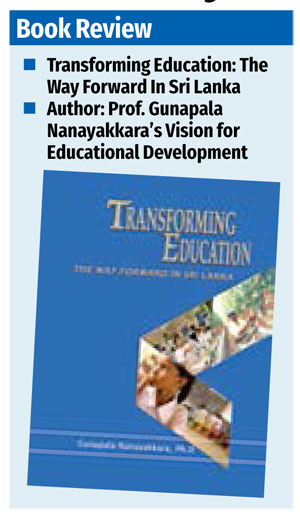
The first part of the book is thoughtfully divided into two sections: (a) The System and Need for Change and (b) Redesigning Education at National Level: Governance, Policy, and Planning. In “The System and Need for Change”, Prof. Nanayakkara provides a meticulous analysis of the governance framework of Sri Lanka’s education system, especially its administrative arrangements, past achievements and entrenched issues, inequities in access, and the gap between education and the demands of the modern global knowledge economy. The arguments are supported by empirical data and global comparisons, making a compelling case for urgent reform.
In the subsequent section on “Redesigning Education at National Level”, the author offers a blueprint for overhauling the system. He emphasises the importance of robust governance structures, forward-thinking policy frameworks, and strategic long-term planning. Prof. Nanayakkara’s approach is holistic, recognising the interplay between educational policy and broader socio-economic factors. The recommendations are pragmatic, focusing on scalability and sustainability, which is especially relevant for policymakers and educational leaders in Sri Lanka.
Part Two: Towards a New System of General Education
The second part of the book, while delving into the future trajectory of general education in Sri Lanka, is divided into three sections: General Education: Reforms and Transformation; General Education, a New Impetus to Training and Development; and General Education: The Way Forward.
In “General Education: Reforms and Transformation”, Prof. Nanayakkara advocates for a learner-centred, skills-orientated framework that prioritises logical thinking, innovation, and adaptability. He critiques the exam-centric culture and proposes methods to foster creativity and problem-solving abilities among students. The variations in learning styles and needs of students and the importance of optimising learning are especially valuable. The discussion of financing and the need to allocate resources within a sound framework is also important. Overall, this section is particularly insightful, as it balances theoretical discourse with practical recommendations for classroom practice and curriculum development.
Under the topic “A New Impetus to Training and Development”, the book highlights the need for continuous professional development for teachers and the integration of training within the general education system. The author gives special attention to the importance of human resources within the education system. The role of school principals as leaders of education development at the institutional level is emphasised. Prof. Nanayakkara underscores the significance of aligning educational outcomes with workforce needs, suggesting closer collaboration between academic institutions and industry partners.
The final section, “The Way Forward”, synthesises the book’s central themes and presents a visionary yet attainable roadmap for the future. The author calls for a shared commitment among educators, policymakers, parents, and students to drive systemic change. His optimism is cautious but grounded in a clear understanding of the obstacles and opportunities that lie ahead.
Conclusion
“Transforming Education: The Way Forward in Sri Lanka” is a significant contribution to the discourse on educational reform in Sri Lanka. Prof. Gunapala Nanayakkara’s blend of scholarly rigour and practical insight based on extensive experience of education policy discussions makes the book essential reading for educators, administrators, policymakers, and anyone interested in the future of education in the country.
(Dr Harsha Aturupane is a lead economist at The World Bank.)