


Exploring the deeper, plural story of Sri Lanka
View(s):A few weeks ago, on a long journey from Colombo to Toronto, I carried with me the second edition of Shared Sanctities by Hasini Haputhanthri and Sujeewa de Silva. Among the many books I have read on shared heritage and conservation, this work stands out as a moving and creative achievement that merits close attention.
Geopolitically and historically, Sri Lanka has long been home to people from many regions. Despite claims of racial purity, our heritage is unmistakably mixed and shared. For centuries, this land absorbed ideas, faiths, and artistic forms with a confidence modern Sri Lanka struggles to reclaim. What makes this book compelling is not simply its content, but the way Hasini reanimates that forgotten spirit of confluence.
From the beginning, Hasini roots her narrative in movement—oceans, islands, and trade routes. Her encounter with the Nestorian Cross at a Buddhist pilgrimage site sets the tone: Sri Lanka’s past is rarely tidy and far more entangled than our schoolbooks suggest. In chapters such as Greater World: Islands, Oceans and Beyond, she places the island firmly within ancient maritime networks, showing how ships, ideas, and communities shaped art, architecture, and ritual practices long before European colonialism.
One of my favourite extracts from the book is the following: “We never quite realize that the history we learn in school is ‘land-locked’. No one thinks that history ever happened out there at sea. This is possibly because history was held hostage by post-colonial nationalisms, where their scope was defined by newly drawn ‘national borders’. Oceans were nationalized too, but to a lesser extent than the land. After all, there are no ‘sons of the sea’; only ‘sons of the soil’!”
Hasini does not merely describe syncretism; she allows the reader to stand inside it. Nalanda Gedige, with its fusion of Hindu and Buddhist symbolism, becomes not just a monument but a question—challenging our urge to classify heritage into rigid categories. Ambiguity itself emerges as a form of inheritance.
| Book Facts | |
| ‘Shared Sanctities’ by Hasini Haputhanthri and Sujeewa de Silva 2nd Edition, 2025, Published by the International Centre Reviewed by Avishka Mario Senewiratne
|
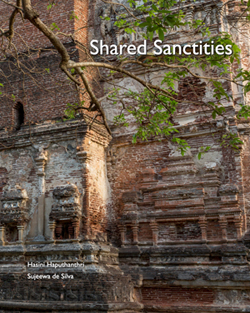
Her exploration of Polonnaruwa in Temple as Museum; Religion as Art is among the book’s finest sections. The Tivanka Image House, with its Hindu architectural frame sheltering a towering Buddha and medieval murals, illustrates a living artistic and spiritual dialogue. Polonnaruwa emerges not as a singular Buddhist space, but as a layered sanctuary shaped by movement, borrowing, and imagination.
The chapters set in Kandy extend this argument into the colonial and modern eras. From the Trinity College Chapel and David Paynter’s murals to the carvings of the Embekke Devale, Hasini traces how faith, power, and art intersect across centuries. A Tale of Two Masjids similarly examines how Islam adapted and reshaped itself within Sri Lanka’s cosmopolitan spaces, using architecture as a language of coexistence.
In The Blonde Behind the Buddha, colonial memory and Buddhist devotion collide in Karagampitiya, where European motifs enter a Sinhala-Buddhist visual world. The blonde figure becomes a metaphor for adaptation rather than cultural purity.
“City of Gods” is one of the most evocative chapters in Shared Sanctities, stitching together maritime history, sacred geography, and memory with impressive ease. Tenavaram emerges not merely as a ruined shrine on the southern tip of the island, but as a cosmopolitan temple-city where peacocks from Sandesha poetry, merchants from Sumatra, Tamil Brahmins, Sinhala kings and Ming admirals all intersect. Hasini handles maps, Tevaram, chronicles and colonial violence without losing the lyrical, almost cinematic quality of her prose. Especially powerful is the tracing of Tenavaram’s afterlives – from Pancha Ishvaram lore to the blue god Upulvan and the half-forgotten lingam and Nandi that still haunt the site.
The later chapters—the shifting representation of women in temple art—push the narrative into cultural politics. Here, Hasini confronts how colonial morality attempted to tame the female body and how nationalist revivalism reshaped identity, dress, and artistic convention. Her reflections on the transformation from sensuous murals to demure, Victorianised figures are particularly striking and reveal how power quietly negotiates aesthetics.
Ultimately, Shared Sanctities is a challenge to monolithic histories. Supported by Sujeewa de Silva’s superb photography and the accompanying documentaries, the book becomes both an academic resource and a heartfelt tribute to an island shaped by openness and exchange. It deserves to be read by anyone seeking to understand the deeper, plural story of Sri Lanka.
Hasini’s account is both compelling and wonderfully lucid; anyone with even a half-curious mind will find it hard to put this book down once they begin. She writes with a distinctly romantic overtone, yet never loses control of a tightly argued, historically grounded narrative—a balance many would struggle to maintain when dealing with such a wide and complex constellation of syncretic shrines in Sri Lanka. Her prose at times recalls the best of H. W. Cave and William Skeen, those early chroniclers of Ceylon’s landscapes and sanctities, whose work quietly shaped our understanding of the island’s cultural memory.
Her careful use of both well-known and lesser-known sources gives the book real scholarly weight, without ever becoming dry. The visual layer provided by Sujeewa de Silva’s photographs—the murals, façades, statues, and architectural details—is not ornamental but essential. His images do not merely illustrate; they converse with the text, and for a reader less inclined to long passages of prose, they offer an inviting, almost meditative way into the material. His craft deserves very warm praise.
If a third edition is ever contemplated, a closer engagement with Donald Stadtner’s Sacred Sites of Sri Lanka would be valuable, as it offers complementary readings of some of these spaces. But that is a suggestion at the margins. For me, reading Shared Sanctities on an otherwise monotonous, long-haul flight was an unexpected delight. It is a book that should be read by anyone who wishes to grasp the essence of the Sri Lankan story—a story still very much being written.
Searching for an ideal partner? Find your soul mate on Hitad.lk, Sri Lanka's favourite marriage proposals page. With Hitad.lk matrimonial advertisements you have access to thousands of ads from potential suitors who are looking for someone just like you.