


A quest for reconciliation
It was an insightful discussion, delving into the making of Ayathurai Santhan the writer and his literary journey when he spoke to Vihanga Perera at the International Centre for Ethnic Studies last week to mark the launch in January of his new novel, Twice Upon a Lifetime.
They strolled through those palmyrah-fenced landscapes, talking of writing about crises and pogroms; writing from experience vs writing based on second hand accounts of historical events; the similarities between the Dravidian and Sinhalese cultures; and why Santhan never speaks about “Tamils and Sinhalese” but rather “people from the South and people from the North”…
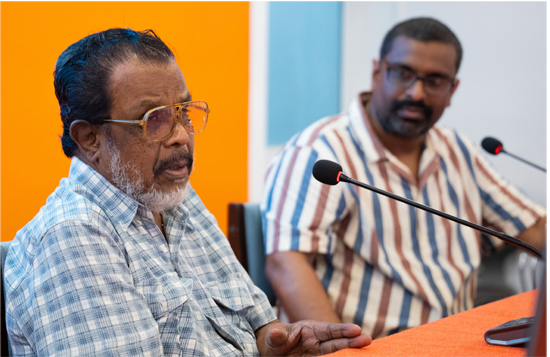
Author Ayathurai Santhan in discussion with Vihanga Perera
There were readings by Gihan de Chickera and Crystal Baines from the novel which is set against our recent economic crisis, across two timelines in Kenya and Sri Lanka, where three drivers narrate. However, the main narrative is of Sivan who embarks on a journey to Colombo, “during the height of the fuel shortage, to find closure to a relationship that was abruptly disrupted years ago”.
What emerges in the non-linear dialogic narrative is a quest, both literal and metaphorical, of a man who has lived through the violence of war, as he invites conversations on reconciliation and forgiveness with a younger generation that has inherited new challenges in the aftermath of the crisis.

Readings: Crystal Baines and Gihan de Chickera
In an appraisal of the novel, Nabanita Sengupta has written, “Twice Upon a Lifetime is a story that unfolds like a game of treasure hunt, and in the process unwraps the history of the country…There is a strong resilience in the novel, similar to that of the author himself for whom the zest for life is equal to living.”
In the preface to the novel, Manikya Kodituwakku wrote that the novel “is a timely reminder that reconciliation begins with conversations and dialogues across shared spaces, whether over a cup of tea or with a prayer at a shrine, between people living the ordinary rhythms of life.”
Searching for an ideal partner? Find your soul mate on Hitad.lk, Sri Lanka's favourite marriage proposals page. With Hitad.lk matrimonial advertisements you have access to thousands of ads from potential suitors who are looking for someone just like you.