


Educated but segregated
In many ways, Sri Lankan women have been the greatest beneficiaries of this national investment, excelling in schools and universities and carrying the promise of social progress.
 However, behind this success story lies a troubling contradiction. Despite decades of public investment and women’s educational achievements, Sri Lankan women remain systematically excluded from fair, secure, and well-paid employment. On this International Women’s Day, it is important to examine what national data reveal about women’s real position in the labour market and why the promise of education has not translated into equal economic opportunity.
Educated women, low workforce participation
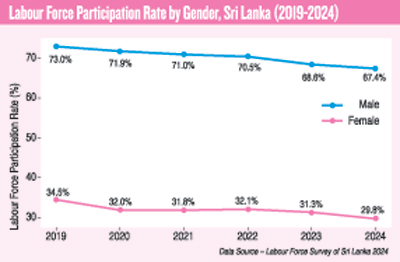
According to Sri Lanka Labour Force Survey (LFS) data (Fig 1.) from 2019 to 2024, women consistently make up a larger share of the working-age population than men. Yet, their participation in paid employment remains strikingly low. In 2019, female labour force participation stood at 34.5%, compared to 73.0% for men. By 2024, participation had declined for both genders, falling to 29.8% among women and 67.4% among men (Department of Census and Statistics, Sri Lanka). This persistent gap, exceeding 37 % points, shows that while education improves women’s chances of labour market entry, it has not been sufficient to ensure sustained and equitable participation.
Despite these challenges, the National Labour Force data show that education still matters. Women with degree-level qualifications consistently record the highest labour force participation rates, remaining close to 80% over recent years. In contrast, participation among women with G.C.E. (A/L) qualifications declined sharply from 47.1% in 2019 to 38.8% in 2024, while participation among women with O/L qualifications or below has remained below 30%.
These trends reveal a dual reality. While higher education increases women’s likelihood of entering the labour force, many educated women remain concentrated in a narrow range of occupations, particularly in the public sector, limiting their access to higher earnings, career advancement, and leadership roles.
Gender-based occupational segregation: A structural problem
One of the main reasons behind Sri Lanka’s education-employment paradox is gender-based occupational segregation. Despite rising educational attainment among women, employment data show that men and women continue to be channelled into distinctly different types of work.
The Labour Force Survey data (2019–2024) reveal that women are heavily concentrated in teaching and education, healthcare and nursing, clerical work, apparel manufacturing, and elementary jobs. These occupations align with traditional caregiving and supportive roles but are typically characterised by lower wages, limited career progression, and reduced access to leadership positions.
In contrast, men are more heavily concentrated in the private sector, particularly in higher-paying and technical roles in construction, engineering, machine operation, and skilled trades. Women, meanwhile, are disproportionately represented in the public sector, especially in teaching, healthcare and clerical occupations. This pattern reflects early educational streaming, limited exposure to technical career paths for girls, employer preferences, and persistent social norms that frame certain types of work as unsuitable for women.
Invisible barrier to leadership
Occupational segregation becomes even more pronounced at higher levels of authority. Data from the Labour Force Surveys (2019–2024) show that women’s representation among managers, senior officials, and legislators declined sharply from around 6% in 2019 to about 3% by 2023, with only a marginal increase to around 3.5% in 2024, despite women accounting for a substantial share of professionals in education, healthcare, and public administration.
 This pattern reflects the persistence of a glass ceiling, in which promotion systems reward uninterrupted career paths, long working hours, and access to informal networks often dominated by men. These criteria disadvantage women, who continue to shoulder a disproportionate share of unpaid care work. Even in female-dominated sectors such as education and healthcare, senior decision-making positions often remain disproportionately male.
Labour Force Survey data show that unpaid caregiving is not a marginal issue but a defining constraint on women’s labour market participation. As shown in Figure 3, engagement in housework and caregiving accounted for around 57%–62 % of women’s economic inactivity between 2019 and 2024, compared to less than 5% among men. This gendered care burden shapes not only whether women participate in paid work but also the types of jobs they can access, reinforcing women’s concentration in care-compatible public-sector roles and limiting their progression into private-sector, technical, and leadership positions.
Wage growth without wage equality
Gender-based occupational segregation has direct consequences for income inequality. According to Labour Force Survey wage data (2019–2024), average wages increased for both men and women; the gender wage gap remained unchanged. In 2024, the average monthly wage for men was approximately LKR 63,000, compared to LKR 51,700 for women. The disparity is more severe among daily-paid workers, where women earned only 50–55% of male daily wages throughout 2019–2024.
Education patterns reinforce segregation
Higher education patterns further explain why occupational segregation persists. University Grants Commission data (2016/17–2022/23) show that women dominate enrolments in Arts (over 80%), Commerce (65–68%), and Biosciences (over 70%), which commonly lead to careers in education, administration, and healthcare sectors offering social value but limited wage growth and leadership opportunities.
In contrast, women remain underrepresented in technical fields. Female enrolment in Physical Science ranged from 30% to 37%, while participation in Engineering Technology ranged from 11% to 19%. From school onwards, girls are often discouraged from pursuing technical subjects due to perceptions about difficulty, safety, and future family responsibilities. These early education choices translate directly into labour market outcomes.
What must change
Gender-based occupational segregation is not only a women’s issue, but it is a serious economic challenge. When educated women are confined to lower-paid sectors or excluded from leadership, productivity declines, skills remain underutilised, and household incomes stagnate. International evidence shows that increasing women’s participation in productive employment boosts national output and strengthens household resilience.
Meaningful change requires expanding affordable childcare and eldercare services, adopting gender-responsive recruitment and promotion practices, enforcing equal pay for work of equal value, and strengthening career guidance to encourage girls into technical and STEM fields. Workplace cultures must also evolve to support women’s leadership and challenge gender stereotypes.
A moment for action
On this International Women’s Day, the message is clear: educating women is not enough if the labour market remains unequal. True empowerment requires transforming the structures that confine women to undervalued work, particularly through the unequal distribution of unpaid care and the lack of affordable, reliable childcare and eldercare systems. It also requires ensuring that both public investment and personal effort are rewarded with fair pay, career progression, and leadership opportunities.
Only then can Sri Lanka fully honour its commitment to women not just in classrooms, but in workplaces, boardrooms, and the broader economy.
( The writer is a PhD Candidate at the University of Waikato, New Zealand)
Searching for an ideal partner? Find your soul mate on Hitad.lk, Sri Lanka's favourite marriage proposals page. With Hitad.lk matrimonial advertisements you have access to thousands of ads from potential suitors who are looking for someone just like you.