

Columns
Expanding West Asian war poses severe threat to Lankan economy
View(s):The war in West Asia has affected most countries and is causing immense damage and disruption in the region. There is a possibility of Russia and other countries being drawn into the war. At the time of writing, there is little prospect of a negotiated settlement. This war could cripple the Sri Lankan economy and bring about severe hardships to the people.
Economic impacts
The repercussions of the war are global. Its impact on the Sri Lankan economy is severe. The country’s balance of payments could deteriorate. A large balance of payments deficit will erode the external reserves that have been built up.
On the other hand, increasing prices and shortages of essentials could trigger social unrest. A continuation of the war would cripple our economy.
Sri Lankan economy
The Sri Lankan economy is facing one of the severest threats to it. The balance of payments deficit is likely to widen sharply owing to increased import costs and decreased exports owing to disruption in shipping. Earnings from tourism are likely to dip owing to disruption of flights, higher travel costs and insecurity. The return of workers from West Asian countries would be a severe blow to remittances that are the main source of foreign earnings.
A large balance of payments deficit will erode foreign reserves that had risen to US$6.9 billion by end January. This would make it impossible to meet our foreign debt repayments.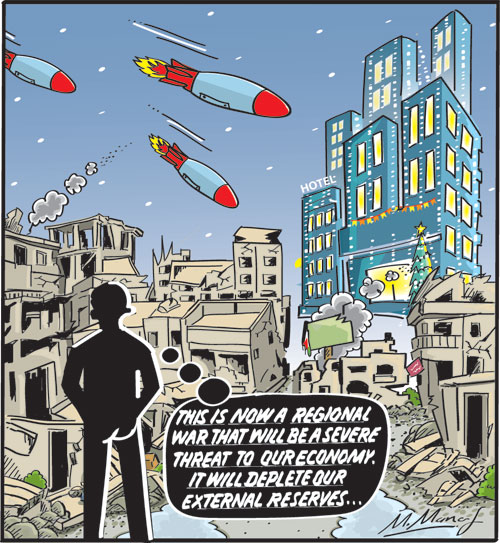
External shocks
Severe global uncertainties and external shocks—high oil prices, lower remittances and a dip in tourism—threaten the Sri Lankan economy. The uncertainties in US tariffs could affect our exports to the US, which accounts for about 25 per cent of our exports. Shipping difficulties and higher freight costs could reduce merchandise export earnings.
Disaster
The war in West Asia is a global disaster. The Sri Lankan economy could face unsustainable external shocks if the West Asian conflict escalates into a global conflict.
Higher tariffs on our exports to the US, high prices for oil and other imports, lower remittances from West Asian countries owing to security conditions and a dip in tourism owing to travel disruptions and higher costs of travel could affect the country’s economy severely.
Economic growth
The Central Bank of Sri Lanka has projected that the economy will grow by 4 to 5 per cent this year, lower than expected earlier. The Central Bank expects this year’s economic growth to moderate amid Cyclone Ditwah and global geopolitical tensions. The downside risks to growth projections in the near to medium term could arise due to global trade frictions and elevated geopolitical uncertainty, which may negatively affect growth in key trading partners and tourism source markets, it said.
Slower growth and heightened global uncertainty could affect tourist arrivals and tourism service exports, lowering export earnings and foreign exchange.
In a global perspective, global economic conditions remain subject to uncertainty amid recent trade policy developments in the United States and ongoing geopolitical tensions, although global growth outcomes for 2025 and the outlook for 2026 are expected to be stronger than previously anticipated.
Threats
The Sri Lankan economy is threatened by war in West Asia and by the Russian-Ukrainian conflict. The war in West Asia between Iran and the US-Israeli coalition, the war between Russia and Ukraine and President Trump’s unpredictable tariffs could impact severely the country’s import-export economy. Global tensions, closure of airspace and increased costs of air travel could affect the country’s tourism that is booming.
The West Asian war that is escalating could have severe adverse repercussions on our economy. Our oil-for-tea agreement with Iran could be jeopardised in several ways, including the closure of the Strait of Hormuz and sanctions Trump has threatened to impose on nations trading with Iran.
The inability to obtain Iranian crude is a serious blow as our refinery is built for the processing of Iranian crude oil. The disruption of our tea exports to Iran will be a disadvantage but one that is sustainable, as we could divert tea to other West Asian markets. Here again the blockade of the Hormuz Straits will matter.
Tariffs
A serious concern is whether the US will impose further tariffs on our exports due to our trade relations with Russia and Iran. If the current tariff on our exports to the US is increased from the current level, our exports of garments and rubber goods could be severely disadvantaged. There is no doubt that our economy could face severe external shocks of higher tariffs, high oil prices and lower remittances.
Conclusion
The Sri Lankan economy could be facing severe external shocks if the war in West Asia continues and escalates. In addition, higher US tariffs on our exports to the US, high prices for oil and other imports, lower remittances from West Asian countries owing to security conditions and a dip in tourism owing to disruptions and higher costs of travel could affect the economy adversely. Hopefully, there would be a change in these conditions that would not affect our economic recovery.
As President Dissanayaka told parliament last Tuesday, “We are not the decision-makers in this conflict but have to face the consequences of it. Hopefully, there would be a change that would lead to a durable peace in the region.
Buying or selling electronics has never been easier with the help of Hitad.lk! We, at Hitad.lk, hear your needs and endeavour to provide you with the perfect listings of electronics; because we have listings for nearly anything! Search for your favourite electronic items for sale on Hitad.lk today!
Leave a Reply
Post Comment