

Columns
The government basking in the IMF’s assessment of the economy
View(s):Although the International Monetary Fund (IMF) has called the country’s recovery after the 2022 economic crisis impressive, it has emphasised that reforms should be taken to ensure the growth momentum.
Furthermore, it has drawn the government’s attention to the possible external shocks that we discussed in last Sunday’s column. Earlier, the Central Bank of Sri Lanka (CBSL) too underscored the need for reforms and the overhang of external shocks.
Reforms
Although the National People’s Power government has discussed several modes of reforming state enterprises, especially the loss-making ones, there does not appear to be any step in that direction.
Government and IMF
The JVP/NPP, which, during the election campaign, promised to abandon the IMF’s Extended Fund Facility (EFF) when it came to power, has continued with it and is basking in the IMF’s assessment of the economy. This change of heart or change in policy has been viewed in divergent ways.
Opposition
Opposition parties have seen the government’s decision to go with the IMF as not keeping to the election promise. There are also JVP/NPP coalition members who are of the view that the government should have ditched the IMF agreement or at least negotiated for a different one in keeping with its critique of the IMF. Those with Marxist leanings are holding on to this view.
Moderate view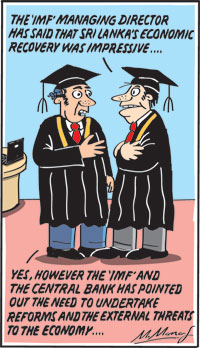
The view of moderates in the government is that the continuation of the IMF programme was not only beneficial but essential for the economic recovery.
There was no other option to rescue the country from the economic crisis than by continuing with the IMF programme that the previous government had entered into.
Pragmatism
A hallmark of the government has been its pragmatism and willingness to change its stance when such a change is in the nation’s economic interest. This has been so not only in economic policies but also in its foreign relations.
IMF assessment
The Sri Lankan economy has been described as a “success story” in recovery—a feat characterised by policies to restore macroeconomic stability following the 2022 crisis.
During her official visit on February 17-18, 2026, IMF Managing Director Kristalina Georgieva commended the country’s tremendous progress, citing a return to positive growth, a steep decline in inflation, and the rebuilding of foreign reserves.
Economic projections
The IMF expects Sri Lanka’s economy to transition toward its long-term trend growth in 2026.
Growth
The country’s economic growth is projected to be 3.1 per cent this year. This is a downward revision from earlier estimates “as the initial post-crisis rebound (5% in 2024) stabilises.
Inflation
Headline inflation has fallen significantly and is expected to gradually return to the Central Bank’s 5 per cent target.
Reserves
Gross official reserves reached $6.3 billion by mid-2025, supported by tourism and remittances.
Sri Lanka’s real GDP growth projections will, however, depend on the government’s reform agenda and the external environment.
Conclusion
Our trade-, tourism- and remittance-dependent economy heavily relies on the external environment. We can only hope that the tariff wars and the conflicts in West Asia will end soon.
Buying or selling electronics has never been easier with the help of Hitad.lk! We, at Hitad.lk, hear your needs and endeavour to provide you with the perfect listings of electronics; because we have listings for nearly anything! Search for your favourite electronic items for sale on Hitad.lk today!
Leave a Reply
Post Comment