


From 100 metres to 5000 feet
View(s):This business began as a small tea boutique 25–30 years ago. What was once a temporary hut on reservation land between the road and the river grew into a large permanent building. The owner’s journey mirrored the growth: from riding a bicycle, to a tuk-tuk, and finally to a luxury V8 jeep.
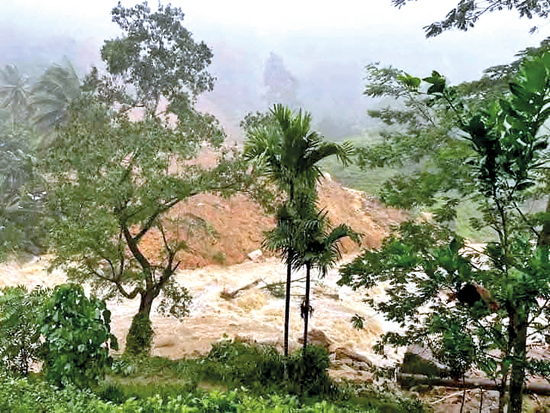
Floods from Cyclone Ditwah.
I learned these details from the person I met that day. But what struck me most was his remark:
“This restaurant is built on reservation land. Residents complained, but authorities told them to go to court instead of taking action.”
He continued: “The other problem is if it was an illegal construction on reservation land, how was it possible that the restaurant owner got telephone connection, water supply, electricity, an official address and Pradeshiya Sabha approval?”
Nature eventually intervened. Cyclone Ditwah’s floods swept the restaurant away. Yet when I visited, a ceremony was underway—politicians were donating cash and electrical equipment to help restart the business.
I won’t mention the exact location, because this isn’t a rare case. Stories like this can be found in countless places across the island.
Line on the sand
It was in the aftermath of the 2004 tsunami disaster of Sri Lanka that the government literally drew a line in the sand along the coastal belt of the country. No house, no shop, no fishing hut would be allowed within 100 metres of the southern and western shoreline, and in the north and east the line was pushed even further, to 200 metres. Further, the coastal towns would be rebuilt in safe locations away from the coast.
The announcement was bold, almost defiant, a promise that never again would families be left so exposed to the fury of the sea. But what looked like a neat solution on paper quickly unraveled on the ground. While people did not wait until the lethargic state machinery would draw the plans, undertake implementation and invite them to come to their new homes. The next day onwards after the tsunami, people started returning to their original locations.
Some of the fishing communities that were sent inland to hastily build relocation sites were not livable or sustainable. The new settlements were far from the water, far from the boats, and far from the livelihoods that had sustained generations. Just a piece of land with a small house and access road would not keep the families without basic amenities and opportunities in newly introduced relocated sites.
 Opposition too grew louder by the day. Fishermen argued that a house without the sea was no house at all. Influential parties and individuals seemed to slip past the rules with ease arousing public anger. The pressure was too much, and the government quietly began to forget and ignore its own directive. Families returned to the coast, rebuilding in the very places the buffer zone had sought to forbid.
Twenty‑two years later, the buffer zone survives only as a memory of a failed experiment. The beaches are once again crowded with homes, shops, and fishing boats, as if the tsunami’s lesson has faded with time. Disaster management today leans on early warning systems and community preparedness rather than blanket exclusion zones.
The buffer zone remains a cautionary tale. It showed how disaster policy, when imposed from above without regard for livelihoods, can collapse under the weight of resistance. The sea may have claimed the land in 2004, but the people reclaimed it soon after—reminding us that resilience is not built by lines on a map, but by listening to those who live closest to the waves.
Aftermath of Ditwah
From an economic point of view, Cyclone Ditwah resulted in a much more complex and much more intense disaster throughout the country. It was not merely a storm; it was an economic shockwave that rippled through every corner of the country.
The destruction of homes and infrastructure was only the beginning. Roads and bridges collapsed, severing supply chains and inflating transport costs. Farmers lost entire harvests, fishermen saw their boats destroyed, and factory floors fell silent as raw materials failed to arrive.
The intensity was felt in the sheer breadth of disruption: agriculture, industry, tourism, and finance all staggered under the weight of the cyclone’s impact. In economic terms, Ditwah was not a single disaster but a compound one, exposing the fragility of interconnected systems and leaving scars that will take years, not months, to heal.
The government has to deal with the immediate humanitarian crisis that first emerged with the COVID-19 pandemic in 2019, deepened with the economic collapse of 2022, and now multiplied by the devastation of Cyclone Ditwah.
Families already weakened by years of hardship face yet another blow, with livelihoods destroyed, homes swept away, and communities left vulnerable. Relief efforts must therefore prioritise not only food, shelter, and medical care but also the restoration of dignity and stability for those who have endured repeated shocks.
At the same time, the nation cannot afford to remain trapped in emergency mode. Rebuilding infrastructure and restoring productive assets is essential if economic growth is to regain momentum in the coming years. Roads, bridges, railways, factories, and production facilities must be reconstructed with resilience in mind, while farmers, small businesses, and workers need support to restart their activities. Without such investments, the recovery will remain fragile, and the cycle of poverty and vulnerability will only deepen.
Beyond rebuilding
Beyond the immediate relief and rebuilding, Cyclone Ditwah forces us to face a deeper truth: this was not only a natural disaster, but one made worse by human choices.
Years of deforestation, land grabbing, unregulated construction, and poor planning left the country more vulnerable. When the cyclone struck, these weaknesses magnified the damage. Corrective action is no longer optional—it is essential. Policies must embed environmental safeguards at every level if we are to avoid repeating the same mistakes.
The burden, however, falls unevenly. It is the poor who suffer most. With limited options, they often build homes and find their livelihood on risky terrain—coastal belts, riverbanks, mountain slopes, even government reservation lands. These areas are more exposed to floods, landslides, and storms. Meanwhile, wealthier families can afford safer locations.
This imbalance highlights a painful reality: disasters are not just about nature’s fury, but about inequality and injustice. Protecting the environment and enforcing fair land‑use policies is therefore not only about resilience—it is about restoring justice and lifting the poor.
Development planning
Development planning must now put environmental sustainability at its core. Protecting people from future disasters means more than rebuilding—it requires foresight. Climate risks must be factored into every project, building codes must be enforced, and biodiversity and ecosystems that act as natural shields against storms must be preserved.
The government’s recent call to vacate housing above 5,000 feet, while difficult to implement, is at least an acknowledgment of the dangers posed by fragile terrain. But relocation alone is not the answer. What is needed is a holistic approach—one that balances where people live with how the environment is safeguarded, ensuring that growth does not come at the cost of safety.
Cyclone Ditwah has shown us that disasters are not just acts of nature; they are shaped by human decisions. To rebuild stronger, the country must adopt a vision of development that is both economically sound and environmentally sustainable. Only then can we escape the cycle of crisis and move toward a future where resilience is not just a slogan, but a reality lived by communities every day.
We may no longer treat this as a matter of policy choice but continuing “business as usual” is no longer an option. The bitter consequences of neglecting physical planning and land‑use patterns are now plain to see. Disasters expose what poor physical planning and unsustainable land‑use patterns try to hide: vulnerability built into the ground itself.
(The writer is Emeritus Professor at the University of Colombo and Executive Director of the Centre for Poverty Analysis (CEPA) and can be reached at sirimal@econ.cmb.ac.lk and follow on Twitter @SirimalAshoka).
Hitad.lk has you covered with quality used or brand new cars for sale that are budget friendly yet reliable! Now is the time to sell your old ride for something more attractive to today's modern automotive market demands. Browse through our selection of affordable options now on Hitad.lk before deciding on what will work best for you!